
Pendant lights over an island: balancing the light
This article is also available in French: Suspensions multiples cuisine îlot équilibrer la lumière
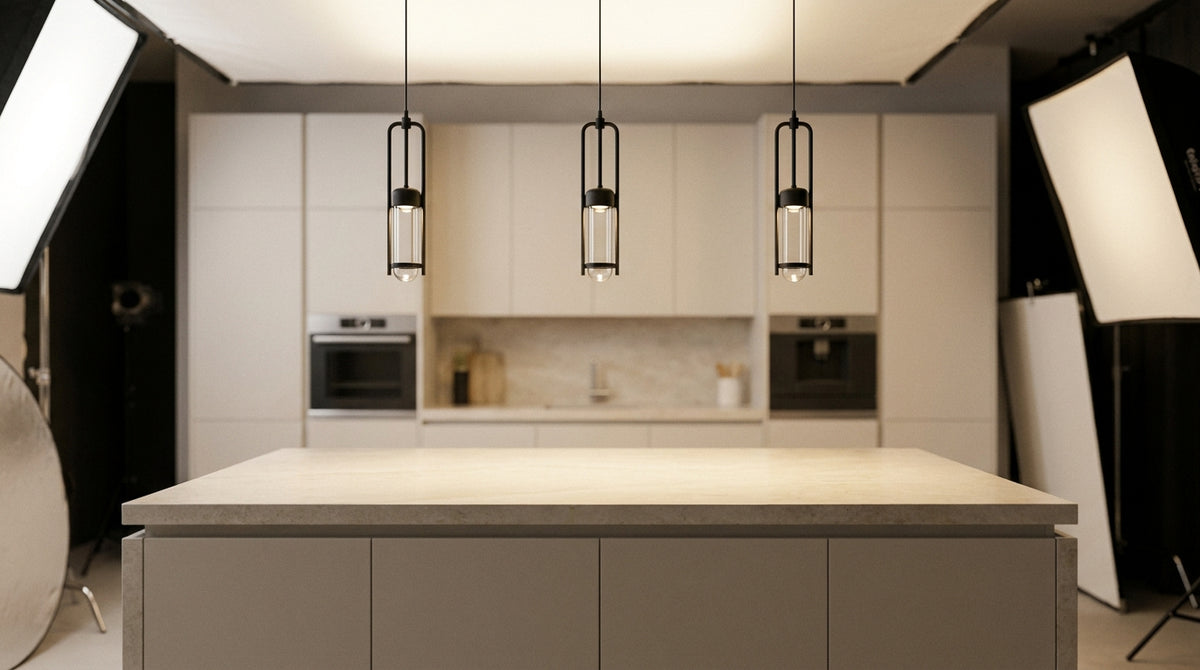
A single pendant light placed in the middle of an island leaves the ends of the countertop in shadow, and three poorly spaced light sources create pools of light instead of continuous illumination. Everything depends on three simple measurements: the number of light points, their height above the countertop, and the spacing between them. To help you decide quickly, our selection of island pendant lights brings together models designed for this configuration.
Before choosing a style, you need to establish a method. A well-lit island is used as much for cooking as it is for entertaining, and our tips for lighting your kitchen properly set the general scene for the island.
How many pendant lights above a kitchen island?
Count one pendant light for every 60 to 70 cm of usable countertop. A 1.20 m island can accommodate two light sources; a 2 m island can support three. Align the light points on the central axis of the island, with a setback of about 30 cm at each end to prevent the light from spilling over into empty space.
An even number remains the most visually balanced: two or four pendant lights distribute naturally around the center. An odd number requires aligning the middle light source exactly on the axis; otherwise, the whole thing will look off-center. For a long, narrow countertop, a tube or linear kitchen pendant light covers the width better than isolated globes.
Our pendant lights to arrange above an island
 Glass globe pendant light, modern gold and black design | Sphère Céleste
 Design Globe Kitchen Island Pendant Light | Éclat Moderne
 Brushed steel kitchen island pendant light, 4 dimmable LED discs 90 cm | Soleil
 Dimmable gold LED ring pendant light, dining room | Ringlux
 Original Ceiling Light | Kore
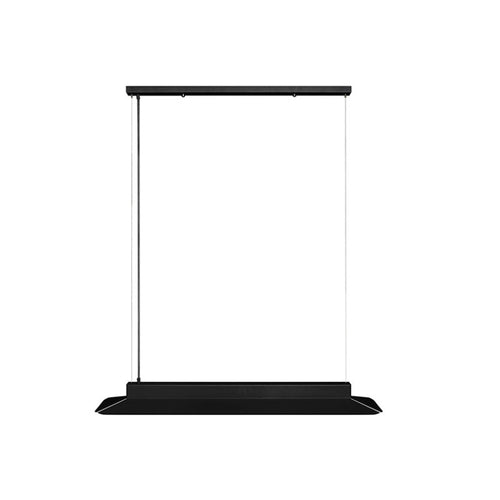
 Kitchen LED pendant light, 114.5 cm steel bar with touch dimmer | Liné'Acier
At what height should pendant lights be hung above the countertop?
Aim for 70 to 85 cm between the countertop and the bottom of the lampshade. Lower than that, the pendant light obstructs your view and movement; higher, the light spreads out and loses intensity on the work area. For a dining area where you remain seated, raise it slightly to around 90 cm to keep faces clear.
This height is measured from the finished countertop, not the floor, and should be set once the countertop is installed. It also depends on the ceiling height: a high ceiling allows for longer cables and a more generous look. If you are rethinking the entire room, your kitchen layout should be finalized before drilling.
For spacing, distribute the light sources at equal intervals along the axis: on a 2 m island with three pendant lights, count about 50 to 60 cm between each center. It is this regularity that eliminates the spotted effect.
Once the number, height, and spacing are set, it is best to validate your layout before drilling: you can ask our team for advice to avoid a failed alignment above the island.
Should pendant lights be identical or mismatched?
Three identical pendant lights give a clean and easy-to-achieve result: it is the safe choice above an island. Mismatched lights work provided you keep a common thread, such as the same metal finish or a common base, otherwise the arrangement looks cluttered. In an open kitchen, harmony with the rest of the room takes precedence over the originality of each piece.
If you prefer mismatched lights, vary the size or shape but keep a constant color. A black trio in tube, globe, and oval shapes remains coherent; three different shades will strain the eyes. A single kitchen chandelier is a great alternative when the island is short. Our article on combining light fixture styles details the rules for coordination.
What style of pendant lights do you want to line up above your island?
What kind of light (temperature, intensity) above an island?
Choose a neutral white around 3000 to 4000 K: warm enough for the dining ambiance, crisp enough to distinguish food. Provide sufficient intensity over the cutting area, with the ability to dim it for dinner. Intensity variation is the feature that allows an island to shift from work mode to entertainment mode.
Based on a survey of 30 pendant lights in our catalog as of September 14, 2026, 43% feature dimmable intensity: enough to modulate the light without changing bulbs. The dominant bases are E27 and GU10, which are easy to equip with LED. Our collection of LED pendant lights for kitchens includes 2237 references as of that same date.
The choice between warm white and cool white deserves reflection based on the room's exposure; our guide on white or yellow light helps you decide. Also consider using variable intensity if your pendant lights allow it.
Mistakes to avoid before drilling
The costliest mistake: drilling before having traced the actual axis of the island on the floor and ceiling. Next are uneven spacing, height measured from the floor instead of the countertop, and a single central pendant light that leaves the edges dark. A paper template on the ceiling avoids unnecessary holes.
Also check that the cable outlet falls exactly on the axis: a 10 cm offset is visible to the naked eye. Anticipate the weight and the fixation point in a drywall ceiling. To compare sizes before making your choice, browse our kitchen lighting. In a kitchen open to the living room, the island becomes the visual anchor of the room.
In stock · shipping costs shown at checkout · up to 30% off in your cart


Ready to turn inspiration into reality?
Tell us about your room, your style and your budget, and we will show you the pieces that truly suit your project.
Get guidance in 30 seconds →


