Best smart bulb: choosing one for your socket
This article is also available in French: Meilleure ampoule connectée
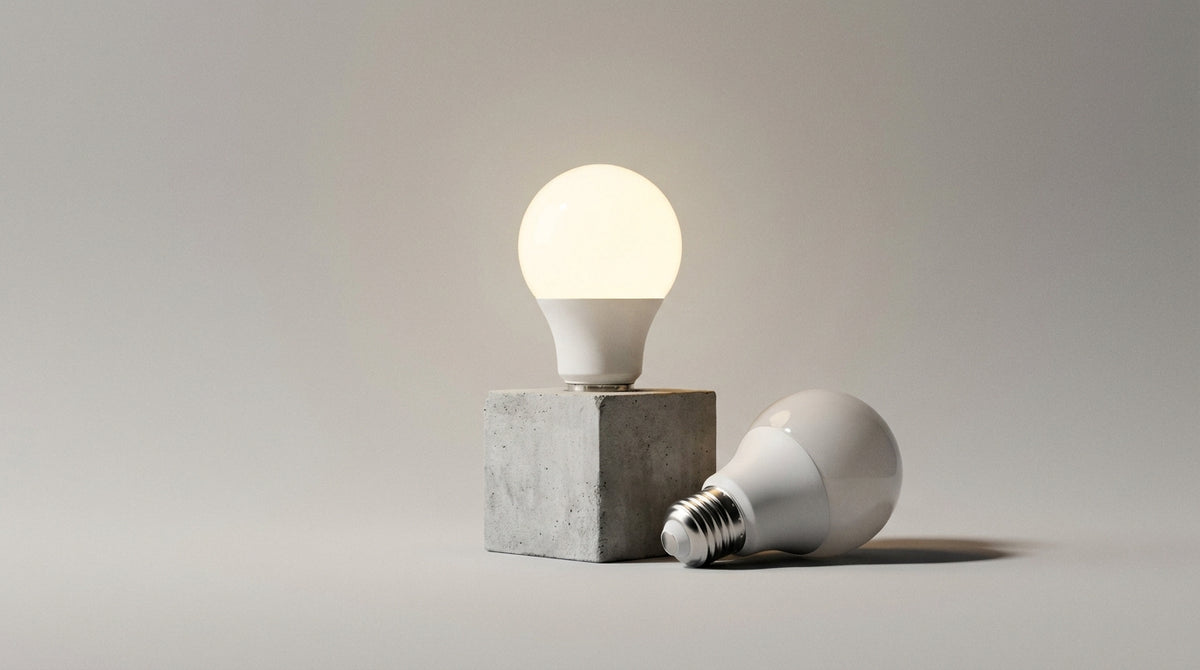
Check the socket base before comparing anything: smart bulbs do not exist in every format. Out of 33 references in our catalogue recorded on 29 September 2026, the base is stated on 33 listings out of 33: E27 42%, G9 27%, G4 24%, E14 15%. Without that reference point, the brand tells you nothing.
How do you choose a smart bulb?
Check three things in this order: the base available in the room, the radio protocol that your router and your phone accept, then the colour temperature you want. The brand comes last. A bulb at 2700 K with the right base lights better than a well-known model in a format you do not have.
The sorting is done once and for all: our selection of design bulbs can be filtered by base, temperature and dimming, which avoids ordering blind.
E27, E14, GU10 base: which sockets exist in a smart version?
Three families make up most of the smart range, a fourth stays almost empty.
| Base | Where it is found | Smart range |
|---|---|---|
| E27 | Ceiling lights, pendants, floor lamps | Wide |
| E14 | Bedside lamps, small wall lights, chandeliers | Medium |
| GU10 | Recessed spotlights, tracks | Varies by module |
| G9 and G4 | Small light fittings, pin spotlights | Rare |
With G9 or G4, a smart bulb is often not the right answer: a control module fitted on the circuit does the same job. Our guide to bulb base sizes shows how to read a socket without taking the fitting apart.
WiFi, Bluetooth or Zigbee bulb: what changes in your home
WiFi avoids any accessory but loads the network; Bluetooth is enough in one room; Zigbee covers several rooms with a bridge.
- WiFi: remote control without a gateway, but beyond about ten bulbs the home network struggles.
- Bluetooth: immediate pairing, range limited to the room you are in.
- Zigbee: stable mesh network, provided you accept a hub.
- Heat dissipation: a glass or metal body sheds heat better than a plastic shell.
The radio module draws power even when the bulb is off. To understand what the driver adds to consumption, our article on how an LED works details the chain.
And if you are still hesitating between a connected source and a classic one, the guide to the different types of bulbs sets the families straight.
Design bulbs: our selection by base and by style


Which smart bulb should you choose, room by room?
The room dictates the temperature before the power. Allow 2700 K for living, 3000 K for working, 4000 K for cooking. In a living room, two sources at 2700 K are better than one central point at 4000 K that flattens the materials.
The living room: what light for living and entertaining?
A successful living room mixes ambient light and reading light, never a single source on the ceiling. That is exactly what a smart bulb is for: turn it down a notch in the evening, turn it up when you have guests.
- 2700 K for a warm living room, with wood and natural textiles.
- 3000 K if the living room also serves as an office.
- Lumen output: aim for a combined total rather than one very powerful point.
The shade is chosen first for the mood it gives to walls and fabrics, as explained in our article on white or yellow light.
The bedroom: is a smart bulb really useful?
Yes, on one condition: that it dims very low without flickering. A gradual wake-up and a minimum brightness change a night; a bulb that buzzes at low power ruins it.
Dimming depends on the driver, not the app. Our article on dimmable LED explains why some models hum on an old dimmer.
For a child or for reading in bed, the source matters less than its position: the guide on which bulb for a bedroom details the heights.
The rest comes down to the light fitting, and a well-chosen bedroom fitting makes the smart bulb almost secondary.
Kitchen and dining room: two moods in one room
Worktop at 4000 K, table at 2700 K: two temperatures, two uses, one switch if everything goes through the app.
An LED bulb of 8 to 10 W is enough above a two-metre worktop. And above the table, a kitchen pendant with an E27 base accepts almost all the smart bulbs on the market.
If you are still unsure about the base or the temperature to choose, our selection can be filtered by E27, E14, G9 and G4, and for a specific case you can ask us directly.
Which room do you want to change the bulb in first?
How do you connect a bulb to your phone?
Screw in the bulb, turn on the switch, open the manufacturer's app and start detection. Allow two to three minutes per bulb. The most common blocker remains the network frequency: a 2.4 GHz network works, a 5 GHz-only network does not.
A smart bulb: what exactly is it?
It is an LED to which a radio module and an electronic driver are added. The module receives the commands, the driver translates them into brightness and colour. The light remains an LED, and that is what determines the final rendering.
This setup allows you to turn on the light remotely with your phone, including from outside the home.
Compatibility with voice assistants should be checked on the technical sheet, never on the promise on the packaging.
The pairing steps, one by one
- Screw in the bulb and leave the switch on at all times.
- Enable 2.4 GHz WiFi and the phone's Bluetooth.
- Open the app, create the room, start the search.
- Reset the bulb if it does not appear: three cycles of off and on.
- Name the bulb and save the scenes.
A programmable smart bulb is then controlled by schedule or by scene. A rechargeable smart bulb, on the other hand, is more of a portable accent lamp.
Installers validating a client's choice will find up-to-date specifications in our professional area.
Which bulb uses the least, and where should you buy it?
At equal output, an 8 to 10 W LED replaces a 60 W filament bulb. The difference between two smart bulbs therefore does not lie in the light produced, but in the standby draw of the radio module. Look for lumens, never the wattage printed on the box.
The weight of standby and the radio module
A module that is always active weighs more than you would think in a little-used room. Out of the 33 listings recorded on 29 September 2026, the protection rating is stated as IP20 on 33 listings out of 33: these bulbs are made for dry interiors, not for an exposed bathroom.
The warranty is the second reference point: on the same survey, 73% of references are covered for 2 years and 27% for five years.
Where to buy a smart bulb without getting it wrong
On a site that shows the base, the lumen output, the temperature and the protection rating, not just a staged photo.
- Base: compare it with your socket before confirming the basket.
- Temperature: a single fixed value does not suit every room.
- Warranty: two years is the minimum to demand on a radio module.
A comparison table of LED bulbs helps you compare values line by line rather than trusting a marketing argument.
The shop counter is also a reference point: the Design Bulbs collection has 282 references as of 29 September 2026, and the selection is reviewed by buyers.
When doubt persists, the Designix Google listing can be checked in one click.
On the same subject
In stock · shipping costs shown at checkout · up to 30% off in your cart


Ready to turn inspiration into reality?
Tell us about your room, your style and your budget, and we will show you the pieces that truly suit your project.
Get guidance in 30 seconds →