Trendy living room chandeliers 2026: how to choose the right one
This article is also available in French: Lustre salon tendance 2026

Start by measuring three things: the ceiling height, the clearance under the lowest point of the fixture (75 to 85 cm above the sofa or table), and the width of the living room. The chandelier diameter falls between one third and one half of that width. These reference points alone rule out half of the tempting models.
What are the trendy living room lights for 2026?
Organic shapes, natural materials and large graphic pieces are leading the way this year, but the real shift is elsewhere: several light sources spread across the room rather than a single point on the ceiling. A selection of well-proportioned living room chandeliers remains the centrepiece of the living room.
What are the pendant light trends for 2026?
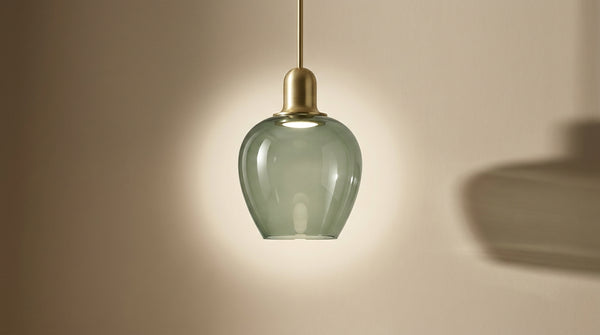
Long pendants and multi-cable compositions are gaining ground, especially in open-plan living rooms. Blown glass, woven rattan and brushed metal dominate, with larger shades hung lower than before.
- Blown glass: diffused light, a material that never goes out of style
- Rattan, wicker, cane: soft shadows, ideal for a boho living room
- Brass or matte black metal: slim frame, a clear read of the space
- Ball and petal shapes: several light points for a large volume
Always start from your furniture: a selection of trendy living room lights reads better when you already know what materials the room is made of. Multi-cable living room pendants suit large coffee tables, less so low ceilings.
Trendy ceiling light 2026 and trendy lamp 2026: what to remember?
The ceiling light is back in a flat, wide version, flush with the ceiling, and the table lamp is gaining height. Three formats are enough to cover a living room, provided each one is given the right role.
| Format | Role | Placement guide |
|---|---|---|
| Chandelier or pendant | Ambience in the centre of the room | 75 to 85 cm above the lower surface |
| Ceiling light | General lighting | Close to the ceiling, out of head height |
| Floor lamp or table lamp | Accent and reading light | Free corner, near an armchair |
What is the best chandelier for a living room?
The one that meets three constraints: a diameter in proportion to the room, sufficient clearance under the lowest point, and a fixing capable of carrying its weight. A chandelier that is too large overwhelms the living room; one that is too small in a large volume disappears.
Which chandelier diameter for which living room size?
Allow one third to one half of the room width, and a width 30 cm smaller than the table when the fixture sits above a fixed surface.
| Living room width | Recommended diameter |
|---|---|
| Under 3 m | 40 to 50 cm |
| 3 to 4 m | 50 to 65 cm |
| 4 to 5 m | 65 to 80 cm |
| Over 5 m | 80 cm and more, or two light points |
These reference points intersect with the shape of the room in our guide to dimensions and styles. When the measurements do not match any standard, the support offered in living room and main living space renovation lets you rethink the light point along with the rest of the project.
At what height should a chandelier be hung above the dining table?
Allow 75 to 85 cm between the bottom of the chandelier and the tabletop, and never less than 2.10 m from the floor in a walkway. On a 2.50 m ceiling, this margin often means ruling out models with long chains.
A low ceiling copes better with a compact glass chandelier, placed close to the ceiling, than with a bronze pendant chandelier. Borderline height cases are detailed in our article on chandelier ceiling height.
When the fixture also has to cover a dining corner, a dining room chandelier hung lower does the job without doubling the light sources.
How many kilos can the fixing point carry?
A crystal or solid metal chandelier often weighs more than its size suggests. Check the nature of the support (concrete, plasterboard, old plaster), the anchor used and whether there is a ceiling reinforcement. The full method is described in our article on hanging a chandelier from the ceiling.
If your measurements fall between two sizes or your ceiling is unusual, send us your dimensions: we will tell you which model will work. One message is enough to write to us to confirm your measurements before ordering.
Which light colour should you choose?
For a living room, aim for 2700 K to 3000 K for general light, and go up to 4000 K only in a reading or work area. Below 2700 K, the room turns orange; above 4000 K, it cools down and natural materials lose their relief.
2700 K or 3000 K: how to decide?
A wood-filled living room with textiles and warm tones calls for 2700 K. A white, grey or concrete interior copes with 3000 K, which is more neutral and keeps colours accurate on the walls.
The full reasoning is in our article on the difference between white light and yellow light.
Which bulb cap should you choose, and why does it matter?
- E27: large screw cap, the most common on chandeliers
- E14: small cap, for slim pendants and candle shapes
- Integrated LED: nothing to replace, but the fixture lasts as long as its lifespan
- Dimmer compatibility: check on the bulb before buying
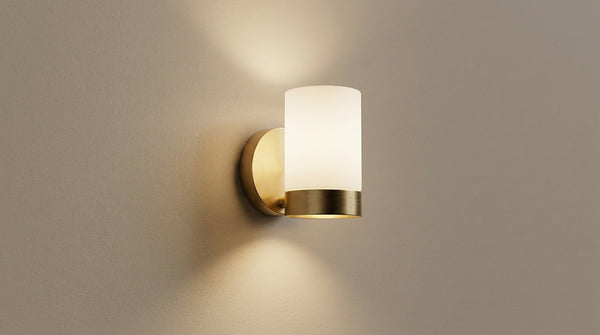
Accent light on the walls, with wall lights, complements the chandelier without weighing down the ceiling.
Which chandelier suits your living room?
What are the ceiling trends for 2026?
The ceiling is now composed: several light points of small diameter, low and wide shapes, natural materials that cast soft shadows. The single large object in the centre of the room is losing ground, except in volumes that can absorb it.
Low ceiling, beams, ceiling rose: what to do?
- Low ceiling: flat ceiling light or wall lights, no long pendant
- Exposed beams: fix to a beam, shorten the cable
- Existing ceiling rose: keep the electrical axis, adapt the mounting plate
- Old plaster: add reinforcement before hanging any weight
Keeping the ceiling rose is often the simplest solution, provided the fixture is adjusted: our article on choosing a chandelier with a ceiling rose details the cases. For rooms where height is really lacking, a flat LED ceiling light solves the question in one installation.
How do you fill a double-height space or a large volume?
Above 3 m in height, diameter is no longer enough: it is the cable length that gives the scale. A composition of several pendants at different levels fills the space better than a single undersized chandelier. The selection guidelines are detailed in our article on large living room chandeliers.
On the same subject
In stock · shipping costs shown at checkout · up to 30% off in your cart


Ready to turn inspiration into reality?
Tell us about your room, your style and your budget, and we will show you the pieces that truly suit your project.
Get guidance in 30 seconds →