Large living room: lighting that structures the space
This article is also available in French: Astuces Déco Éclairage : Sublimer un Grand Salon
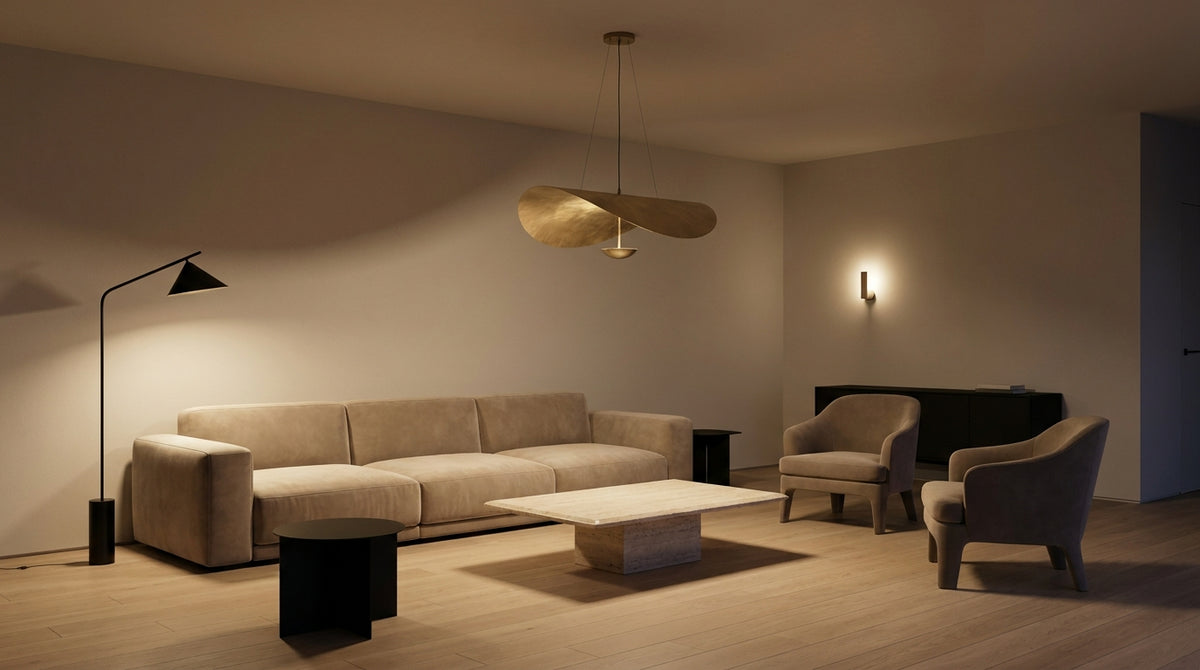
Plan for three layers of light placed at different heights: a ceiling light or pendant that anchors the centre, wall lights or a floor lamp at mid-height, a table lamp or a low strip close to the floor. In a large living room, the distance between the sources sets the balance, never their number.
How do you light a large living room without multiplying the light points?
Three well-placed sources are better than ten badly distributed spots. A high source gives the general light, a mid-height source serves daily uses, a low source sets the evening mood. Each layer works a distinct zone, and the eye no longer stops at a flat wall.
In a living space of 35 to 40 m², this breakdown is drawn up before buying: sofa area, reading area, circulation, entrance to the room. This is the work carried out on a living room and living space renovation, where the lighting plan is settled before the finishing touches.
What is the rule of 3 in decoration?
In lighting, the rule of 3 is read in heights, not in objects. A volume holds when the ceiling, mid-height and floor each carry a source, with different intensities.
- Ceiling: pendant or ceiling light, it structures the volume and gives the general light.
- Mid-height: wall lights and floor lamp, they light daily uses and movement.
- Floor: table lamp and low strip, they shape the evening mood.
- One intensity per layer: the lower the source, the more discreet it becomes.
Lighting decor tip: where to place each source in a large volume?
Place the high layer above the living area, not at the geometric centre of the room. The low sources are then arranged in a triangle, so the eye moves instead of staying fixed.
- Living centre: a chandelier or a large-diameter pendant marks the gathering point.
- Mid-height: wall lights at 1.70 m from the floor light the seating without glare.
- Blind spot: a floor lamp in the darkest corner recovers the lost surface.
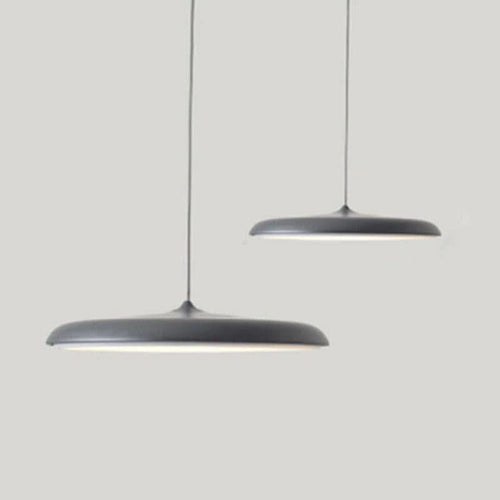
- Circulation: a long living room pendant above a sideboard or low furniture guides the step.
To achieve a warm living room atmosphere, the rule stays the same: sources at several heights, never just one in the centre.
How do you make a living room brighter when it stays dark in the evening?
Light the walls rather than the floor. A source at 1.70 m lights a seat, a source at 90 cm lights a table, a flow directed towards a light wall sends the light back into the room. The feeling of brightness comes from the wall, not from the bulb.
Before adding a point, check what you already have: a living room can be lit effectively by reusing the existing sources and only changing their direction.
Large living room lighting: why the ceiling alone is not enough
A central ceiling light covers about a third of the usable surface and leaves the corners in shadow. The flow falls vertically, does not touch the walls, and the room looks lower than it is.
- Verticality: no light on the walls, so no effect of depth.
- Hard shadows: a single point casts shadows behind every piece of furniture.
- Uniformity: everything is lit the same, nothing draws attention anymore.
In a standard-sized room, the principles for lighting a medium-sized living room also apply: slightly multiply the points and create paths of light.
Tips for lighting a dark room without redoing everything
Three moves are enough: a diffusing ceiling light, two wall lights facing each other, a floor lamp directed towards the lightest wall. No heavy cable routing is needed.
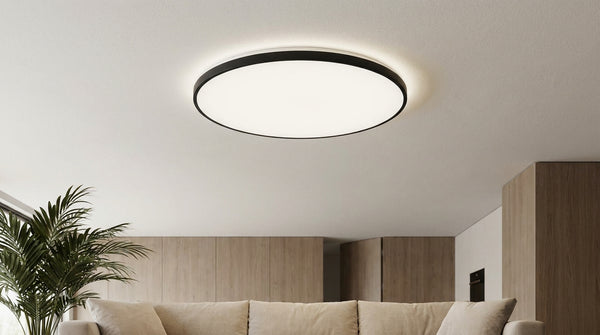
- Diffusing ceiling light: a translucent glass or shade spreads the flow instead of concentrating it. See the low-profile LED ceiling light models.
- Dimmable bulb: the same source goes from mood to task depending on the time.
- Lit light wall: the light that bounces back enlarges the room without emptying it.
- Light textiles: a lighter curtain or rug reflects more light.
In the evening, what is the weak point of your large living room?
How do I make my living room warmer?
Lower the colour temperature and multiply the low sources. A room becomes warm when the light grazes the materials: wood, textile, plaster. Aim for 2,700 K for the evening mood and keep a more neutral source for reading.
Which colour temperature should you choose?
2,700 K for mood, 3,000 K for task, and never both in the same zone. The eye immediately spots an inconsistent mix, like two whites contradicting each other.
- 2,700 K: entertaining, dinner, sofa area, warm and enveloping white.
- 3,000 K: reading, desk area, slightly warm but readable white.
- One temperature per zone: the eye accepts the contrast between two rooms, not within the same space.
- Dimmer: it adjusts the intensity in the evening without changing the hue.
Understanding what ambient lighting is avoids the classic mistake: switching everything on at once, at full power.
How do you make your interior look chic?
Consistency of materials and stems, never accumulation. Two finishes maximum per room, the same fixing height for the wall lights, and shades from the same family.
- Matching stems: brass and black, or wood and white, but not all three together.
- Alignments: wall lights and pendants placed at the same height on the same wall.
- One statement piece: the rest of the lighting plan steps back to let it dominate.
- Catalogue by style: choosing from a living room lighting range designed for one spirit avoids mismatched pairings.
Make a large living room stand out with a statement piece
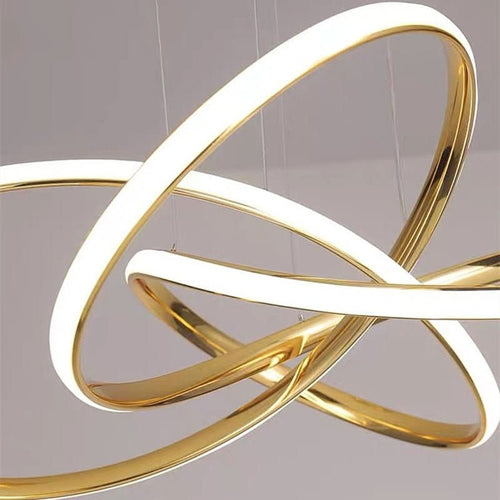
One statement piece is enough: a large chandelier, an oversized pendant or a sculptural fixture. It must be the most important visible source in the room, the others staying discreet. This is the principle of accent lighting, applied to the volume.
Pendant above the living area: what height, what diameter?
Allow 75 to 85 cm between the bottom of the shade and a worktop or table. Outside a passage area, a pendant can hang lower, provided no one walks into it.
| Location | Installation height | Diameter reference |
|---|---|---|
| Above a table | 75 to 85 cm from the shade | one third of the table width |
| Above the living area | bottom of the fixture at 2.10 m | one quarter of the zone width |
| Circulation area | never below 2.10 m | compact format or wall light |
If you prefer to start from a lighting plan already calibrated for your surface rather than improvising, the team answers questions about height and temperature via the contact page.
Chandelier and ceiling height: the rule of proportions
The chandelier hangs low enough to fill the void, without ever getting in the way of walking. The higher the ceiling, the longer the chain: a fixture left too close to the ceiling leaves the room bare.
- Proportion: a chandelier takes up about one tenth of the total height of the volume.
- Under 3 m: keep at least 2.10 m clear under the fixture in a passage.
- Great height: a longer rod breaks the feeling of emptiness.
The details of the measurements depending on the room are set out in our article on the height of a chandelier under the ceiling.
In a volume of this size, the installer validates the feasibility of the plan before installation: fixing, rod length, cable cross-section. The professional area centralises these exchanges for craftspeople and specifiers.
In stock · shipping costs shown at checkout · up to 30% off in your cart
Ready to turn inspiration into reality?
Tell us about your room, your style and your budget, and we will show you the pieces that truly suit your project.
Get guidance in 30 seconds →