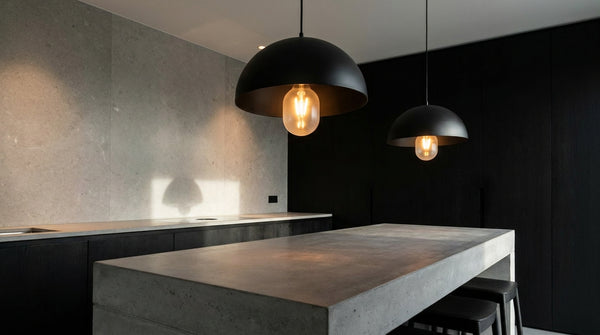
Sloped ceiling: hanging a light fitting perfectly straight
This article is also available in French: Quel Luminaire suspendre à un plafond en pente
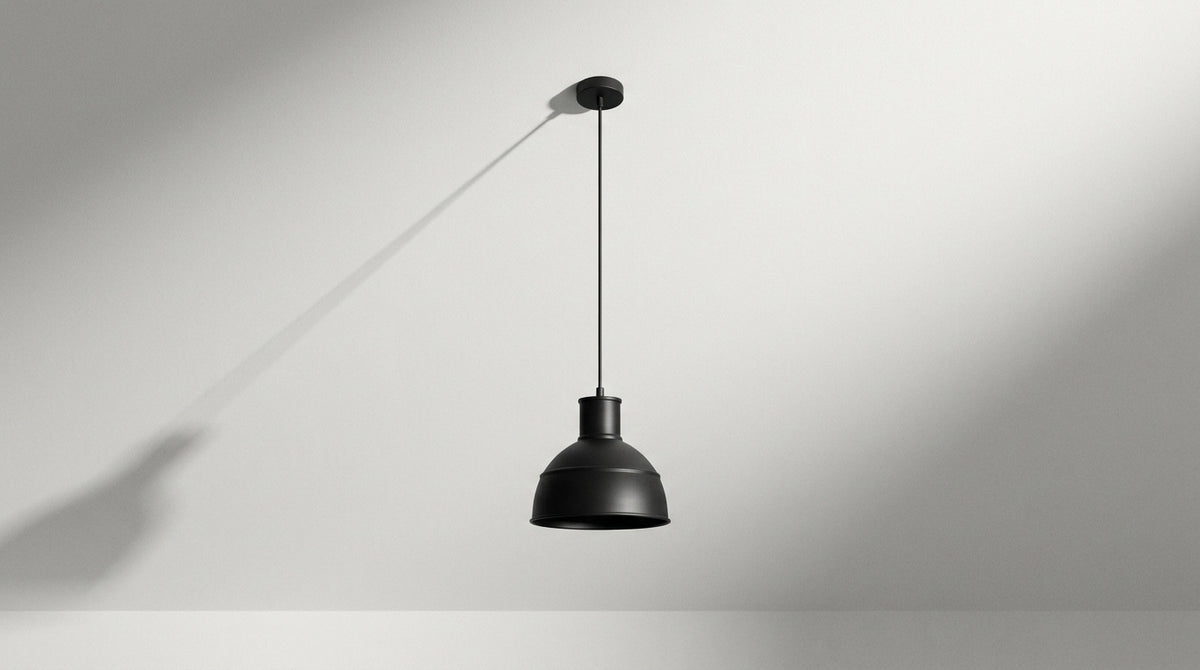
A pendant on an adjustable cord or cable, with a swivel joint if the slope exceeds 20 degrees. The cord hangs vertically under gravity: the fixing point can be off-angle, the shade stays level. Set the final height from the floor, at 75 or 80 cm from the surface it lights.
How do you hang a light fitting perfectly straight under a sloped ceiling?
The cord solves the problem for you. Suspended from a slope, it always hangs vertically: the fixing can be crooked, the light fitting stays level. A rod, by contrast, carries the ceiling angle through. Beyond 20 degrees of tilt, add a swivel joint between the mount and the stem.
Before drilling anything, draw your lighting plan for the living room on the floor: the line of the sofa, the table, the walkway, then work upwards. On a slope, the right question is not "where is the middle of the ceiling" but "where does the light fall".
- Textile cord or cable: hangs straight whatever the slope, height adjustable once installed.
- Rigid rod: follows the angle of the mount, so it tilts if the mount tilts.
- Swivel joint: compensates for tilt between 15 and 45 degrees, depending on the model.
- Offset fixing: the light fitting starts from the wall or a beam, no longer from the slope.
| Mounting | Behaviour under a slope | Choose it when |
|---|---|---|
| Adjustable cord or cable | Hangs straight, gravity does the work | Slope up to 30 degrees, height to adjust often |
| Rigid rod | Copies the ceiling angle | Flat ceiling, or very slight slope |
| Swivel joint | Corrects the angle, the stem stays vertical | Marked slope, more than 20 degrees |
| Offset fixing | Moves the fixing point off the slope | Attics, inaccessible ceiling, height under the ridge |
Why a cord hangs straight while a rod follows the angle
A cord has no rigidity: it takes the direction of the force pulling it, which is vertical. A rod, by contrast, is fixed to its base. Tilt the base by 25 degrees and the stem tilts by the same amount. It is mechanical, no brand escapes it.
Height is set by unwinding the cable at the canopy. Measure the distance between the bottom of the shade and the surface to be lit, then work upwards. An adjustable-height pendant can be readjusted in two minutes, without removing the mount.
Adapter for a sloped ceiling light: what actually exists
There is no universal adapter. What you actually find are three families of parts, and each only works with a given canopy diameter.
- The swivel canopy: supplied as standard on some models, it pivots and locks with a screw.
- The machined wedge: a wooden or metal spacer, cut to the exact angle of the slope.
- The offset on a base plate: a plate fixed higher or lower, which moves the light fitting out of the sloped area.
The swivel assumes the manufacturer has provided for it. If in doubt, the cord remains the safest solution.
How do you light a sloped ceiling?
Light downwards, not upwards. A slope sends light back into the acute angle, where nobody stands. Multiply low, directional sources: a wall light on the highest wall, a pendant above the area in use, a table lamp in the darkest corner.
Sloped ceiling light idea: three layouts that work
From a survey of 250 references in our catalogue on 4 October 2026, 45% are declared as pendant mounting and 36% as wall mounting. These two mountings are precisely the ones that forgive a slope. Our selection of designer pendants covers both.
- A row of pendants parallel to the slope, at a constant height: the eye reads a horizontal line, the slope disappears.
- A high wall light on the vertical wall, which lights the room without ever touching the tilt.
- Two low points above the table and the reading corner, rather than a single central point.
Other, more radical layouts are detailed in our article on sloped ceiling light ideas.
Lighting for a sloped ceiling: aim low, not high
A light fitting that shines upwards under a slope loses half its output in the angle. Under a low attic ceiling, it is the vertical surfaces you need to work: walls, headboard, worktop. A wall light placed 1.80 m from the floor lights better than a ceiling light fitted at 2.20 m.
Materials matter too: from a survey of 250 references on 4 October 2026, 85% are metal and 40% glass. Glass diffuses, metal reflects. In an attic room, glass avoids hot spots on the slope. Our collection of glass light fittings brings these models together.
Pendant light under a slope: which room, which model?
The room decides the format, the slope decides the mounting. A bedroom calls for low, soft light, a living room for a high point that structures the space, a kitchen for clear lighting placed near the worktop.
Pendants and light fittings that hang straight under a slope
 Pendant light | Bravara
 Pendant light | Harmonie Florale
 Pendant light | Mirdanissa
 Ceiling light | Dorica
 Ceiling light | Cylira
 Living room floor lamp | Foglia
See the whole selection: Alternative to Luminaire.fr: designer lighting shop | Designix
Light fitting under a bedroom slope: the light seen from the bed
Lying down, you do not see the ceiling: you see what hangs in your field of view. A pendant that is too low cuts the room in two. Aim for the bottom of the shade at 60 cm above the mattress, and move it towards the foot of the bed rather than the pillow.
A bedroom and office lighting project can be worked out in ten minutes on a plan, and saves you drilling three times. As for models, our selection of bedroom pendants favours small diameters, suited to low volumes.
Light fitting under a roof slope: attic, loft, mezzanine
Under a roof, the constraint changes: headroom quickly drops below 1.80 m near the gutters. The light fitting must stay in the area where people move. So you hang it short, or switch to wall mounting.
Pendants for the loft meet this specific case, including lighting a sealed attic with no easy access. As long as the room stays dry, an IP20 rating is enough: in our survey of 250 references on 4 October 2026, 94% are declared IP20.
Chandelier on a sloped ceiling and ceiling light under a slope: when should you give up?
You give up on the chandelier when the mount cannot take its weight, and on the ceiling light when the projection becomes too small. In both cases, the solution is not to give up but to change the mounting.
Under your slope, what light are you missing today?
Chandelier on a sloped ceiling: weight before style
A chandelier pulls downwards, vertically. On a slope, that pull acts on a fixing fitted off-angle, which strains the anchor. Best practice is to go through the plate and find the structure, never to stop at the first layer.
Our article on how to fix a chandelier with a hook details this step. For a light, vertical model, look instead at bedroom chandeliers, whose straight stems can be fitted under a slope without a swivel joint.
If your slope is plasterboard and the light fitting is heavy, have the fixing point checked before drilling: the Designix team answers this kind of case from its contact page.
Ceiling light under a slope: the projection that solves the problem
A ceiling light is mounted flush. On a gentle slope, it stays almost parallel to the slope and the visual gap is small. On a steep slope, it points crookedly towards the floor, and that is immediately visible.
The answer lies in the projection: the further the light fitting comes down, the more the ceiling angle fades behind its volume. An LED ceiling light with a low diffuser does this job without glare. When the fixing point is off-centre because of the slope, an offset base plate remains the best answer.
Lighting for an attic ceiling: measure before drilling
Three measurements are enough: headroom at the fixing point, distance to the floor of the area to be lit, and the angle of the slope. Without these three numbers, no model can be chosen correctly.
Light fitting for a sloped roof: headroom, point by point
Measure at the fixing point, not in the middle of the room. Headroom there is often 30 to 50 cm lower than at the ridge, which changes the type of light fitting.
- Under 1.90 m: wall light or low-projection ceiling light.
- Between 1.90 and 2.40 m: short pendant, bottom of the shade at least 60 cm from the floor in a walkway.
- Above 2.40 m: standard pendant, lowered to stay close to where it is used.
The installation itself does not change: our tutorial on installing a pendant ceiling light still applies under a slope, with one caveat: switch off the power before drilling. For an attic kitchen, our selection of kitchen pendants offers short models, designed to stay above the worktop.
Wooden sloped ceiling: aim for the joist, not the board
On a panelled ceiling, the fixing must go through the board and bite into the joist. Locate it with a magnetic stud finder or by tapping: the sound changes. A fixing that only holds in the board gives way at the first draught.
If the joists are exposed, they become an ideal fixing point. Our article on ceiling lights with beams shows how to use them rather than work around them.
In stock · shipping costs shown at checkout · up to 30% off in your cart
Ready to turn inspiration into reality?
Tell us about your room, your style and your budget, and we will show you the pieces that truly suit your project.
Get guidance in 30 seconds →