
Attic pendant light: illuminating the loft
This article is also available in French: Suspension luminaire pour grenier : éclairer les combles
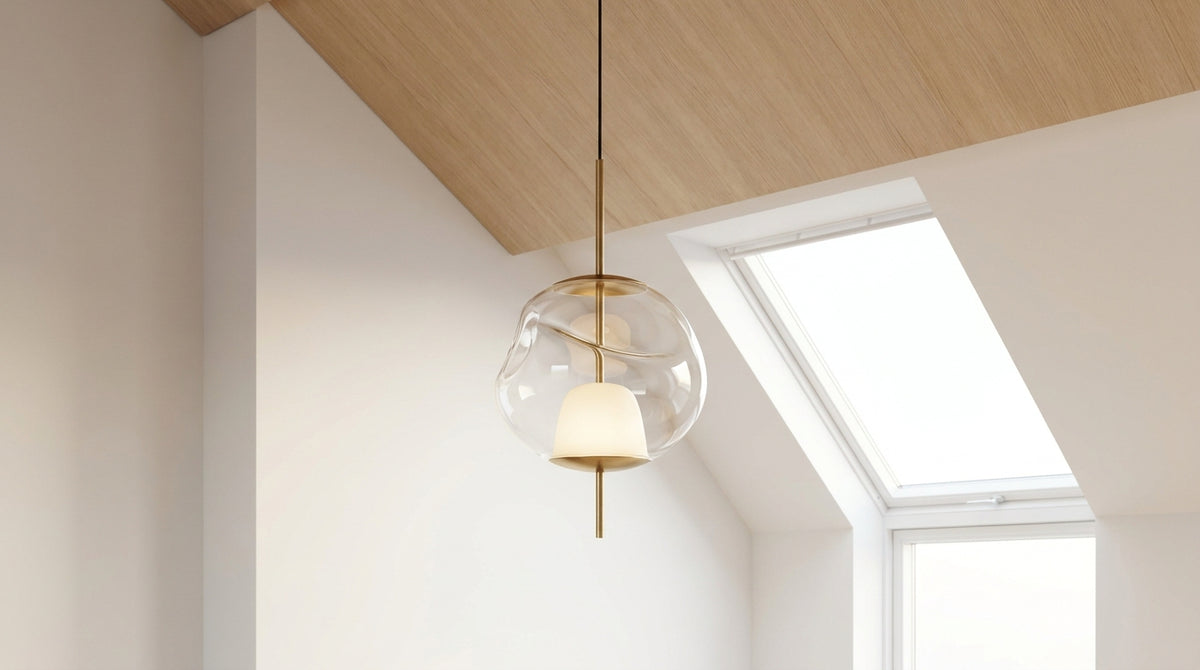
Reserve the pendant light for the high area of the attic, under the ridge, where the height exceeds 2.20 m. Under the low slope, opt for a ceiling light or flush-mount spots. Aim for three light sources at different heights and a total lumen output suited to the surface area, never a single central point.
What is the difference between a ceiling light and a pendant light?
A ceiling light attaches flush to the ceiling and provides broad illumination without hanging down; a pendant light hangs from the end of a cable and focuses light lower, on a table or in a corner. In an attic, this detail changes everything: a pendant light only belongs where the ceiling is high enough to let it breathe.
Count on at least 2.20 m under the attachment point so that a head does not become an obstacle. Below that, a model fixed to the ceiling remains the safe solution. To decide based on your exact height, our pendant light collection includes short formats designed for reduced volumes.
On our lighting catalog sheets, pendant mountings make up only 24% of a survey of 93 references as of September 23, 2026. The rest are mounted or fixed to the wall: in an attic, it is better to combine several types than to rely on a single head.
How to naturally light a dark room?
Multiply light inlets and surfaces that reflect it. A roof window or glass roof provides the flow; light-colored walls and ceiling diffuse it instead of absorbing it. In the evening, no bulb replaces the sun, but a neutral light around 4000 K comes closest to it.
Place white where it bounces back: facing a light wall, the same fixture appears twice as powerful as in a dark corner. When no central point is planned, you can light a room without a ceiling light by combining floor lamps, wall lights, and table lamps distributed throughout the volume.
Which lighting to choose under a roof slope?
Adapt the fixture to the ceiling angle. Under a steep slope, a short pendant hung from the ridge clears the walkway; on the slope itself, an adapter straightens the socket, or an adjustable spot follows the incline without sticking out. The rule can be summed up in one sentence: nothing that hits your head in a circulation area.
Pendant at the ridge, ceiling light on the low slope
At the highest point, a pendant fits in and dresses up the volume. On the low slope, under 1.80 m, a flush-mounted ceiling lamp avoids any obstacle above a bed or in a walkway.
Adapter for sloped ceiling
A sloped ceiling misaligns a pendant, which hangs crooked. An adapter for sloped ceilings corrects the angle and brings the fixture back to plumb. The specific steps are described in our guide to hanging a light under a sloped ceiling.
Lighting under a slope in an attic bedroom
In a bedroom, separate the relaxation light (bedside, wall light) from the general lighting placed at the ridge. Design strategies for the volume are detailed in how to furnish an attic bedroom.
For a consistent result, a range dedicated to bedroom lighting gathers low-profile and warm formats adapted to under-slope areas.
A non-insulated attic collects humidity. Out of 93 pendant lights in our catalog as of September 23, 2026, 98% are IP20, therefore reserved for dry rooms and to be kept away from a humid, unheated attic. A 2-year warranty is declared on 100% of this inventory.
Our selection is commented on by buyers, whose reviews are gathered on our Google profile. The Original Lighting collection includes 1588 references as of September 23, 2026, filterable by room, base, or shape to find exactly what fits your case.
Our pendant lights suitable for attics
 Pendant Light | Lotus
 Art Deco Monkey Wall Light | Oryn
 Glass Globe Chandelier | Bely
 Modern Designer Headboard Wall Light | Kira
 Astronaut Wall Light | Siya
 Deer Wall Light | Silo
See the full selection: Original Lighting: Pendant Lights and Chandeliers with Unique Design
How many light points and what temperature?
Count about one light point per 4 to 6 m² and think in terms of cumulative lumens rather than the number of bulbs. For relaxation, stick to warm white (2700 to 3000 K); for an office or reading corner, go up to a neutral white (4000 K) which aids concentration.
An attic conversion should be handled zone by zone: add up the lumens of each source before finalizing. The complete method for calculating the necessary lighting avoids under-lighting a low-ceiling room.
You now know which height and area to address; if your slope is unconventional, ask for personalized advice rather than trial and error.
Regarding the color temperature, it all depends on usage: the debate between white or yellow light is decided by whether the room is used for sleeping or working, not by fashion.
What will your converted attic be used for?
In stock · shipping costs shown at checkout · up to 30% off in your cart


Ready to turn inspiration into reality?
Tell us about your room, your style and your budget, and we will show you the pieces that truly suit your project.
Get guidance in 30 seconds →


