Outdoor solar lantern to place: choosing the large size
This article is also available in French: Lanterne exterieur à poser grande taille solaire
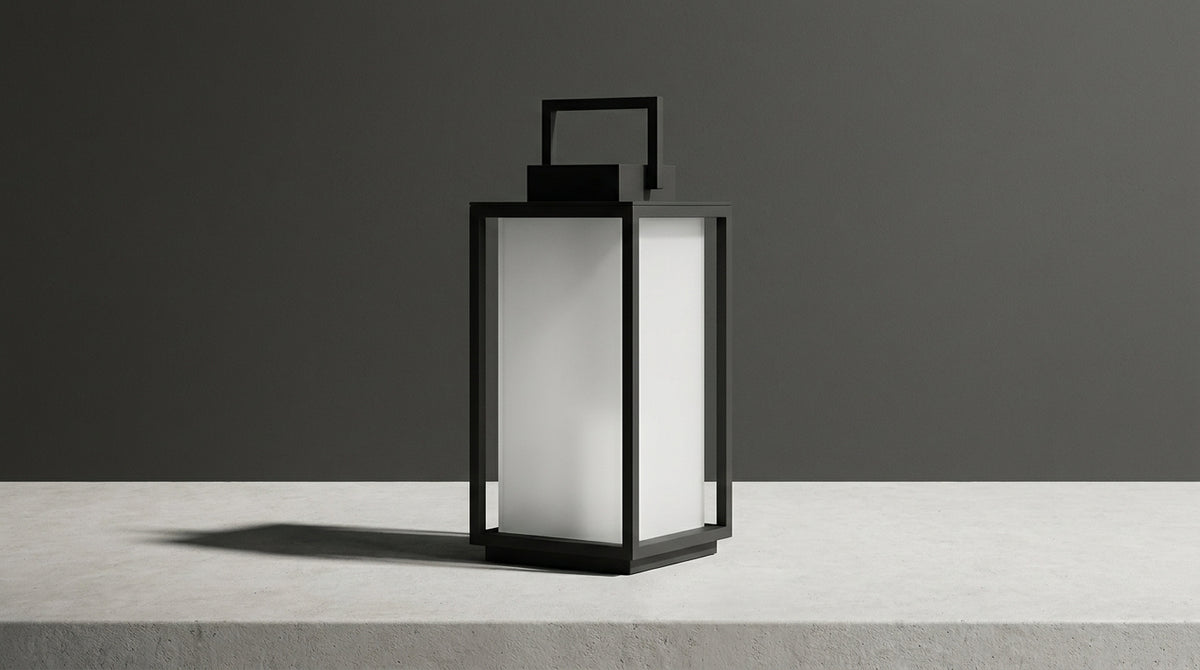
Place the base first, not the lantern: measure the slab, the ledge or the step edge that will hold it, then check the sensor's actual exposure between 10 a.m. and 4 p.m. Size and light color come after. A lantern too wide for its base tips over at the first gust of wind.
What is the best outdoor solar lantern?
The one whose sensor gets sun without cast shadow during the day, and whose base fits on the intended support. The advertised power comes far behind. A wide base, frosted glass and an IP65 rating weigh more than a promise of a thousand lumens.
On a survey of 69 outdoor references in our catalog as of September 28, 2026, 43% carry an IP65 rating and 59% list aluminum. Those two lines of the spec sheet decide how it holds up outdoors. Our outdoor lighting range goes from freestanding to wall-mounted models.
The sensor matters more than the advertised power
A sensor tucked in a wall's shadow recharges far less than in full sun, whatever the advertised specs. Before choosing, observe the target area around 1 p.m. and note what blocks it.
- Six hours of direct sun: comfortable charging, even mid-season
- Two to four hours: reduced autonomy, the lantern becomes an ambiance object
- Total shade: no charging, solar is not the right choice there
- Sensor facing north: move it, the loss is immediate
When the wall is well exposed, a solar wall light makes better use of the radiation than a large lantern on the ground, simply because it is higher.
Are 2000 lumens a lot?
For an ambiance lantern, 2000 lumens is a lot. The value is measured with a full battery and a new sensor, early in the evening. What matters afterward is the consistency of the flux until it turns off, not the advertised peak.
Large freestanding outdoor lantern: which sizes for which surface?
Allow 25 to 35 cm in height on a balcony ledge, 40 cm and more on a terrace slab or step edge. Width matters just as much: beyond 25 cm per side, the base must be flat, clear and at least half the base wide.
| Support | Suitable height | Watch point |
|---|---|---|
| Balcony ledge | 25 to 35 cm | Wind, railing |
| Terrace slab | 40 cm and more | Flat base, weighting |
| Step edge | 30 to 45 cm | Stability, foot traffic |
| Planter or flower bed | 40 cm and more | Sensor hidden by leaves |
On a terrace or balcony
A large lantern on the ground stands out from afar and structures the space. On a balcony, prefer a slim body that lets the eye pass through: an aluminum stem withstands rain and frost better than thin resin.
Our outdoor lighting covers both uses, freestanding and fixed, with colors often crossed: on the same survey, black accounts for 46% of references and white for 38%.
On a narrow balcony, renovating a balcony or terrace starts with a placement plan, not with buying.
Along a garden path
Two tall lanterns placed in a staggered pattern give more depth than a line of small models. Space them 3 to 4 m apart and keep the same height for a regular effect.
Large outdoor lanterns are also chosen for their cast shadow: the taller the body, the lower and wider the light spreads.
What is the downside of solar lamps?
Charging. A sensor in the shade or a low sky in December does not fill the battery, and the lantern turns off after a few hours. It is not a manufacturing defect: it is a use to anticipate from installation, with a slow season accepted.
The sensor that stays in the shade
The classic case: a lantern installed against a wall, under an awning, sensor facing the facade. It lights up the first evening then declines. Move it 50 cm toward the center of the area to be lit, the difference shows within a week.
Winter evenings
Reduced output, same consumption: short days cost autonomy. A larger battery does not make up for a poorly placed sensor. Our article on the outdoor solar lamp separates what can be fixed by placement from what cannot.
If your terrace is exposed to wind or the sensor will stay in the shade, tell us: the team answers from Vaulx-en-Velin and points you to the right size. Start by asking the team your question.
Where to place a large solar lantern?
On a flat surface, at least 50 cm from the nearest wall on the sensor side. Weight and wind decide the rest: a lantern 40 cm tall offers a real wind catch, so you weight it, shelter it, or bring it inside.
A placement plan avoids mistakes: our guide on outdoor lighting starts from the areas to be lit rather than from the fixture.
On a slab or ledge: weighting
Three contact points are better than a flat bottom. A 25 cm base placed on a balcony ledge stays stable; a wider model needs a solid support or discreet weighting slipped inside. On a terrace, plan these supports before placing each outdoor fixture, so as not to clutter the passage.
Terrace, path, step edge
The step edge is the best spot: the lantern lights the descent, not the void. On a path, alternate with an outdoor post light to mark the stages of the route.
A practical point: insects and light react mainly to white and cool sources. On a terrace where you dine, a warm tone limits the crowd.
Which outdoor solar lighting to choose?
Solar for ambiance and areas without power, mains for passages and security. Many lanterns accept an E27 base: the bulb can then be replaced without changing the fixture.
On the same survey of 69 references as of September 28, 2026, 84% are LED technology and only 16% carry an interchangeable LED base. Understanding how an LED works helps decide between a sealed lantern and a model with a replaceable bulb. The selection is also reviewed by buyers, and Designix's Google listing remains the public reference for checking all reviews.
For an entrance or garage, an outdoor floodlight with detector complements an ambiance lantern without replacing it. Outdoor wall lamps take over on poorly lit facades, and the most elaborate pieces are found in our design lighting.
Freestanding outdoor lanterns: the selection


Where will you place your solar lantern?
Sur le meme sujet
In stock · shipping costs shown at checkout · up to 30% off in your cart


Ready to turn inspiration into reality?
Tell us about your room, your style and your budget, and we will show you the pieces that truly suit your project.
Get guidance in 30 seconds →