Kitchen ceiling spotlights: light that follows your moves
This article is also available in French: Idee spot plafond cuisine
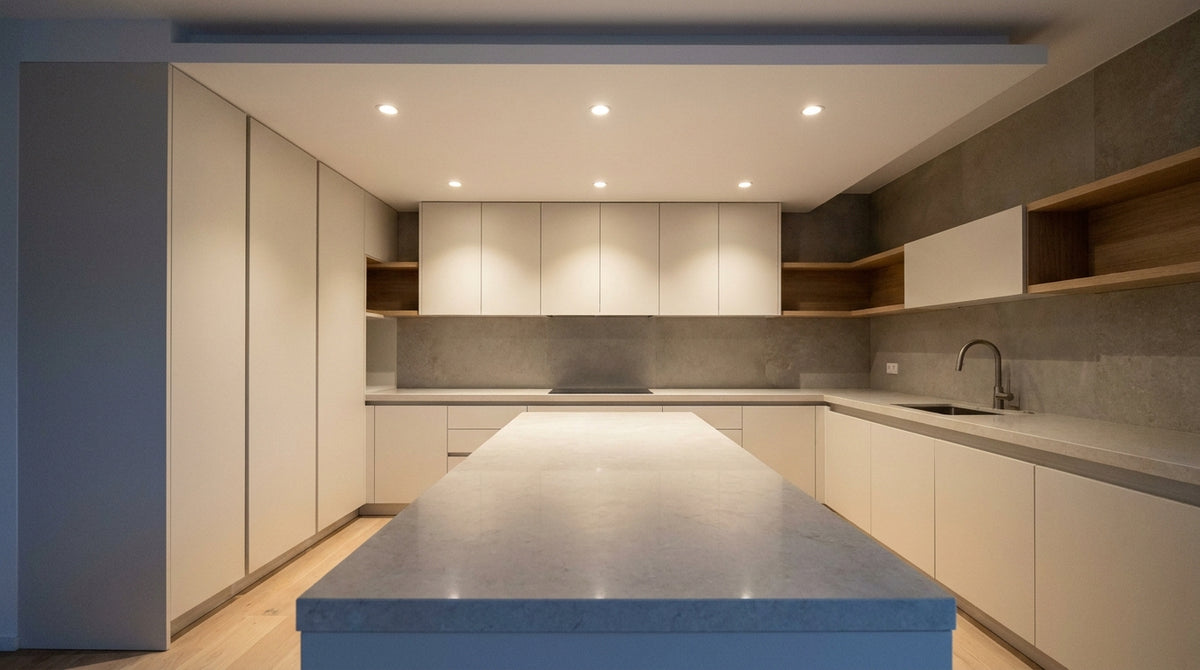
First, mark the plumb line of the front edge of your wall cabinets, then shift the spots 15 cm into the room: this setback removes your shadow from the worktop. Space them 80 to 100 cm apart, then add a wider light on the ceiling.
What ceiling lighting for a kitchen?
Plan for two layers in the same room: a line of spots aimed at the worktop, and a wide ceiling light for moving around and entertaining. A single central point mainly lights the floor and leaves your hands in shadow when you are chopping.
Choosing a kitchen light therefore comes down to two levels: the wash directed at the worktop, which is adjusted to the centimetre, and the fill of the volume, which depends on the diffuser.
Recessed spots, ceiling light or pendant: what to choose?
| Solution | What it lights | When it fits |
|---|---|---|
| Line of recessed spots | The worktop, in an even wash | New ceiling or false ceiling, open kitchen |
| Ceiling light | The whole room, diffused | Small closed kitchen, low ceiling |
| Pendant or track | A specific area, at eye level | Island, kitchen table, glass partition |
Three criteria matter more than the rest when deciding.
- Output: 400 to 500 lumens per point above a worktop.
- Beam angle: 36° for a crisp beam, 60° for a more enveloping light.
- Colour rendering: a high colour rendering index keeps food looking right.
A kitchen that changes hands should be planned as a whole: redoing the lighting after the worktop is fitted means drilling twice. The page on kitchen and dining room renovation gathers the decisions to make before the work, electrical supplies included.
And in a kitchen open to the living room?
Two layers coexist in the same volume: the working one, tight and directed, and the living one, wide and diffused. In a living room, ceiling spots in the living room are placed higher and further apart, often as indirect light. Without a partition, this height difference is obvious.
How to position a ceiling spotlight in the kitchen?
Align the spots with the plumb line of the front edge of the wall cabinets, then shift the line 15 cm into the room. Space each point 80 to 100 cm apart. Keep at least 60 cm between the last spot and a wall, otherwise the cone is cut and the wash is interrupted.
Kitchen ceiling spotlight layout: the line that avoids your shadow
Four markers are enough to draw a layout that works in use.
- Mark on the floor the plumb line of the front edge of the wall cabinets.
- Draw the line of spots 15 cm in front of that plumb line, on the room side.
- Space the points 80 to 100 cm apart and keep 60 cm from the nearest wall.
- Stand at the worktop: no spot should fall in the axis of your head.
Kitchen ceiling spotlight distance: the markers that hold up
At a height of 2.50 m, a 90 cm gap gives a continuous wash over a 60 cm deep worktop. At 60 cm, the cones become visible; beyond 1.20 m, dark areas appear between them. The full calculation is in our article on the distance between ceiling spots.
The number of points follows from this gap: for a 3 m line, count three to four spots. The number of spots per m2 method is a safeguard when the room is not yet furnished.
If your worktop is already fitted and you are still unsure about the exact position of the spots, send us the room plan: our contact page lets you have your layout checked before buying.
What type of spotlight for a kitchen?
An adjustable recessed model as soon as the beam must aim at the worktop, a fixed model if the line is already well placed. Aim for a tight beam, around 36°, to light without glare, and a light close to 3000 K that keeps food looking crisp.
Recessed kitchen ceiling spotlight: the void above the ceiling
Measure the available void before ordering: a recessed model must house its body and its heat sink, often 5 to 8 cm depending on the model. Under a solid slab with 3 cm of void, the right answer is not a forced recessed spot but a surface-mounted spot or a flush LED ceiling light.
Kitchen worktop spots: adjustable or fixed
| Criterion | Adjustable spot | Fixed spot |
|---|---|---|
| Adjustment | 20 to 30° after installation | None |
| Use | L-shaped worktop, corner sink | Straight line over a continuous worktop |
| Look on the ceiling | Flush ring | Crisp disc, more discreet |
Check the actual rotation range before choosing: some models pivot by 20°, others by 30°. The rest comes down to the finish, and a well-designed light stands out most when it is switched off.
On long lines, keeping the same LED spotlight reference along the whole length guarantees an identical shade from one end to the other, which a mix of models cannot do.
Installation stays simple as long as you mark before drilling: our guide to installing ceiling spots details the order of steps.
Kitchen spots and ceiling lights, selected for their light


What is the best lighting for a fitted kitchen?
It follows your moves: direct lighting on each work area, indirect lighting under the wall cabinets, and an ambient light for meals. A fitted kitchen therefore needs three distributed sources, never a more powerful ceiling light placed in the centre.
Closed kitchen, open kitchen: two layers in one volume
- Work area: directed light, switched on continuously.
- Under the wall cabinets: a strip that removes shadows from the worktop.
- Meals: a warmer, lower light, and dimmable if possible.
In a closed kitchen, a single switch is often enough. In an open kitchen, separate the two moods: the work line comes on for cooking, the wide light stays for entertaining. The markers in our good kitchen lighting advice apply in both cases, only the control changes.
The island: pendant or line of spots?
Over an island, the light comes down low, at eye level, to light the worktop without dazzling seated guests. Several pendants above an island are adjusted by aligning them on the axis of the unit and at the same height of the lowest point.
The regular gap between the points matters more than the shape of the shades: it is what creates the impression of alignment.
For a calmer silhouette, a wide kitchen pendant replaces several small points, provided it hangs 75 cm above the worktop.
What is your kitchen layout?
What are the kitchen lighting trends in 2026?
The continuous line replaces the bright point: recessed profiles and bars draw a regular stroke rather than a series of visible circles. Warm light is coming back over dining areas, neutral light stays over the worktop. Slim flush ceiling lights are gaining ground under low ceilings.
Modern kitchen ceiling spotlight idea: the discreet line rather than the bright point
A line of spots aligned along the length of the worktop disappears into the ceiling and leaves only the light visible. This approach ties in with a simple kitchen light idea: fewer points, better placed, with sources that follow one another.
- Continuous lines: bars and profiles rather than isolated circles.
- Low ceilings: flush and slim sources.
- Dimmable output: 27% of the survey of 219 product pages in our catalogue as of 28 September 2026 state dimming capability.
To go further in continuity, an adjustable spotlight bar in a single piece gives a clean line without multiplying drill holes.
White or warm light in a kitchen?
Neutral light, around 4000 K, gives clear vision on the worktop; warm light, around 2700 K, softens meals. In a kitchen open to the living room, the break between the two is visible. Stay close to 3000 K everywhere, and play with intensity instead.
What our product pages say
Our Decoration By Room collection has 30,324 references as of 28 September 2026. In a survey of 219 catalogue pages on the same date, 84% carry the IP20 rating, 11% a GU10 socket, and 89% a 2-year warranty.
IP20 is enough above a worktop, IP44 becomes useful near a sink exposed to splashes. A GU10 socket is replaced on its own, an integrated LED is changed with the light. The selection is commented on by buyers, and the Designix Google listing remains available if you want to read those reviews before ordering.
On the same topic
In stock · shipping costs shown at checkout · up to 30% off in your cart


Ready to turn inspiration into reality?
Tell us about your room, your style and your budget, and we will show you the pieces that truly suit your project.
Get guidance in 30 seconds →