Installing outdoor lighting: a step-by-step guide
This article is also available in French: Installer éclairage extérieur

Three decisions drive everything: the protection rating of each point according to its exposure, a cable able to live outside, and two or three light sources spread out rather than a single floodlight. A wall under a canopy is fine with IP44. A driveway, a low wall or an exposed post calls for IP65.
How do you install outdoor lighting, step by step?
You identify the areas that must stay readable at dusk, you set the protection rating for each one, then you run the power supply to the chosen points. Starting by buying the fixture and looking for a place for it afterwards almost always means redoing the installation, and sometimes reopening a trench.
The right reflex is still to start from a use: marking a step, lighting a threshold, drawing a border. The outdoor lighting collection brings together shapes that hold up outside without looking like site equipment.
Installing outdoor lighting on a terrace
A terrace is lit in layers, never from a single point. Three levels are enough to separate a simply lit outdoor space from an outdoor space that feels lived in.
- The passage between the door and the garden stays marked out, without dazzling whoever walks through.
- The table gets a warm light, never thrown back into the guests' eyes.
- The borders gain a low point that draws the edge of the plot.
If the ground is being redone, deal with the lighting at the same time as the terrace. Renovating a balcony or terrace is prepared before drilling, not after.
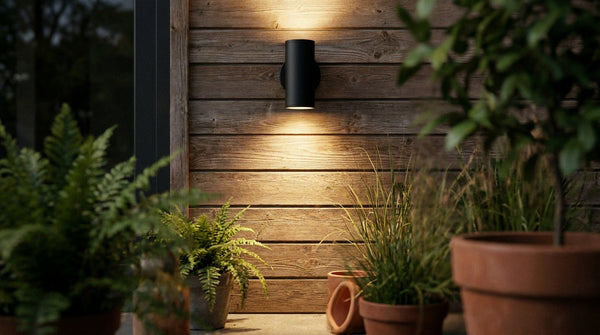
Installing wall-mounted outdoor lighting
The wall carries the light where no ceiling exists. A surface-mounted wall light shines downwards and secures a threshold. Placed higher, it shines upwards and stretches the facade.
A successful facade lighting scheme is judged at dusk, when the wall's materials reappear without the source being visible.
In a survey of 250 references from our catalogue on 29 September 2026, 32% declare wall mounting and 8% surface mounting. So there is plenty to dress a facade, not just a ceiling. Outdoor wall lights bring these models together.
Which cable and which power supply for outdoor lighting?
A cable designed for outdoor use, resistant to moisture, laid in conduit as soon as it is buried or runs along an exposed wall. The connection is made on a protected circuit, with waterproof boxes and cable glands. Never a bare connector block out in the open.
Outdoor electrical installation: what changes in the rain
Outside, water does not fall straight and creeps back up by capillary action. Four details separate an installation that lasts from a repair after the first storm.
- The cable drop forms a drip loop before entering the box.
- The conduit protects the cable wherever it is buried or fixed against a wall.
- The connection boxes stay waterproof and accessible, never buried in the masonry.
- The fixture shows a protection rating consistent with its real exposure, not with the shop's.
The connection is no different from an indoor point, provided you respect the order of the wires and tighten the connections. Wiring a fixture properly means checking waterproofing before switching the power back on.
Installing an outdoor floodlight with a sensor
A floodlight with a sensor is placed opposite the area being monitored, angled downwards, never facing a road or a neighbour's window.
The delay and sensitivity are set at night, by actually walking through the detection field. A correctly set outdoor light with a sensor switches on at the right moment, and not every time an animal passes.
GU10 socket units are repaired bulb by bulb, which avoids replacing the whole floodlight when a single source dims. GU10 LED bulbs do this job without heating up.
What is the difference between IP44 and IP65?
IP44 resists water splashes, IP65 resists water jets. An IP44 holds up under a canopy or a roof overhang. An IP65 stays outside, exposed to driving rain, jet washing and sea spray.
IP20, IP44, IP65, IP67: what each one protects against
| Rating | Protection against water | Where it holds up |
|---|---|---|
| IP20 | None | Indoors, enclosed conservatory |
| IP44 | Splashes | Sheltered wall, under a canopy |
| IP65 | Water jets | Exposed wall, post, driveway |
| IP67 | Temporary immersion | Poolside, flood-prone area |
The rating applies to the assembled fixture, not to its shade alone. In the catalogue, outdoor lights are therefore read first by their rating, then by their style.
Why 94% of our survey is IP20
In a survey of 250 references from our catalogue on 29 September 2026, 94% declare IP20, against 4% IP65 and 2% IP44. The collection counts 26,176 references on that date, and it remains first and foremost an indoor catalogue. Outdoor lighting is not chosen there the way a living room fixture is.
That is not a flaw, it is a reminder: a model sold as outdoor without a rating suited to its location will last less long than a modest model well placed.
An outdoor scheme rarely fails because of the fixture: it fails because of the location. You can describe your facade, your driveway or your terrace to us, and we will tell you where to put what.
What is the most efficient outdoor lighting?
LED wins over solar as soon as a point has to light strongly or for a long time. Solar wins when running a cable costs more than the device itself, or when drilling is not possible.
Outdoor lighting: the selection that holds up outside
 Basic form Suspension luminaire doré
 Basic form Suspension luminaire doré
 Basic form Suspension luminaire doré
 Velora Luminaire exterieur marron
 Suspension Bobi 2 lumières noire
 Suspension Gentor 4 lumières blanche
See the whole selection: Lighting, Home Lighting, Online Lighting Store
LED or solar: the right trade-off
| Criterion | Mains LED | Solar |
|---|---|---|
| Intensity | Constant all night | Varies with charge |
| Installation | Cable to run | No trench |
| Ideal use | Driveway, facade, entrance | Marking, border, isolated wall |
To decide, start from the LED power for outdoor lighting that the surface actually requires, then see whether solar can supply it every evening.
Which LED power for outdoor lighting?
Power is chosen after the surface and the use, never before. A marking point is fine with a few watts. A courtyard floodlight goes higher, but lights wider.
The decisive question remains the number of lumens reaching the ground, not the value printed on the box. Two devices of the same power do not give the same light depending on mounting height and beam angle.
To calibrate, ask yourself how many lumens outside are enough for the distance between the source and the area to be lit.
What advice for lighting a terrace outside?
Light what you look at in the evening, not what you want to show off during the day. Two or three low sources are worth more than a central floodlight that flattens the terrace and dazzles the guests.
Installing solar outdoor lighting, with no cable or trench
Solar avoids the trench, not thinking about exposure. A panel placed in the shade of a wall or under a tree does not recharge enough to last a whole evening.
Solar wall lights suit walls with no power supply and rentals where drilling is a problem.
Two or three sources rather than one central point
A single point creates a bright area and leaves the rest of the terrace in the dark. Spreading the light gives a depth that power alone does not provide.
- A floor lamp near the sofa or the table, for seating light.
- A wall light on the back wall, which lights without taking up floor space.
- A low point along a border, to draw the edges.
- A high source above the table, for atmosphere without glare.
The freestanding outdoor floor lamp plays this seating role without drilling into the facade.
For atmosphere, string lights hung high and without crossing do the work of an extra light point.
An LED string light is chosen on the total length to cover, not on the number of points advertised.
Which outdoor space do you want to light first?
In stock · shipping costs shown at checkout · up to 30% off in your cart


Ready to turn inspiration into reality?
Tell us about your room, your style and your budget, and we will show you the pieces that truly suit your project.
Get guidance in 30 seconds →