How to calculate wattage without making mistakes
This article is also available in French: Comment calculer la puissance en watt

How do you calculate the electrical power of a device in watts?
Multiply the voltage in volts by the current in amps: P = U × I. On an LED light fixture, the wattage is often set at the factory and printed on the product sheet, since the bulb cannot be replaced. The result is always expressed in watts.
Where to find the voltage and current on a light fixture
Three places give the information, and the last one is the most reliable.
- The socket shows a wattage limit. This is a heat resistance rating, not the actual consumption.
- The bulb packaging highlights consumption and puts the equivalence in small print.
- The rating plate, under the base or behind the shade, gives the voltage and current of the complete assembly.
- The driver, on an integrated LED model, states the wattage directly.
On a fixture with a replaceable bulb, the label states a maximum wattage, not a consumption. This limit depends on the socket and the shade, which retain heat. An integrated LED model, by contrast, shows its actual consumption, and cannot be changed.
A bulb often carries two values: its consumption and a wattage equivalence, inherited from filament bulbs. For a replacement, keep the same base and choose from the LED bulbs a model with equal or slightly higher wattage.
The calculation applied to a bulb, step by step
- Note the current in amps on the packaging or with a power meter.
- Check the voltage: 230 V on a French outlet.
- Multiply: 230 × 0.1 gives 23 W.
- Compare with the socket limit to keep a margin.
This calculation applies to a single bulb. On a fixture with several sockets, add up the wattage of each bulb to get the total.
How to calculate the power of a device without a label
Measure the current while it is actually running with a power meter or a clamp meter, then redo the calculation. Take several readings and keep the highest one, the one that corresponds to the most demanding setting.
On an old fixture or a modified assembly, the exact source may remain unclear. If the label has disappeared and the calculation remains uncertain, send a photo of the assembly by writing to the Designix team: you will know what you are dealing with before buying.
What is the formula for calculating power?
The formula is P = U × I: the power in watts equals the voltage in volts multiplied by the current in amps. It applies to direct current as well as to a single-phase outlet, to a bulb as well as to a complete light fixture. A simple calculation is enough for domestic use.
P = U × I: what each letter means
- P: the power, in watts, what the device consumes.
- U: the voltage, in volts, 230 V on a French outlet.
- I: the current, in amps, the flow of electricity.
- kW: 1,000 W, the unit for energy-hungry devices and for bills.
To plan the lighting for an entire room, wattage is only one step: the number of light points matters just as much. This guide to calculating the lighting for a room details the method.
How do you convert 2.5 kW to watts?
Multiply by 1,000: 2.5 kW is 2,500 W. The reverse conversion divides by 1,000, and works the same way for any value.
| Kilowatts | Watts |
|---|---|
| 0.5 kW | 500 W |
| 2.5 kW | 2,500 W |
| 3.5 kW | 3,500 W |
How many watts is 3.5 kW? 3,500 W, obtained by the same multiplication. Three places separate the two units, so you simply move the decimal point.
Why wattage does not indicate brightness
A watt measures the electricity consumed, a lumen the light emitted. Two bulbs of the same wattage can light very differently depending on their efficiency. The difference between lux and lumens explains why we now choose based on lumens.
LED changed the scale: the bulb that consumes the least at comparable brightness is almost always an LED, because it converts electricity into light more efficiently.
How do you calculate the wattage to light a room?
Start with the lumens the room needs, then work back to the wattage of the bulbs. Watts per m² gives a rough idea, to be cross-checked with the actual use of each area. A living room is lit from several points rather than with a single source.
- The overhead point lights broadly: a LED ceiling light is enough in a modest living room.
- Large volumes call for a living room chandelier or several low sources.
- Walls free up surfaces: a wall light above a low piece of furniture.
- Reading corners benefit from a directed point, lower in wattage and closer to the eye.
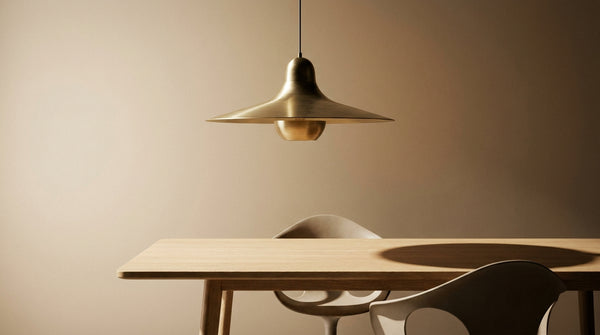
Above a table, the source hangs low: the wattage per point there is lower than in a hallway, because the distance to the eye is short. Too powerful in that spot, it dazzles instead of lighting.
Is 1000 watts a lot in a home?
Yes for a light fixture, no for a heating appliance. No residential light fixture needs such wattage to light a room. The figure means nothing without knowing what it powers.
On a socket, the stated limit mainly protects against heat. An open pendant light dissipates heat better than a closed shade, which matters more than the wattage itself. Going from a stronger bulb to a weaker one creates no risk: see what changes when you replace a 60 W bulb with a 40 W one.
Wattage and color temperature
A warm white and a cool white can consume the same wattage for opposite atmospheres. Color temperature, expressed in kelvins, decides the mood; wattage, the light intensity.
The right approach is to choose the shade first, the wattage second. It is this combination that guides the selection of one designer light fixture rather than another.
Two pendant lights of the same wattage do not look the same depending on the shade. Reading customer reviews shows the light as it actually falls, which no technical sheet can tell you.
Which device are you trying to calculate right now?
In stock · shipping costs shown at checkout · up to 30% off in your cart


Ready to turn inspiration into reality?
Tell us about your room, your style and your budget, and we will show you the pieces that truly suit your project.
Get guidance in 30 seconds →