How to light a dark room: the 3-layer method
This article is also available in French: Comment éclairer une pièce sombre
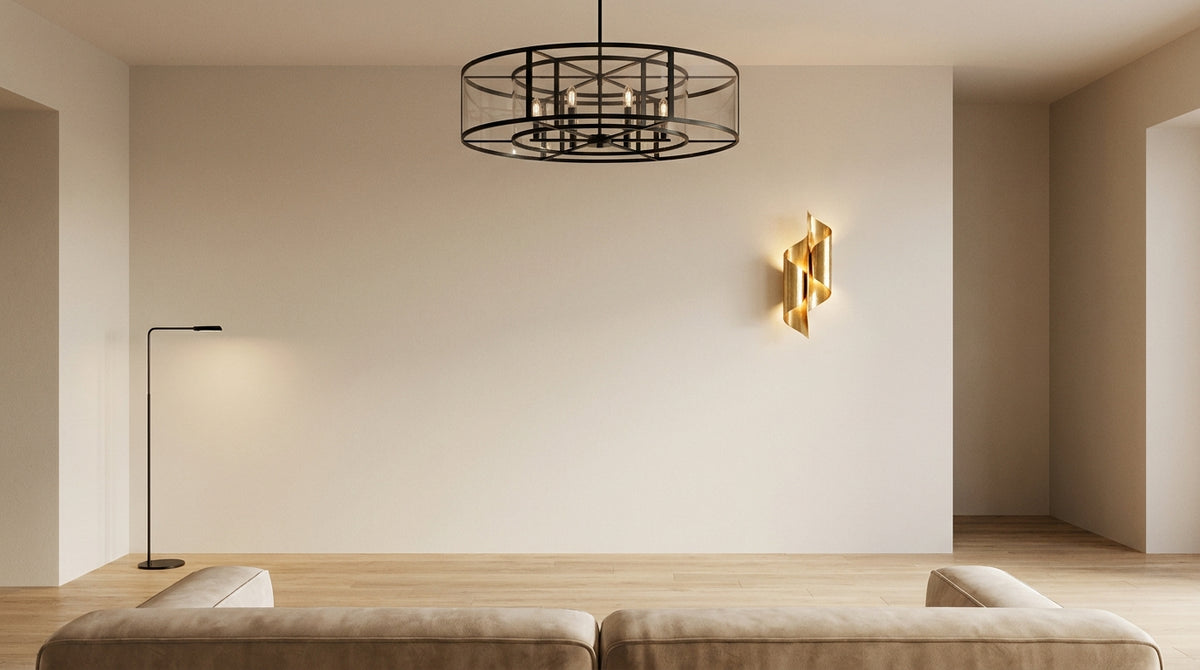
Count three sources at three different heights: a pendant or ceiling light in the centre, a wall light between 1.50 and 1.80 m from the floor, a floor lamp in the corner that stays dark. Add up the useful lumens for the surface area rather than concentrating a single powerful point: a dark room rarely lacks power, it lacks layers.
How to light a dark room?
Three layers are better than one: general lighting on the ceiling, wall lighting at waist height, a movable extra light in the area that stays in shadow. From a survey of 219 references in our catalogue as of 28 September 2026, wall-mounted fittings account for 36% and pendants 31%: light is now placed on walls as much as on the ceiling.
Why a single ceiling source is not enough
A single light point casts light vertically: the floor is lit, the corners and the bottom of the walls stay black. This is the starting point for most living rooms we take on in Vaulx-en-Velin. Renovating a living room therefore begins with the lighting plan, before choosing furniture.
Multiplying sources softens shadows and removes dead zones. A well-placed light fitting lights better than a powerful one placed too high.
- General: a diffusing LED ceiling light, sized to the surface area, for background light.
- Wall: a wall light that shines upwards and downwards, 1.50-1.80 m from the floor.
- Extra: a floor lamp or table lamp in the darkest corner.
Add up lumens instead of concentrating them in one point
A 20 m² room is better served by three medium sources than by a single very powerful one. The combination lights reliefs and tires the eye less.
| Layer | Type of light fitting | Placement guide | What it brings |
|---|---|---|---|
| General | Pendant or ceiling light | Centre of the ceiling | Background brightness |
| Wall | Wall light | 1.50 to 1.80 m from the floor | Depth of the walls |
| Extra | Floor lamp, table lamp | Corner or reading nook | Use in the evening |
To put the right figures on your surface area, calculating the required amount of lighting takes two minutes.
Once the three heights are identified, the longest part is knowing what to put where: describing your room, its openings and constraints, lets you leave with a lighting plan suited to your surface area.
How to brighten a dark room without a window?
Light the surfaces rather than the void. In a windowless room, the useful light is the one that bounces off light-coloured walls, ceiling and floor. Three well-distributed sources, a mirror positioned to reflect brightness and matte tones are enough to erase the cellar effect, without cutting an opening.
How to make a room without a window bright
The ceiling acts as a second sun: the lighter and more matte it is, the more it redistributes light downwards. Avoid opaque lampshades, which concentrate the flux on the floor and leave the rest in grey.
- Diffusing ceiling light: frosted glass or acrylic spreads the flux over the whole surface.
- Two wall lights: offset from each other, they light at eye level.
- Adjustable floor lamp: for the desk or reading corner that stays dull.
- Glass partition: if an adjacent room is bright, an interior glass wall lets its brightness through.
At waist height, wall lights replace the second ceiling light: they free up the ceiling and light the eye line, not the feet.
An adjustable reflector floor lamp completes the setup in the forgotten corner.
Working on volumes matters as much as the sources: expanding the visual space with lighting relies on the same thinking.
The surfaces that reflect light
A large mirror placed facing the window doubles the brightness received, even in a room with little exposure. On a window sill, a light reflector tilts towards the ceiling and sends brightness to the back of the room.
Light matte walls reflect better than satin white, which creates shiny spots and hardens the atmosphere. A mirror facing the window follows the same logic: reflect rather than add, even before touching the light fitting.
Which colour brightens a dark room?
No colour creates light: a light tone reflects existing light better. Paint first the wall facing the main source, then the ceiling, with a white or beige lighter than the walls. A matte finish avoids harsh reflections.
Which wall to paint to light a room
The wall facing the window or the source reflects light towards the rest of the room: that is the one to lighten first, along with the ceiling.
- Ceiling: a matte white, lighter than the walls, to redistribute flux downwards.
- Wall facing the source: off-white, light beige or very pale grey.
- Wall behind the source: free, it is the only place where a dark tone costs nothing.
- Matte finish: it diffuses, whereas satin creates shiny spots.
A bright room stays cold if the light does not accompany it: creating a warm atmosphere with light relies on low temperatures and multiple sources.
Which colour for a dark kitchen
Aim for a slightly warm white on the upper cabinets and a light worktop: it is the worktop that reflects the most light upwards. Matte black on the splashback absorbs the spotlights' flux and darkens the worktop.
Paint does not do everything. A kitchen light fitting distributed under the upper cabinets and above the worktop changes the feel more than an extra coat.
Which light fitting for a dark room?
It is not the colour of the light that lights more, it is the flux in lumens. For a relaxation room, aim for 2700 to 3000 K and a flux suited to the surface area. The light fitting is then chosen on the stated flux, the cap and the ingress protection.
What are the alternatives to a ceiling light for lighting a room
A ceiling light can be replaced by four families of light fittings, easier to distribute and adjust according to the time of day.
- Wall light: 1.50-1.80 m from the floor, in a hallway or bedroom.
- Floor lamp: in the corner, with a reflector aimed at the ceiling.
- Low pendant: above a table, it lights the useful area and nothing else.
- Table lamp: a movable extra, to move around during the evening.
From the survey of 219 references as of 28 September 2026, plug-in fittings account for 10% and dimmability is stated on 27%: adjustment remains the exception, even though it changes everything in the evening.
Removing the ceiling light forces you to rethink placement: lighting a room without a ceiling light details these setups point by point.
Above a table, a low-hung dining room chandelier structures the space and lights faces rather than the floor.
Cool white or warm white: which lights the most
At equal flux, cool white does not light more: it simply appears whiter, and hardens materials. The lumen rating on the packaging remains the only measure of light quantity.
| Temperature | Rendering | Where to use it |
|---|---|---|
| 2700 K | Warm white, golden | Living room, bedroom, reading corner |
| 3000 K | Strong warm white | Kitchen, hallway, dining room |
| 4000 K | Neutral white | Office, workshop, worktop |
| 6000 K and above | Bluish cool white | Avoid in relaxation rooms |
The cap matters just as much: in the survey, 24% of references are E27 and 21% integrated LED, 11% E14 and 11% GU10. Comparing white or yellow light before ordering avoids ending up with the wrong temperature.
The technical sheet settles the rest: 84% of the survey is IP20, sufficient in dry interiors, versus IP44 in damp rooms. 89% of the survey carries a two-year warranty. The Decoration By Room collection has 30,324 references as of 28 September 2026, and the Designix Google listing gives a verifiable reference in one click when two models are still hesitating.
Where do you lack the most light at home?
The light fittings that rescue a dark room


Bright living rooms share one thing in common: none relies on a single source. Our selection of trendy living room lighting shows the result on real surfaces.
In stock · shipping costs shown at checkout · up to 30% off in your cart


Ready to turn inspiration into reality?
Tell us about your room, your style and your budget, and we will show you the pieces that truly suit your project.
Get guidance in 30 seconds →