Gold lighting: the right room, the right light
This article is also available in French: Luminaire doré
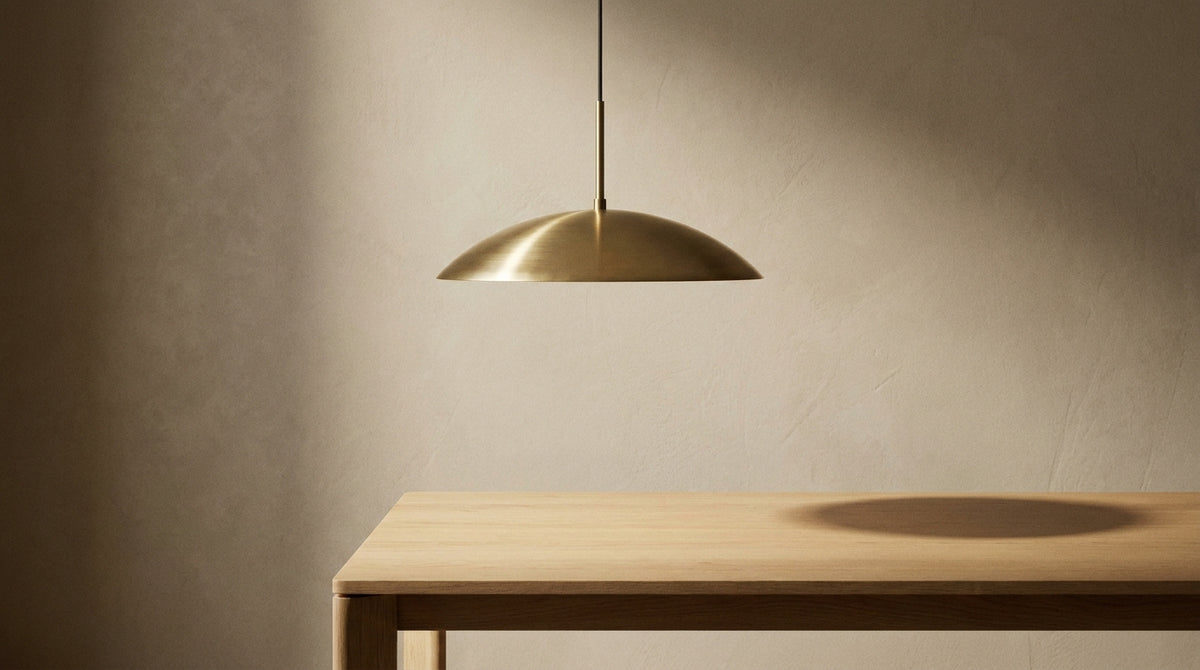
Measure first, choose second. A gold pendant hangs 75 or 80 cm above a table top, a bedside wall light 1.20 m from the floor, a hallway wall light 1.50 m. The metal tone and the bulb temperature come after, once the room and the fixing point are settled.
Which gold light for which room?
The room decides the mounting, not the other way round. A dining room calls for a pendant, a hallway for a wall light, a living room for a ceiling light or a floor lamp. On a survey of 250 references from our catalogue on 5 November 2026, suspended mountings account for 42% of the listings and wall mountings for 38%. The quickest route is to filter by room in our selection of designer lighting, then narrow down by tone.
Which gold pendant above a table?
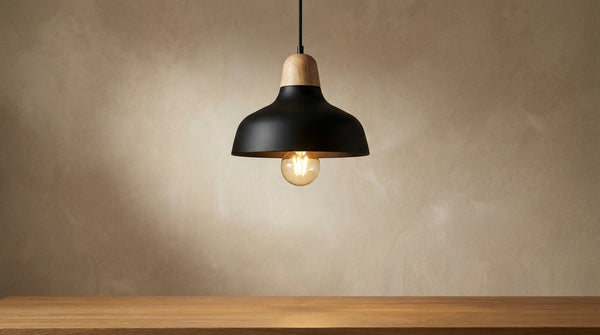
A gold pendant above a table lights the meal before it decorates the room. Allow 75 to 80 cm between the bottom of the shade and the wood, and aim for the centre of the table top. The gold metal reflects light downwards and onto faces, warming the gathering as soon as dusk falls.
Width matters as much as height. A model that is too narrow leaves the ends of the table in shadow, and that is where guests push their plates back. The dining room chandelier selection should therefore be read by diameter as much as by style.
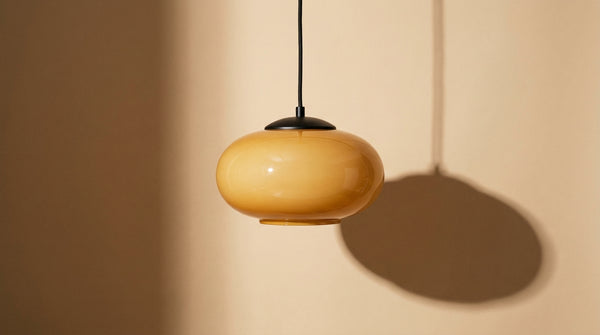
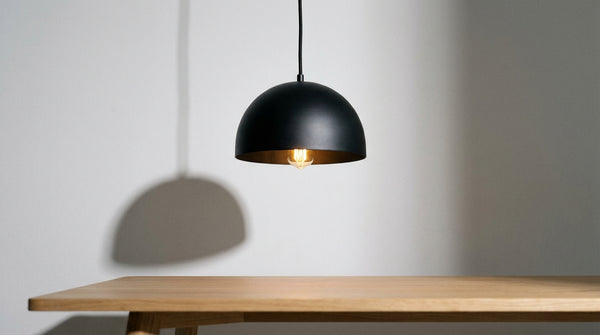
The shade colour also plays a part: smoked glass calms the gold, a black shade underlines it, a cream fabric softens it.
In a bedroom, the same logic applies with a lower and more discreet pendant, detailed in this guide to the gold pendant in the bedroom.
Where to install a gold wall light, in a hallway or entrance?
Two wall lights are better than one in the middle of a hallway. Grazing light enlarges the passage and the gold holds the wall without weighing it down. In an entrance, place it opposite the door handle, at shoulder height.
A gold wall light is judged on three points: the projection, the direction of diffusion and whether the fixture has a switch. In a hallway less than 1.20 m wide, stay under 12 cm of projection.
Gold, brass, bronze: which material lasts?
Metal, by a wide margin. On the survey of 250 references on 5 November 2026, metal is declared on 82% of the listings, glass on 38%. Gold is a finish applied to that metal, not a material in itself: it is the finish that decides the real tone and how well it ages.
Metal, the dominant material in our listings
Three bases come up most often, and they do not give the same gold.
- Brass: a warm yellow gold, it patinates and gains depth
- Steel with a gold finish: a more neutral tone, discreet reflections, ideal on a pale wall
- Anodised aluminium: a light, even gold, stable in a very bright room
Brass needs a little attention. An unvarnished brass ceiling light changes tone over time, and that is precisely what gives it its character.
How to spot a gold that turns green?
The green shift comes from a finish that is too thin or from a base that reacts to humidity. Three clues before buying:
- The tone in the photo: a gold that looks pale yellow in neutral light will turn green in reality
- The stated finish: varnished, anodised or raw, the listing must say so
- The weight: a very light metal often carries a thin layer
A properly documented brass wall light gives its finish and its ingress protection rating, two pieces of information that prevent the wrong shift.
Gold and black lighting: the duo that structures a room
Black draws the lines, gold warms them. A black frame above the table, gold on the wall light or table lamp: the contrast holds the room without loading it. The duo also works with a silver light, cooler, provided you do not mix three metals in the same room.
In an interior already rich in materials, gold alone is safer. Two metal tones are more than enough.
A contemporary light in pale gold then plays the role of a line, with no competition.
You are looking for a gold light for which use?
At what height should a gold light be installed?
Three reference points are enough: 75 to 80 cm above a table top, 1.20 m from the floor for a bedside wall light, 1.50 m for a hallway wall light. A floor lamp is measured by use, the shade should reach shoulder height when you are seated.
Before ordering, have your drop and your fixing point checked: one message is enough to avoid drilling twice. The contact details are on the contact page.
At what height should a pendant be hung above a table?
Allow 75 to 80 cm between the bottom of the shade and the surface. Go down to 70 cm for a compact pendant, up to 90 cm above an island, where you work standing.
| Location | Reference height | What changes |
|---|---|---|
| Dining table | 75 to 80 cm from the surface | the light falls on the plates |
| Kitchen island | 85 to 90 cm | the source stays out of sight |
| Bedside wall light | 1.20 m from the floor | the switch can be reached lying down |
| Hallway wall light | 1.50 m from the floor | the light grazes the wall without dazzling |
Where to fix a wall light and a headboard?
A bedside wall light is installed 1.20 m from the floor, 20 or 30 cm above the mattress, on the outer side of the bed. Two wall lights frame the headboard, one is enough in a small bedroom.
The model matters less than the spacing: two wall lights placed too close together overwhelm the bed. The selection of wall lights for adult bedrooms is read by headboard width, not by colour.
Gold lights: our selection
 Pendant light | Interlacia
 Pendant light | Nivara
 Pendant light | Ysandre
 Ceiling light | Bruna
 Living room floor lamp | Hyra
 Wall light | Sveva
See the whole selection: Alternative to Luminaire.fr: designer lighting shop | Designix
Which light should go in a gold fixture?
A 2700 K bulb, warm white, warms the gold and gives it depth. At 3000 K, the metal looks sharper, more contemporary. Above 4000 K, it turns pale yellow and loses its relief: this is the most common mistake with a gold light.
2700 K or 3000 K: which to choose?
2700 K suits rooms where you sit in the evening: living room, dining room, bedroom. 3000 K works better in an entrance or a kitchen, where you want to see clearly. A gold light placed in a room with no other source copes badly with 4000 K.
To compare the two renderings on the same model, 2700 K bulbs offer the most flattering reference for a warm metal.
Visible bulb or closed shade?
With a closed shade, the temperature is read on the wall, not on the bulb. With an open frame, the bulb becomes part of the decor and its filament matters as much as the socket.
Of the 231 listings in our survey that declare a socket, E27 comes first with 26%, ahead of LED 22%, E14 16% and GU10 10%. The socket decides the available power, and therefore the mood. This guide to warm or cool light helps you decide before buying.
What does humidity change for a gold light in a bathroom or kitchen?
The ingress protection rating, and nothing else. IP20 is enough in a dry zone, IP44 in zone 2 of a bathroom, IP65 if the wall light receives splashes. Of 250 listings surveyed on 5 November 2026, 94% declare IP20: a gold bathroom light has to be sought out, it is not found by chance.
IP20, IP44 or IP65: which for which wall?
- IP20: dry rooms, living room, bedroom, hallway
- IP44: zone 2 of the bathroom, at a distance from the bath
- IP65: facing splashes, near a shower or a sink
Gold does not fear water in itself, it is the finish that suffers: a thin layer on brushed metal marks more quickly. IP44 wall lights for bathrooms settle the question without giving up the tone.
In the kitchen, which gold light above the worktop?
Near the sink, aim for IP44. Elsewhere, IP20 is enough, provided you keep the light away from the steam flow. A gold light is cleaned little and often: soft cloth, no abrasive, and the finish lasts.
This guide to caring for a gold light covers varnished as well as raw finishes.
In stock · shipping costs shown at checkout · up to 30% off in your cart


Ready to turn inspiration into reality?
Tell us about your room, your style and your budget, and we will show you the pieces that truly suit your project.
Get guidance in 30 seconds →