Designer desk lamp: how to choose it for your needs
This article is also available in French: Lampe de bureau design
Designer desk lamp: which model to place, and how to set it up
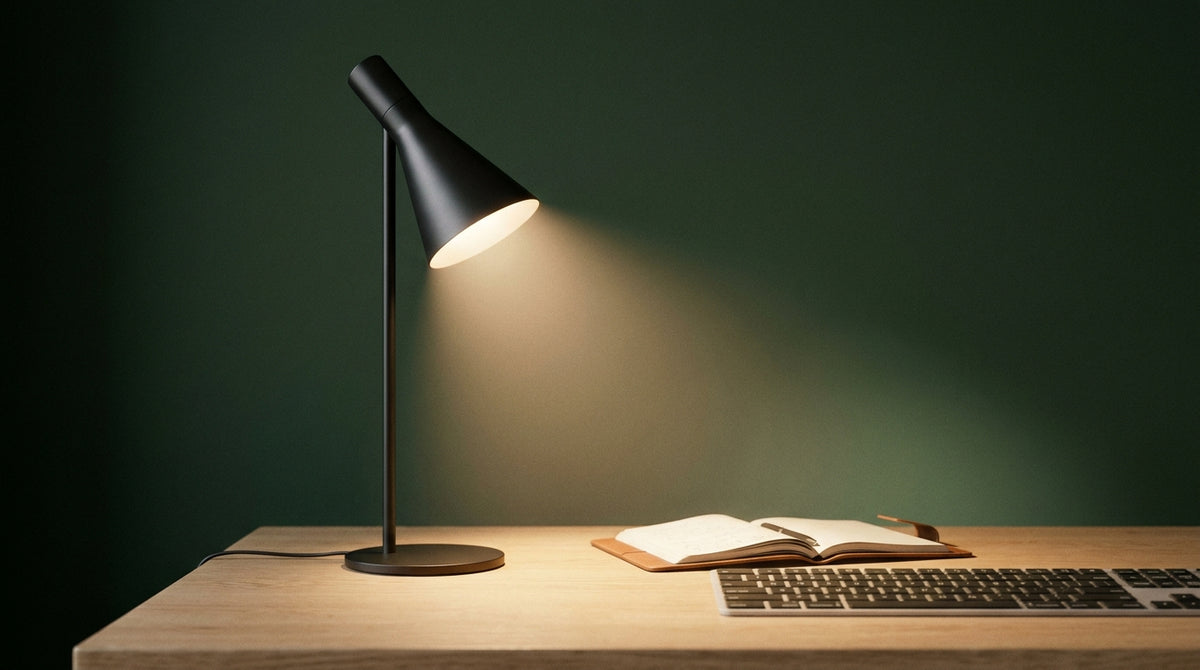
Place the lamp on the opposite side to your writing hand, with the head turned toward the keyboard and not toward the screen, then adjust three things: the shade below eye level, a colour temperature around 3000 K, and an intensity you lower as dusk falls. The design comes afterwards, it replaces none of these steps.
A workspace is set up around three points: where the light falls, what colour it is, and how hard it works. The rest, shape, material, finish, comes afterwards. That is exactly what a bedroom and office lighting project deals with, starting from the whole room rather than the light fitting alone.
Which type of lamp for a desk?
Two families, two approaches. An integrated LED lamp fixes its light at the factory and cannot be changed. A model with a socket lets you choose the bulb, and therefore the temperature and intensity. In a sample of 62 desk references from our catalogue on 5 October 2026, E27 accounts for 47% of the sample, E14 for 23%, integrated LED for 16% and GU10 for 5%.
The right instinct is still to choose the shape of the shade and the travel of the arm before the bulb. Our designer desk lamp comes in all three socket types: you keep the same model across several workspaces and only change the temperature.
The integrated LED lamp: when the light is fixed in advance
It imposes its characteristics and simplifies everything else. In the same sample of 62 desk references on 5 October 2026, 46 listings declare LED technology, that is 74% of the sample.
- Adjustable intensity on most models, to go from reading to a video call without changing lamps
- Diffusing shade, which avoids a bright point in your field of vision
- Non-replaceable module: when the LED stops, the lamp stops too
- Compact format, often slimmer on a narrow desktop
E27, E14 or GU10 socket: what difference does it make on a desk?
The socket decides everything else: the size of the shade, the shape of the beam and the range of bulbs available.
| Socket | What it brings | On which workspace |
|---|---|---|
| E27 | The widest choice of bulbs, filament included | Main desk, articulated arm |
| E14 | Compact format, slimmer shade | Small secretary desk, side table |
| GU10 | Directed beam, grazing light | Vertical surface, niche, wall lighting |
To go further on the correspondences, our guide to bulb types: socket and light details each family, including the small G9 and G4 sockets found on table models.
What lighting ideas work for a desk?
Three roles are enough to cover almost every workspace: an adjustable lamp for working, a low light for the back of the room, and a wireless solution when no socket reaches the right spot. Style is chosen last, once these three roles are assigned.
Designer desk lamps from our catalogue
 Bedside lamp | Compagnon Luminé
 Bedside lamp | Ours
 Bedside lamp | Oursons
 Desk lamp | Xyvena
 Bedside lamp | Sphère Luminosa
 Bedside lamp | Aura Impérial
See the whole selection: Desk lamps, Small lamps and Designer Office Lighting
Task lighting: the light that works with you
A desk lamp does not light the room, it lights a zone: the keyboard, the notebook, or both. That is the very definition of task lighting.
That is why a well-placed accent lamp tires you less than a ceiling light mounted high: the light comes from the side, without the hand casting a shadow on the page. The benefits of an accent lamp are most noticeable at the end of the day.
Study workspace and multimedia workspace: two different needs
A student desk needs a clear light on the worktop and a second low point for reading in bed. Our article on the student desk: lamp, storage and chair details this balance.
A multimedia workspace handles reflections badly: the screen must stay matte and the ambient light placed behind it can add colour without lighting. The premium gaming corner relies entirely on this principle.
Scandinavian, industrial, vintage: style comes after function
Thin metal for a contemporary interior, glass and brass for a more dressed-up desk, wood to soften a bright room. Our guide to matching your lighting to your interior starts from the materials already present in the room.
The wireless lamp, for desks without a socket
A desk set up under a window or in a corner rarely has the socket in the right place. Rechargeable models move as needed. For fixed light without running a cable, wall lights are mounted above the worktop and free up the desktop.
How do you set up a desk lamp to avoid eye strain?
Place the source on the opposite side to your writing hand, the shade below eye level, and close enough to the worktop for the light to fall on it. Then lower the intensity as the room darkens. A well-adjusted lamp is invisible: you only read what it lights.
Which side should the lamp go on a desk?
Right-handed, the lamp goes on the left, and the other way round. The writing hand then casts no shadow on the page. The head faces the keyboard and not the screen: this is the most common mistake, it turns a good model into a source of glare.
- Opposite side to the writing hand, no exception
- Head turned toward the worktop, never toward the screen
- Shade below eye level, to stay out of your field of vision
- Clear desktop around the base, otherwise the lamp moves back and the beam misses
A piece of furniture to place a lamp on solves this last point when the desktop is too short.
Which colour temperature should you choose for working?
Allow 3000 K for a home office: white enough to stay crisp, warm enough not to cut the room off at nightfall. 2700 K suits an accent lamp read in the evening, 4000 K suits a workspace where colour matters. Our comparison of white or yellow light shows how each value renders.
Adjustable intensity: the criterion that matters most
A lamp that cannot be adjusted forces you to choose between too much and too little depending on the time. The simplest solution remains a dimmable E27 bulb on a model with a socket, or a built-in dimmer on LED models.
Hesitating between two models for the same spot: describe the depth of your worktop and the hand you write with, and we will reply with the format that fits. Simply describe your workspace to get that answer.
What are the table lamp trends for 2026?
Shape weighs more than colour this season. In a sample of 62 desk references from our catalogue on 5 October 2026, the ball shape is declared on 45% of the sample, the tube on 26%, the oval on 19% and the round on 16%. On the material side, metal dominates at 76% and glass follows at 52%.
Which room will you light with this desk lamp?
Shapes and materials that recur in our catalogue
The metal and glass duo takes up a large part of the range, but fabric still accounts for 29% of the sample. It is fabric that softens a lamp placed on a light oak desk. A table lamp in beige fabric and black metal handles two things at once: it diffuses widely and stays discreet when switched off.
The style that stands the test of time
In the same sample of 62 references, 92% have a contemporary style and 74% a modern style. A successful designer desk lamp is recognisable by its silhouette switched off as much as switched on. Our selection of trending table lamps favours this criterion, because a shade is also looked at during the day.
On the same subject
In stock · shipping costs shown at checkout · up to 30% off in your cart


Ready to turn inspiration into reality?
Tell us about your room, your style and your budget, and we will show you the pieces that truly suit your project.
Get guidance in 30 seconds →