Crystal dandelion chandelier: how to recognise one before buying
This article is also available in French: Lustre pissenlit en cristal : le repérer et bien le choisir
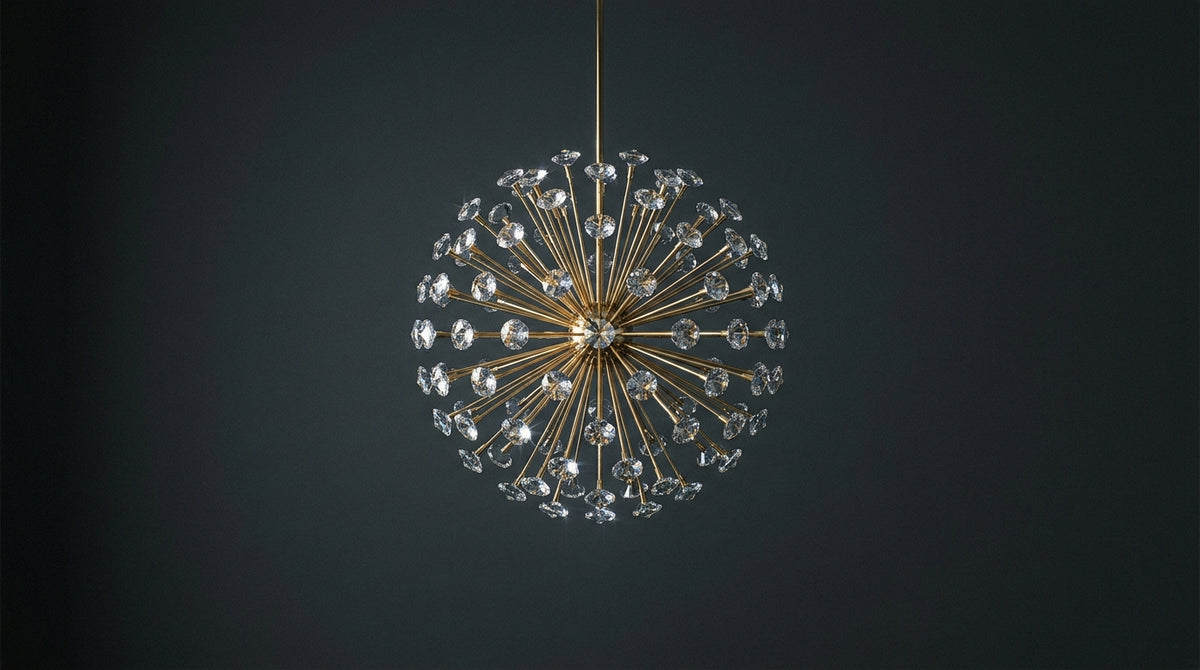
Weigh the piece in your hand: solid crystal is heavy and stays cold to the touch. Tap an edge and it should ring clear and long. Then count the stems fixed to the core: the fuller the crown, the better the light spreads. One last pointer before you choose: IP20, so dry rooms only.
How do you recognise a crystal dandelion chandelier?
Three gestures are enough: weigh a detached piece, listen to an edge, count the stems. Crystal differs from ordinary glass in its density, its clear ring and the way it scatters light. These markers work for an antique piece as well as a new chandelier.
Weight, sound and sparkle
- Weight: at the same size, a solid crystal piece is noticeably heavier than a glass one.
- Sound: tapped with a fingernail, a crystal edge rings clear and long; glass gives a dull note.
- Sparkle: crystal breaks light into small touches, glass lets it through without scattering it.
- Edges: cleanly cut, with no burr or bubble beneath the surface. Our guide to spotting a chandelier copy shows the flaws that give an imitation away.
Counting the stems and the achenes
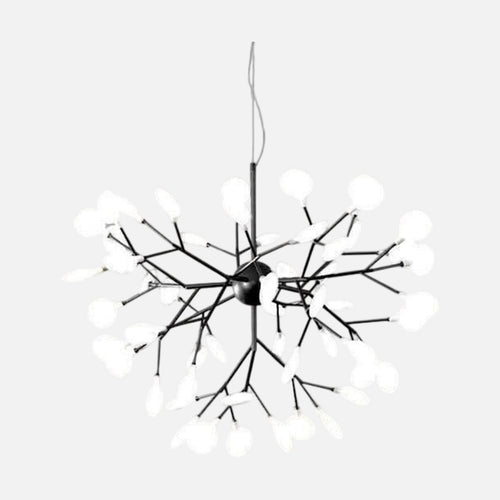
A dandelion is read at its core: fine stems radiate outwards, each carrying a crystal achene. The denser the crown, the more the light diffuses without a hard spot or a shadow on the wall. The number of stems matters less than the light points: a full crown that is poorly equipped leaves dark zones.
This structure sets it apart from a pendant light hung on a single cable, with a closed shade. The chandelier fills the volume, the pendant accompanies it.
Which chandeliers look dated?
What dates a chandelier is not its style but the clutter: too many tiers, too much gilding, novelty drops. A light is judged on its overall line, on the metalwork and on the finesse of its finishes.
Frames that are too busy
- Three stacked tiers that overlap and blur the silhouette.
- Plastic drops that yellow and sound hollow under the fingernail.
- Thick gilding that imitates brass without its weight.
- Opaque shades added to a structure that never needed them.
What replaces them without losing the prestige
An open crown, a fine metal, a crystal that works the light. The volume comes from the stems, not from applied decoration. The baroque style still holds, provided it is lightened: fewer tiers, longer achenes, a single tone.
How do you know if your chandelier is worth anything?
Four things decide it: the signature, the material, the consistency of the assembly and the condition of the pieces. A mark engraved under the cup or on the frame guides the search for its origin. Without one, a chandelier can still be beautiful and well made, but its value becomes hard to establish.
Where is the signature on a chandelier?
You look for it in this order, from the most accessible to the most hidden.
- Under the cup: the dish that closes the bottom of the frame.
- On the central stem: between two knots, sometimes under a collar.
- On the canopy: the piece fixed to the ceiling, often forgotten.
- On a branch: engraved or stamped on a small plate.
The absence of a mark is not proof of a copy. It means you will need to compare the edges, the settings and the assembly to place the piece.
What a dated catalogue survey tells us
In a survey of 250 references from our catalogue on 4 October 2026, 98% declare crystal, 100% an IP20 protection rating, 97% a 2-year warranty and 47% a baroque style. These are product-sheet declarations, not expert appraisals.
Our crystal wall light collection had 565 references on the same date; the 250 sheets surveyed that day give an idea of it.
These surveys tell us one useful thing: the word crystal is everywhere, traceability of the pieces far less so.
The article on what our catalogue reveals sets out the method and its limits.
At what height should a dandelion chandelier be hung?
Two measurements govern everything: the distance between the lowest point and the lit surface, and the clear height left for walking. Above a table, allow 75 to 85 cm. In a passageway, nothing hangs below 2.10 m from the floor.
| Lit surface | Distance to keep |
|---|---|
| Table top | 75 to 85 cm above the surface |
| Kitchen island | 80 to 90 cm above the worktop |
| Passageway | 2.10 m minimum between the floor and the lowest point |
Above a dining table
The measurement is taken between the table top and the lowest achene, never between the top and the core. The diameter follows the table: it should not exceed half its width, or guests will have the chandelier in their field of view. A dining room chandelier centred on the table lights more usefully than an off-centre model.
Living room and hallway: when the ceiling is high
The higher the ceiling, the further the stem drops: a chandelier fixed flat to the ceiling no longer lights the living area and loses its silhouette. A large chandelier is reserved for spaces that can take it.
- Hallway: the lowest point stays above 2.10 m.
- Living room: under a 2.50 m ceiling, keep 2.10 m of clearance.
- High ceiling: lengthen the stem before increasing the diameter.
Ceilings of 3.50 m and above need a separate calculation, set out in our article on the chandelier and high ceilings.
In every case, take the measurement once the room is furnished, never from a plan.
Still hesitating between two diameters? Describe the room and the ceiling height via the contact page: we will reply on the measurements before you order.
Which room suits a dandelion chandelier?
The dandelion is at its best in a dry, high room: living room, dining room, bedroom. It is hung as a volume, away from the walls. It is out of place in a bathroom or outdoors, where damp attacks the frame and dulls the crystal.
Living room, dining room, bedroom
- Living room: at the centre of the room, it replaces the general lighting.
- Dining room: centred on the table, 75 or 85 cm from the top.
- Bedroom: short stem and tight crown, to light without dazzling from the bed.
A bedroom chandelier is chosen on the same crown logic, with a more contained diameter.
G9, E14 or LED: which base for a dandelion
Crystal crowns mostly use G9 bases for capsule bulbs and E14 for screw fittings. An LED at 2700 K warms the crystal without dazzling. Increase the number of light points rather than the power of a single bulb, and our guide to bulb types details each base.
Bathroom and outdoors: the rooms to rule out
In the survey of 250 references on 4 October 2026, 100% carry an IP20 protection rating. IP20 means dry room, protected from splashes. A bathroom, a terrace or an open staircase would expose the frame and the settings to changes in humidity.
Crystal chandeliers: the selection by room and by size


Related reading
In stock · shipping costs shown at checkout · up to 30% off in your cart
Ready to turn inspiration into reality?
Tell us about your room, your style and your budget, and we will show you the pieces that truly suit your project.
Get guidance in 30 seconds →