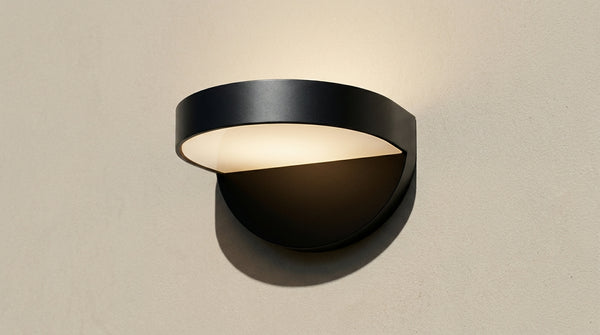
Connected outdoor lighting: choosing the right evening light
This article is also available in French: Luminaire extérieur connecté

Start with the area to be lit, not with the model. An entrance calls for a wall light mounted high, a path for low bollards, a terrace for a cordless lamp post. Then check the ingress protection rating and the power supply: outdoors, these two lines decide how well a light lasts, not its style.
Which connected outdoor light for which area?
Each area calls for a specific type. A facade is handled with wall lights, a path with spaced low bollards, a terrace with a lamp post or a waterproof string light. Start with the area you use most in the evening: it sets the height, the power and the style for the rest of the project.
Unsure whether to choose a wall light, a bollard or a cordless lamp post for your setup? talk to an adviser: the team helps you decide area by area before you buy.
These three families are all in our outdoor lighting, sorted by use rather than by brand.
What should you fit to light a facade or an entrance?
Two wall lights either side of a door are enough to define an entrance. Mount them between 1.80 m and 2 m from the ground, high enough not to dazzle, low enough to light a face.
- Downward light output: avoid porthole fittings that throw light at the sky.
- Aluminium or treated metal: more stable than plastic that fades in the sun.
- Wall format: a wide wall light reads better on stone than a recessed spotlight.
Our outdoor wall light collection groups models by material and colour, from glass to black metal.
How do you mark out a path without digging a trench?
Low bollards spaced 1.50 m to 2 m apart are enough to follow a walkway. With no trench, choose a solar or rechargeable model that you can move as needed.
- Under 60 cm: the light stays at ground level and dazzles no one.
- Even spacing: one bollard every 1.50 m to 2 m, never two close together and then a gap.
- Solar: zero cable, provided there is decent afternoon sunshine.
The most understated shapes are found among designer outdoor bollards. A garden reads better with a few low points than with a single floodlight.
The overall rhythm matters as much as each light: enhancing a terrace, garden or balcony comes down to three or four well-placed points.
Which IP rating do you really need outdoors?
It all depends on exposure. IP44 is enough under a canopy that keeps off the rain. IP65 withstands a wind-driven facade and jets of water. IP67 resists brief immersion. The higher the rating, the more water the light tolerates, but the fewer slim shapes are available.
We reviewed 250 references from our catalogue, taken from a collection of 35,326 as of 12 October 2026. In that sample, 94% are declared IP20, against 3% IP65, 2% IP44 and 1% IP45. The useful habit is to read the rating on the product page, never to guess it from the photo.
IP44, IP65, IP67: what does each rating protect against?
| Rating | Protects against | Where to use it |
|---|---|---|
| IP44 | Splashes of water | Covered wall, under a canopy |
| IP65 | Dust and water jets | Exposed facade, garden bollard |
| IP67 | Temporary immersion | Pond edge, terrace washed with a hose |
Can you leave a light outdoors all year round?
Yes, if the rating matches the actual exposure and the body withstands frost. In the sample of 12 October 2026, 89% of the 250 references declare a 2-year warranty, 9% a 5-year warranty and 2% a 3-year warranty. That line matters more than the number of lumens shown.
The fixing matters as much as the product page. On a damp wall, press the housing flat, let the seals work and never pinch the cable. The start of the line goes under a canopy, in a waterproof box, never at ground level.
Choosing where the power goes before drilling saves redoing the whole wall: installing outdoor lighting starts with that reference point. Buyers comment on the selection, and the Designix Google listing remains the public reference for the rating and reviews, kept up to date.
Which outdoor area do you want to light first?
Cordless: battery, solar or outdoor socket?
Three approaches, three uses. The outdoor socket powers a steady light all night. The battery model recharges indoors and goes wherever you want. Solar works without a cable where the panel catches the sun at the end of the day.
- Outdoor socket: the simplest solution when a wall already has a power supply.
- Removable battery: no visible cable, recharges indoors.
- Solar: best kept for open areas.
- Battery string light: to hang a light without drilling.
A rechargeable outdoor lamp post goes on a terrace without an electrician, and moves around as the evenings go by. It is the most flexible solution for a rental or a stone courtyard.
How does a solar light work in the evening?
A cell captures daylight, charges a battery, then a sensor switches on the LED as soon as night falls. The wider the panel, the faster the charge. In our sample, 76% of the 189 references that declare a technology state LED, and none mention solar.
On a shaded path, the outdoor solar lamp often disappoints: better to use a battery you bring indoors.
How long does a battery last outdoors?
Runtime depends on capacity, the brightness chosen and the temperature. A whole night at full power drains faster than a soft glow. In cold weather, discharge speeds up: a rechargeable model brought indoors for winter lasts several more seasons.
App, remote control, smart plug: which control?
The app handles schedules and scenes, the remote control stays on the table, the smart plug switches on a light that is not connected at all. The most useful setting stays simple: on at sunset, off at a fixed time.
- Schedules: on at dusk, off automatically late in the evening.
- Scenes: low brightness for dinner, brighter for tidying up.
- Voice control: handy from the kitchen with your hands full.
- Dimming: declared on only 25% of the 250 product pages reviewed.
What can you really automate outdoors?
Almost everything, except the weather. A connected lamp post handles these scenes directly, with no intermediate plug. On a standard wall light, a simple smart plug placed indoors is enough and stays dry.
The socket sometimes settles the question faster than the light. The E27 cap accounts for 26% of the 250 product pages reviewed, the most common in the catalogue. The principle is explained in how a connected bulb works.
All that remains is to choose a bulb intended for outdoors, among waterproof outdoor bulbs: the socket stays the same, the rating changes everything.
And a motion sensor?
A sensor switches on as you approach and off after a set time: perfect for an entrance, a garage or a service passage. It can be added to a wall light, a bollard or a bulb. Range and delay make the difference between a pleasant outdoor space and constant blinking.
Connected and cordless outdoor lights from our selection
 Pendant light | Bravara
 Pendant light | Harmonie Florale
 Pendant light | Mirdanissa
 Ceiling light | Dorica
 Ceiling light | Cylira
 Living room lamp post | Foglia
See the whole selection: Alternative to Luminaire.fr: designer lighting shop | Designix
One last point, often overlooked: network range. A module that communicates poorly from the back of the garden is better controlled from a gateway near the house. The topic ties in with switching on the light remotely with your phone.
Which light so it doesn't look like a car park?
Stay between 2700 K and 3000 K and lower the brightness. Warm light keeps faces and foliage pleasant, whereas a very cold white at 6500 K turns a terrace into a service area.
- 2700 K: the warmest, for a terrace where you dine.
- 3000 K: a crisper warm white, perfect for a path.
- 4000 K and above: best kept for the garage or the gate.
- Three soft sources are better than one very powerful single point.
Which colour temperature outdoors?
Warm white remains the safe choice: it flatters stone, wood and plants, and tires the eye less after nightfall. The calculation is then done in lumens, not watts, and the guide how many lumens for a terrace or garden helps set the level area by area.
How many light points for a terrace?
Allow three to four sources on a 20 m² terrace: two low ones for the ground, one mid-height on the wall, one near the table. Light comes from several places, never from a single central point.
Of the 238 product pages in the sample that specify the mounting, 36% are wall-mounted and 11% surface-mounted: facade lighting is fixed, not hung. A plan is better than a wish list, and a balcony, terrace and garden lighting project takes an hour to sketch out.
On the same subject
In stock · shipping costs shown at checkout · up to 30% off in your cart


Ready to turn inspiration into reality?
Tell us about your room, your style and your budget, and we will show you the pieces that truly suit your project.
Get guidance in 30 seconds →