How to change a ceiling spotlight: the safe method, step by step
This article is also available in French: Comment changer spot plafond
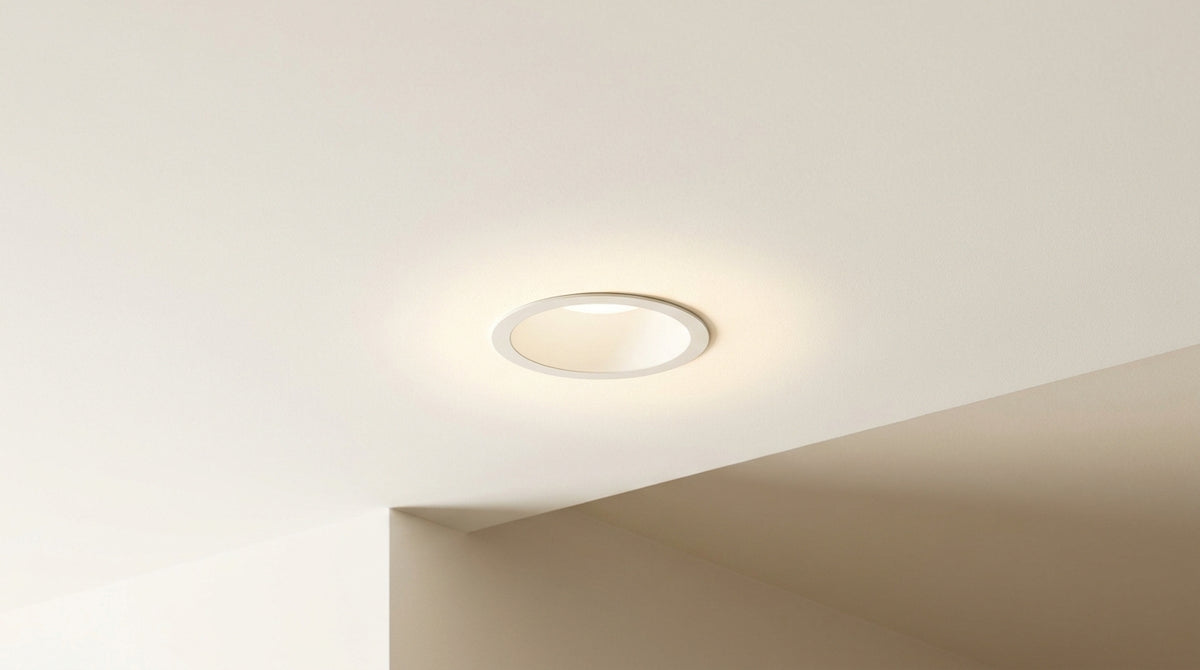
First, look at what is holding the light in place. A bare bulb unscrews, a bulb hidden behind a trim ring comes free with its ring, and a sealed unit is replaced as a whole spotlight. Three moves, three tools, and one reflex before touching any wire: switch off the circuit breaker.
This diagnosis takes two minutes and often saves you an unnecessary purchase. It becomes decisive when the replacement is part of a larger project: renovating a living room means fixing the position of the light points before painting, not after.
Should you change the bulb or the whole spotlight?
You replace the part that fails, not the rest. Accessible base and sound socket: a new bulb is enough. Cracked socket, broken spring or sealed LED unit: the whole spotlight needs replacing. Bare housing with no working support: you move on to the entire light fitting.
The clue is mechanical. What unscrews or unclips is replaced quickly. What resists without showing a socket is sealed, and that is where LED spotlights sold as a complete module take over.
How do you change a bulb in a recessed spotlight without clips?
Without clips, the bulb is held only by its base. Switch off the power, let it cool, press the face of the bulb with a clean cloth and unscrew it a quarter turn. Nothing to dismantle around it. Removing the bulb to change a spotlight without clips takes three moves, with no tools.
How do you change a bulb in a spotlight with a trim ring?
The trim ring comes off before the bulb, never the other way round. Pry the ring with your fingernails or a thin spatula: the assembly drops a few millimetres and frees the socket. Conversely, when the ring is attached, changing the bulb in a spotlight without a trim ring is done entirely on the base.
- Bulb only: visible base, sound socket, no tools needed.
- Bulb and its ring: the trim ring unclips, the bulb is changed underneath.
- Complete spotlight: cracked socket or sealed LED module, you replace the whole unit.
- Entire light fitting: nothing holds to the ceiling any more, you start again with a new model.
- Same base: the replacement is chosen in the same base, among bulbs with E27, E14 or GU10 bases.
| What you see on the ceiling | What you replace | Clue |
|---|---|---|
| Visible bulb, clean socket | The bulb | Nothing resists the quarter turn |
| Metal ring around the bulb | The bulb, ring refitted afterwards | The ring moves before the bulb |
| Flat block, no visible socket | The complete spotlight | Smooth surface, no grip |
| Round housing, cover without a bulb | The entire light fitting | Three wires visible in the housing |
If you would rather have the installation done for you and start again with a light designed for the room, asking Designix for advice saves you buying twice.
How do you remove a ceiling spotlight without damaging the paint?
Switch off the circuit breaker, then work flat against the ceiling. A spring-loaded spotlight comes free by pulling the collar straight down, without jerking. A bowl ceiling light unclips after a quarter turn. A flat spatula slipped between the cover and the plaster spreads the pressure.
- Breaker off: check the light is out before climbing the stepladder.
- Clean hands: a light-coloured ceiling marks at the first touch.
- Vertical pressure: pull along the axis, never at an angle.
- Flat spatula: it replaces the screwdriver, which scratches and chips the plaster.
How do you remove an LED spotlight from the ceiling without a spring?
Without a spring, the collar is held by friction or by two side screws. Look for the screw before pulling: on a screwed model, pulling marks the ceiling and breaks the cover. Dismantling is then done screw by screw, holding the spotlight with one hand.
How do you unclip a ceiling light?
A bowl turns a quarter turn, a screwed model comes free from the centre. The bowl stays hanging from the wire: support it before lowering it. For older models, our method for dismantling a ceiling light details the order: cover, then socket, then wire.
How do you replace a GU10 recessed spotlight?
Identify the base before buying. Switch off the circuit breaker, remove the bulb with a quarter turn, present the new one the same way, lock it with a quarter turn. A GU10 runs on 230 volts, a GU5.3 behind a transformer: the two are never swapped for one another.
| Base read on the old bulb | Power supply | What you check |
|---|---|---|
| GU10 | 230 V | Two flat, spaced pins |
| GU5.3 | 12 V, transformer | Two thin, pointed pins |
| E27 | 230 V | Large screw thread |
| E14 | 230 V | Small screw thread |
| G4 and G9 | 12 V or 230 V | Very short pins, ceramic base |
In a survey of 147 ceiling lights in our catalogue as of 29 September 2026, the E27 base is stated on 31% of the listings, integrated LED on 24%, E14 on 12% and GU10 on 8%. Replacing like for like therefore remains the rule. Once the base is identified, GU10 bulbs are chosen by their colour temperature and beam angle.
How do you change the bulb in a directional spotlight?
First point the head downwards to reach the base without forcing the joint. Hold the collar with one hand and the bulb with the other. A directional spotlight is then adjusted by hand, but the joint wears when you move it with the bulb in place: better to change the bulb head down and reset the tilt afterwards.
Which spotlight will you fit in its place?
How do you change a complete ceiling light?
The DCL is the round box fixed to the ceiling that powers the light fitting. Switch off the circuit breaker, remove the cover, unscrew the central screw, disconnect the three wires. The new light fitting is reconnected to the same box, without cutting or extending a single wire.
In the same survey of 147 ceiling lights as of 29 September 2026, 85% are surface-mounted and only 1% recessed. In practice, many replacements of recessed units end up as surface-mounted models.
- DCL box: live, neutral and earth, identified before disconnecting.
- Hook: it carries the weight of the light fitting and is refitted with the screw that held it.
- Cover: removed first, it gives access to the screws.
- Weight of the light fitting: a heavier model is mounted on a suitable fixing point, never on the wire alone.
How do you remove a DCL hook?
The hook is unscrewed after removing the cover, when it is held only by its central screw. Keep it: on a pendant light, it resumes its role. If you move to a flat model, a surface-mounted ceiling lamp is fitted directly to the box, without a hook.
How can I change the DCL box?
The box is rarely replaced, it is checked: three stripped wires, tight terminals, plastic without cracks, and it stays in place. Before reconnecting, identify the three wires, that is the only point where a mistake is costly, and the method for installing a light on a DCL box covers this identification step by step.
Which spotlight should you choose so you do not have to redo the ceiling in two years?
Aim for the warranty and the protection rating before the colour. In a survey of 147 ceiling lights in our catalogue as of 29 September 2026, 99% are guaranteed for 2 years, 97% state IP20 and 2% IP44. These figures rule out most mistakes before you even talk about aesthetics.
On the same date, the catalogue contains 4772 ceiling light references. Two families stand out in use: the LED ceiling light, supplied with its integrated light source, and the socket model, which lets you choose the bulb. The first saves you hunting for a base for years.
For colour, the survey gives 44% white, 39% black and 37% gold. Metal is stated on 82% of the listings, glass on 22%. Frosted glass softens the light and hides the source: a glass light fitting changes the feel of a living room more reliably than a gain in power.
- 2-year warranty: 99% of the survey of 147 ceiling lights, as of 29 September 2026.
- IP20: dry rooms, living room, bedroom, hallway.
- IP44: damp rooms, only 2% of the survey.
- Dimmability: stated on 12% of the survey, to check if you want to lower the light in the evening.
Which colour temperature for each room?
Warm, around 2700 K to 3000 K, in a living room or bedroom. More neutral, near 4000 K, in a kitchen or hallway where you work. Consistency matters more than the exact value: two temperatures in the same room are noticeable. The Living Room is the most stated room in the survey, 68%, the Bedroom 54%, the Kitchen 46%. The choice between white or yellow light is therefore made room by room, not home by home.
Which spotlight for a bathroom?
Aim for an IP44 rating near the shower, IP20 elsewhere in the room. The survey counts only 2% IP44 references against 97% IP20: the choice narrows quickly, so it is worth knowing before drilling. Replacing a bathroom spotlight requires the same check, seal included.
Reviews left by buyers are public and verifiable on the Designix Google listing, useful when the hesitation still concerns a model.
Spotlights and ceiling lights to replace yours
 Barn 3-light ceiling light, black and gold, Premium
 Barn 3-light ceiling light, black, Premium
 Square bathroom ceiling light | Quadris
 Barn 3-light ceiling light, black
 Gearwood Grey Industrial Ceiling Light
 Barn ceiling light, black
See the whole selection: Ceiling Light, Ceiling Lamp and Ceiling Lighting
On the same subject
In stock · shipping costs shown at checkout · up to 30% off in your cart


Ready to turn inspiration into reality?
Tell us about your room, your style and your budget, and we will show you the pieces that truly suit your project.
Get guidance in 30 seconds →