How to change a recessed spotlight bulb in a bathroom
This article is also available in French: Comment changer ampoule spot encastrable salle de bain
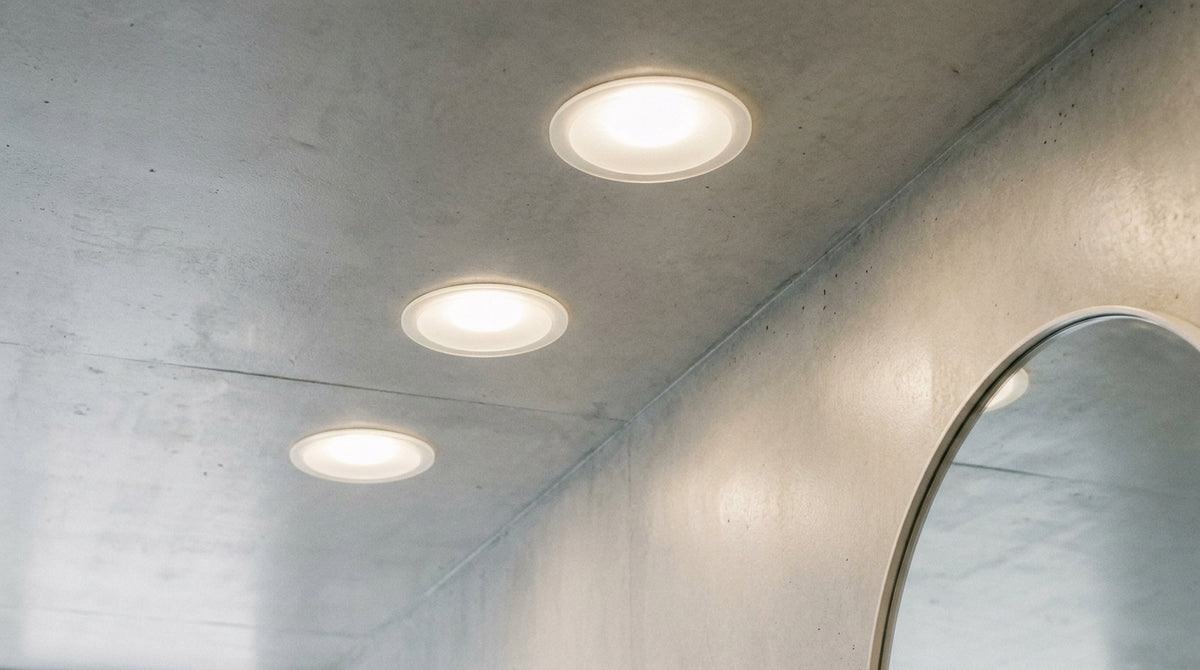
Switch off the power at the breaker, let the bulb cool down, then identify the type of spotlight before pulling anything: a sealed glass cover to unclip, a bezel with a ring, or a module held by two springs. This check takes ten seconds and saves you from breaking a seal or ripping out a spring.
How do you change the bulb of a recessed spotlight in a bathroom?
Three moves depending on the model: unclip the sealed glass cover with a quarter turn, release the ring from the bezel, or gently pull the module down. No tool is needed in most cases. The only exception is the single-unit spotlight with integrated LED, where you replace the module rather than the bulb.
Bathroom light is not about the ceiling, it is about the mirror. One spotlight that gives up above the sink is enough to dull a neat room. If you are using the replacement to rethink the whole room's atmosphere, remember that a bathroom renovation is decided by where the light points go, never by how many there are.
How do you change the bulb of a spotlight with a bezel
The bezel is the ring visible around the spotlight. It holds the glass cover, and sometimes the bulb itself.
- IP65 glass cover: palm of the hand on top, a quarter turn, it unclips.
- Screw ring: unscrew by hand, one full turn, never with pliers.
- O-ring: leave it on the glass cover, it is what restores the seal when you put it back.
- Bulb: press then quarter turn for a pin base, a simple pull for pins.
Each model has its own removal subtlety. The case of damp areas, seal and glass cover included, is detailed in our guide to changing the bulb of a bathroom spotlight.
How do you change a recessed LED spotlight in the ceiling
Up high, the difficulty is mostly keeping your hand steady. A step stool, both hands free, and the module comes down without force. If it resists, do not pull harder: it is almost always a forgotten spring or a locking screw.
In front of the mirror, a badly refitted spotlight shows immediately, the shadow returns under the eyes. It is the moment to check whether a better-placed bathroom light fixture would not settle the matter once and for all.
How do you change the bulb of a recessed spotlight without clips?
Look for the two retaining springs on the sides of the module. Pinch them between thumb and index finger at the same time, then pull two centimetres downwards. The module comes down and releases the base. Pinching just one spring is enough to put the spotlight back at an angle and damage the plaster.
How do you remove a recessed spotlight without clips?
The spring is a metal blade folded against the wall of the hole. Once the module is out, it stays splayed: that is normal, it will go back into place when you refit it.
- Two fingers on each spring, never just one side.
- Vertical pull: the module comes down straight, without an angle.
- Bulb removed before pulling on the wires, so as not to stretch them.
- Marker in the hole: a piece of tape on the sleeve before pulling everything out.
The general method, valid for all mountings, is covered step by step for changing the bulb of a recessed spotlight.
How do you change an integrated LED bulb?
When the bulb does not separate from the module, there is nothing to unscrew: the LED and its driver are one piece. You replace the complete module, or the driver alone if it is accessible on the side. Forcing a sealed module means breaking the spotlight.
And if a spring falls into the ceiling void, two options: reach through the neighbouring hole if the spotlights are aligned, or fix the new module with its own springs and leave the old one where it is.
What if the removal goes wrong?
A cracked seal, a socket that moves, a glass cover that no longer clips back: stop and refit the old bulb while you wait. Fitting a new fixture is sometimes wiser than insisting on a tired spotlight. Buyer feedback is available on Designix's Google listing.
A mounting without clips is hard to tell apart from a bezel mounting before removal. Identify the fixing type of your spotlight before pulling, so as not to damage the socket.
If the replacement changes nothing because the spotlight is old, recent recessed LED spotlights solve the problem at the source.
How do you choose the replacement bulb: base and colour temperature?
Note two pieces of information on the old bulb: the base and the voltage. GU10 and E14 run at 230 V, a G9 usually does too in most cases, while G4 ones often go through a 12 V transformer. For colour, count around 2700 K for warm white and 4000 K for neutral white.
Which base size for my spotlight?
The base is the socket. Confusing it with another model means a guaranteed trip back to the shop.
| Base | Shape | Voltage | Where you find it |
|---|---|---|---|
| GU10 | two pins, quarter turn | 230 V | recessed ceiling spotlights |
| G9 | two flat pins | 230 V | mirror spotlights, wall lights |
| E14 | fine thread | 230 V | small lamps, wall lights |
| G4 | very fine pins | often 12 V | mini spotlights, strips |
Unsure about the base size? Measure the gap between the pins with a ruler: a few millimetres change everything.
Warm white or neutral white in a bathroom?
A warm white around 2700 K relaxes and flatters the skin at the end of the day. A neutral white around 4000 K stays sharper in front of the mirror, for shaving or putting on make-up. The compromise that works: warm near the bathtub, neutral above the sink. The selection guidelines are covered in our article on white or yellow light.
How do you change a G9 halogen bulb?
The G9 socket holds by two flat pins pushed in, with no lock. Switch off the power, let it cool, then pull the bulb straight towards you. If it sticks, a slight sideways movement is enough. Never force the glass.
On the survey of 66 references from our catalogue as of 29 September 2026, 95% show LED technology and 97% a 3-year warranty. The base is always named there, without abbreviation.
- GU10: our GU10 LED bulbs cover ceiling spotlights.
- E14: E14 base bulbs fit small wall lights.
- G9 and G4: the selection of G9 and G4 bulbs covers halogen mountings.
You have identified the missing base but are still unsure about the colour temperature? Write to us, we will decide with you, from fixture to light.
GU10 and G9 bulbs for bathroom spotlights


Bathroom: why the IP rating changes everything
IP measures resistance to water and dust. In the splash zone of the shower or bathtub, you need an IP65 spotlight, protected by a glass cover and a seal. Further from the water point, IP44 is enough. An open spotlight, on the other hand, takes in moisture and oxidises from the inside.
Changing the bulb of an IP65 bathroom spotlight
A sealed spotlight goes back exactly as it came apart: glass cover, seal, quarter turn. The seal never goes back on crooked.
- IP65: 35% of the survey of 66 references in our catalogue as of 29 September 2026, resistance to water jets.
- IP44: 38% of the same survey, protected against splashes.
- IP54: 26% of the survey, limited dust and splashes.
- Dry seal: replace it if it cracks, otherwise the stated rating is worth nothing.
How do you light your bathroom like a spa?
A bathroom becomes restful when the light never comes from straight ahead. One indirect point behind the mirror, a second above the bathtub, and the eye rests without effort. The pitfalls to avoid are listed in our bathroom lighting mistakes.
To go further, the complete guide to lighting your bathroom like a spa details the layers of light, from shaving to bathing.
In front of the mirror, an LED wall light often replaces two spotlights and removes the shadows under the face.
Which recessed spotlight is on your bathroom ceiling?
On the same subject
In stock · shipping costs shown at checkout · up to 30% off in your cart


Ready to turn inspiration into reality?
Tell us about your room, your style and your budget, and we will show you the pieces that truly suit your project.
Get guidance in 30 seconds →