How many watts per m²: the right power for each room
This article is also available in French: Combien de watt par m2 lumière
Take the surface area of the room, multiply it by the light level you want, then convert to watts depending on the bulb. A 20 m² living room lit at 150 lux needs 3,000 lumens: a 30 W LED is enough, a halogen bulb needs 200 W. Watts come last in the calculation, never first.
How many watts per m² to light a room?
There is no universal number of watts per m²: the same surface area needs twice as much light in a kitchen as in a bedroom. So you start from lumens, then work back to watts depending on the bulb technology. W/m² is a result, not a starting point.
How do you set up the calculation for a 20 m² room?
Aim for 150 lux at floor level, then multiply by the surface area: 20 × 150 = 3,000 lumens. A 100 lm/W LED bulb needs 30 W, a halogen bulb 200 W. Two products, two consumption levels, one single quantity of light.
- Lumens: the light coming out of the bulb, the only stable basis for calculation
- Lux: the lumens received on a surface, so the real reading comfort
- Watts: the consumption, comparable only at equal technology
- Surface area: the room to light, with a margin if the walls are dark
Why are the watts per m² figures in tables misleading?
These tables come from incandescent bulbs, where one watt always produced the same light. That is no longer true: two 8 W light fittings can output 600 or 1,100 lumens. Check the lumen output first, the wattage second.
These benchmarks change from one room to another, especially for mounting heights and colour temperatures. Our team details them room by room in our decor advice.
Watt, lumen, lux: what does each unit really measure?
The watt measures energy consumed, the lumen the light emitted, the lux the light received on a surface. An 8 W light fitting can light as much as an old 60 W bulb. Since LEDs, it is the lumens per watt ratio that separates two products, not their stated power.
| Unit | What it measures | Where to find it |
|---|---|---|
| Watt | Electrical consumption | On the packaging |
| Lumen | The light emitted by the bulb | On the packaging |
| Lux | The light received by the room | By calculation |
What does watt mean on a product page?
The watt indicates consumption, nothing else. A 9 W bulb draws 9 watts from the mains, whatever light it produces. The volt measures voltage, not power: 230 volts does not indicate any number of watts. In a survey of 250 references from our catalogue on 29 September 2026, 82% of the completed product pages mention LED, i.e. 205 pages out of 250.
Why is the watt no longer the unit of choice since LEDs?
For the same light, an LED uses several times less than a halogen. Comparing two bulbs by watt is like comparing two cars by fuel tank size. The useful benchmark remains efficiency, in lumens per watt. Understanding the difference between lux and lumens avoids oversizing a room.
How many watts per m² depending on the room and use?
The question turns around: better to multiply sources than push a single point to high power. A room works with three or four lights at different heights, all LED, rather than one oversized central ceiling light. Distribution creates comfort, the watt only creates the bill.
What lighting for a 20 m² room?
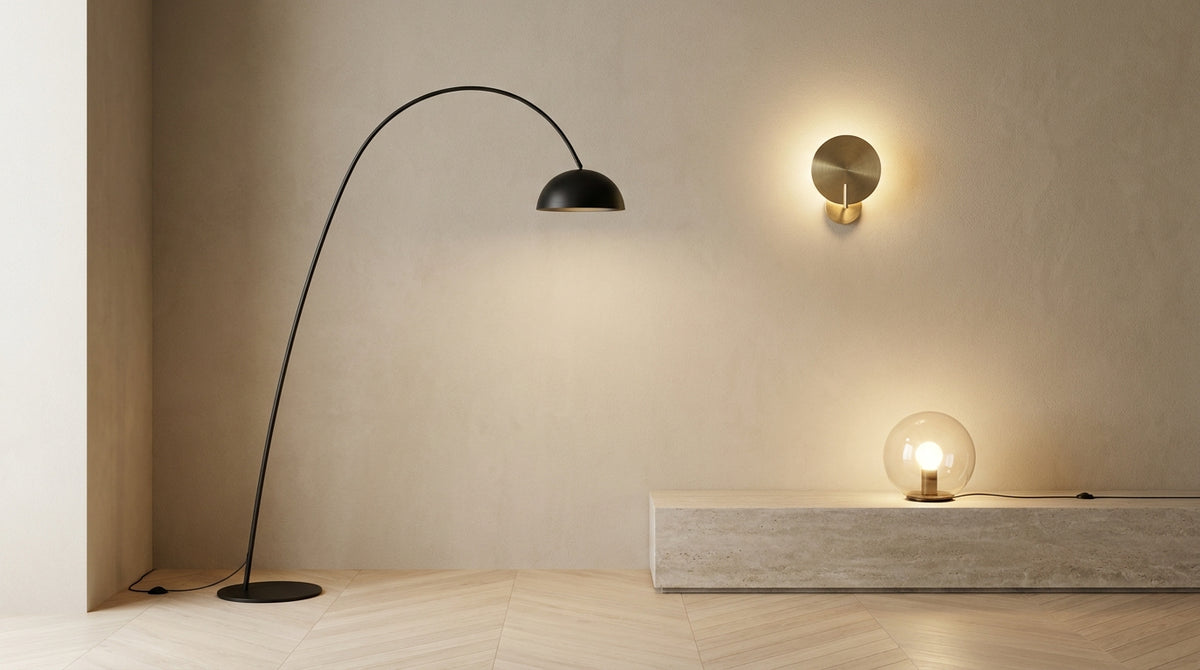
A 20 m² living area combines a pendant in the centre, a floor lamp near the sofa and a wall light as backup on a free wall. Each source stays modest, and together they cover the room without glare. Above a table, a dining room chandelier is often enough on its own.
Should spotlights be counted per square metre or per room?
Recessed spotlights are the only ones counted per square metre, because they are laid out in a regular grid. Elsewhere, you count by use: reading, cooking, moving around. A well-planned layout, where the number of spotlights per m² depends mainly on ceiling height, avoids shadow areas.
In a kitchen, a kitchen pendant placed over the island and worktop lighting are better than a single ceiling light. Here are the levels that come up most often:
- Bedroom: 80 to 100 lumens per m², soft light and a dimmer if possible
- Living room: 150 to 200 lumens per m², spread across three sources
- Kitchen: 300 lumens per m² on worktops
- Bathroom: a model designed for wet rooms, never a bare light fitting
In the same survey of 250 references on 29 September 2026, IP20 covers 94% of the product pages: a wet room therefore requires a separate choice, deliberately more protective.
Your calculated power: the light fittings that deliver it, room by room
 Barn 3-light ceiling light, black and gold, Premium
 Barn 3-light ceiling light, black, Premium
 Gravity 6-light pendant, black, opal glass
 Barn 3-light ceiling light, black
 Aurore Boréale wall light | Rian
 Wood and black wall light | Fusion Élégante
See the whole selection: Alternative Laurie Lumière: your new lighting destination | Designix
How many lumens per m² should you plan for?
Allow 80 to 100 lumens per m² in a bedroom, 150 to 200 in a living room, 300 on a kitchen worktop. These benchmarks are multiplied by the surface area, then converted to watts depending on the bulb's efficiency. Lumens remain the only unit that is accurate from one technology to another.
Are 1000 lumens enough to light well?
1,000 lumens light a hallway, corridor or reading corner very well, but not a 25 m² living room. It all depends on the surface area receiving them: they give 100 lux over 10 m² and only 40 lux over 25 m². Surface area always divides the output.
How many watts is 3000 lumens?
About 30 W with a 100 lm/W LED, 60 W with a 50 lm/W bulb, and up to 200 W with a halogen. Efficiency decides everything, without exception. The benchmark for how many lumens per m² therefore comes before choosing the power.
Then there is the object itself. In a bedroom, an adult bedroom wall light frees up the bedside table and brings the light closer to the book. In a living room, a glass light fitting diffuses a softer light than an opaque shade.
What does a light fitting's watt hour really cost?
Multiply the power in watts by the hours it is switched on, then divide by 1,000: you get kilowatt hours. A 9 W LED switched on for 4 hours a day uses a little more than 1 kWh over a month. All that remains is to apply your bill's rate.
How much does 1000 watt hours cost?
1,000 watt hours equal 1 kilowatt hour. The amount depends entirely on your supplier's rate, written in euros per kilowatt hour on the bill. Multiply that rate by the light fitting's annual consumption. A comparison table of LED bulbs shows the real difference between two technologies.
How do you calculate consumption in kilowatt hours?
Note the power on the packaging, estimate the actual hours switched on, apply the formula power × hours ÷ 1,000. A 20 W ceiling light used 3 hours every evening stays under 22 kWh per year. The same light in halogen exceeds 130 kWh, for identical comfort.
Changing the bulb almost always costs less than changing the light fitting. E27 bulbs cover most pendant models. And a floor lamp fitted with LEDs lights an entire room for just a few watts.
If you would rather start from a room-by-room plan than a general figure, our contact page puts you directly in touch with the team.
These benchmarks are easier to check by seeing the lights switched on. La Maison Designix has 21,057 lighting references as of 29 September 2026, sorted by room and by style.
Which room do you want to light properly first?
On the same subject
In stock · shipping costs shown at checkout · up to 30% off in your cart


Ready to turn inspiration into reality?
Tell us about your room, your style and your budget, and we will show you the pieces that truly suit your project.
Get guidance in 30 seconds →