Can you replace a fluorescent tube with an LED tube? The guide
This article is also available in French: Peut on remplacer un tube fluo par un tube led

Switch off the breaker, check that there is no current with a tester, then measure the length between the two sockets. Note the cap: G13 for a T8, G5 for a T5. Locate the ballast and the starter before ordering. An LED tube with the right cap replaces the old tube in most fluorescent light fittings.
Can you install an LED tube in a fluorescent light fitting?
Yes, in most cases. Three conditions are enough: the same length, the same cap, and a circuit suited to operation without a ballast. The LED tube then slides into the original sockets, without changing the fixture or drilling a new hole in the ceiling. The job takes a few minutes.
Replacing the tube fixes the light on the worktop, not the look of the room. If you are renovating everything, a kitchen and dining room renovation should also be thought through in terms of light, starting with the choice of volumes.
And if you would rather start from a new light fitting than swap a tube, the designer LED lighting collection is chosen by room and by use.
What is the difference between a fluorescent tube and an LED tube?
A fluorescent tube lights a gas and needs a ballast to do so. An LED tube contains diodes and only needs a suitable power supply.
- Mercury: present in fluorescent tubes, absent from LED tubes.
- Starting: immediate with LED, sometimes slow with fluorescent in a cold room.
- Humming: specific to magnetic ballasts, it disappears with them.
- Colour temperature: fixed on a fluorescent tube, free on LED, from warm white to cool white.
What are the drawbacks of LED lamps?
They exist, and three deserve your attention before buying.
- Uneven light quality: two tubes of identical power can produce very different whites depending on the manufacturer.
- Old dimmers: some make an LED tube flicker. Check for the dimmer mention on the product sheet.
- Real lifespan: it depends on the built-in driver as much as on the chip. An entry-level tube dies well before its time.
- Flicker: with a cheap driver, the effect becomes noticeable in peripheral vision.
How do you fit an LED tube on an old fixture?
Three steps, in order: switch off at the breaker, measure between the sockets, then adapt the circuit. With a magnetic ballast, remove the ballast and the starter, then power the tube directly. With an electronic ballast, remove the ballast and rewire both ends.
Check the cap and the length before ordering
| Tube | Diameter | Cap |
|---|---|---|
| T8 | 26 mm | G13 |
| T5 | 16 mm | G5 |
Measure from one socket to the other, never the glass alone. A tube two centimetres too long will not fit, and its immediate neighbour will not light the same way.
Ballast and starter: what to remove, what to keep
- Magnetic ballast: heavy and hot, it often hums. It is removed, and the tube is powered directly.
- Electronic ballast: slim and silent, it determines the rewiring.
- Starter: it only exists with a magnetic ballast. Without a ballast, it is removed or becomes a dummy.
- Sockets: keep them, they hold the new tube.
The rewiring changes depending on the type of ballast. Our guide on and what about the ballast covers the direct connection, wire by wire.
One question comes up when reconnecting, and the answer saves a lot of trial and error: does an LED tube need a starter? No, as soon as the ballast leaves the circuit.
If the old starter stays in place, it is better to understand its role before leaving it: our article on changing a fluorescent starter also explains its replacement with a dummy model.
Every installation has its constraints: ceiling height, number of tubes, condition of the wiring. If any doubt remains on one of these points, you can describe your setup to us before ordering.
Can you replace a fluorescent tube with an LED tube in a kitchen, a garage or an aquarium?
Yes in all three cases, but not with the same tube. A kitchen wants a neutral white and enough flux on the worktop, a garage a high protection rating, an aquarium a spectrum compatible with the plants or the fish.
Kitchen and worktop
Under a wall unit, an LED tube at 4000 K renders colours accurately without tiring the eye. 3000 K, warmer, suits an open-plan room better.
The real question is not power but flux. Our guide on how many lumens per m2 gives the basic calculation, surface by surface.
The doubt between the two shades is quickly resolved: warm or cool light, the choice is made according to the room and the time of use.
To replace a tired tube with a coherent set, the kitchen lighting collection is read by use: worktop, island, circulation.
Garage and workshop
Here, the light must be bright and robust. Aim for a high protection rating if the workshop is damp or dusty, and a neutral shade to distinguish nuances.
- IP65: damp room, jet washing, open shelter.
- IP44: dusty workshop, unheated garage.
- IP20: dry room, storeroom, home office.
- Two light points are better than one: cast shadows disappear.
A wide LED ceiling light covers a work area better than a single tube moved three times.
Aquarium
The LED tube also works above a tank, but the logic changes: it is the spectrum that matters, not just the power. Ambient light makes the water dull and tires the plants.
A dedicated model, in the right length and the right shade, replaces an ageing fluorescent tube that has lost its rendering. Our article on replacing a fluorescent tube room by room applies the same method.
What should you replace a fluorescent tube with when you also want more style?
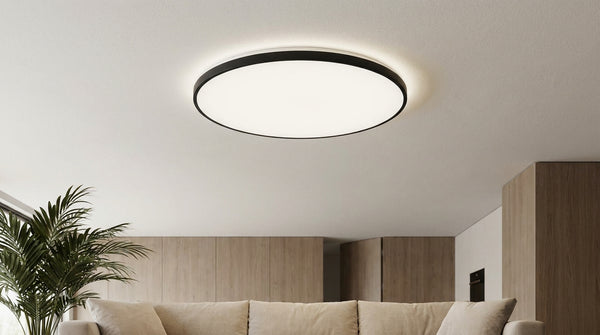
With an LED light fitting that keeps the function of the fluorescent tube and drops its look. A linear profile for continuity, a pendant to mark a table, a ceiling light to light widely, a wall light to free the worktop. The light stays, the grey tube disappears.
Designer LED lights to replace a fluorescent tube


Which room is your fluorescent tube in?
The linear light fitting, when you need to keep the line
A long profile on the ceiling replaces the tube without visual break, thinner and without a starter. It is the choice that requires the least work when the wiring is already in place. Our article on long light fittings details the available formats.
Pendant, ceiling light or wall light: the choice by room
The right light fitting is decided in this order: use first, room second, style last.
- Pendant: above a table or an island, the light comes down to the use.
- Ceiling light: in a circulation area, a laundry room or a garage.
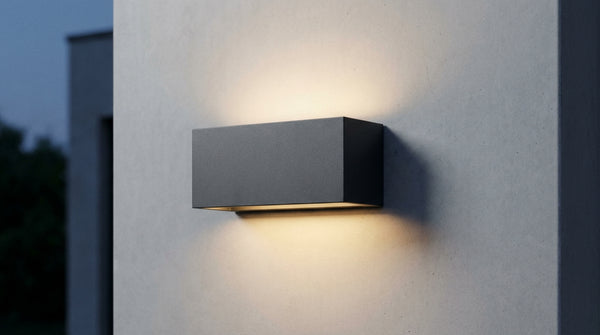
- Wall light: to light a worktop without touching the ceiling.
- Linear light fitting: to take up the line of the fluorescent tube in a thinner version.
Above a table, a pendant light concentrates the light where you eat, which a ceiling fluorescent tube cannot do.
In a living room, a glass light fitting diffuses a soft light that the tube does not produce.
Our Applique tube collection has 127 references as of 29 September 2026. On a sample of 66 of them on that date, 98% are Tube-shaped, 85% are IP20 and 100% carry the CE marking. On the same sample, 61 of the 66 product sheets declare LED technology.
The selection is reviewed by buyers, and the current rating can be read directly on the Designix Google listing.
In stock · shipping costs shown at checkout · up to 30% off in your cart


Ready to turn inspiration into reality?
Tell us about your room, your style and your budget, and we will show you the pieces that truly suit your project.
Get guidance in 30 seconds →