
Calculating room lighting: lumens and lux per m²
This article is also available in French: Comment Calculer La Quantité D'Éclairage Nécessaire Dans Une pièce
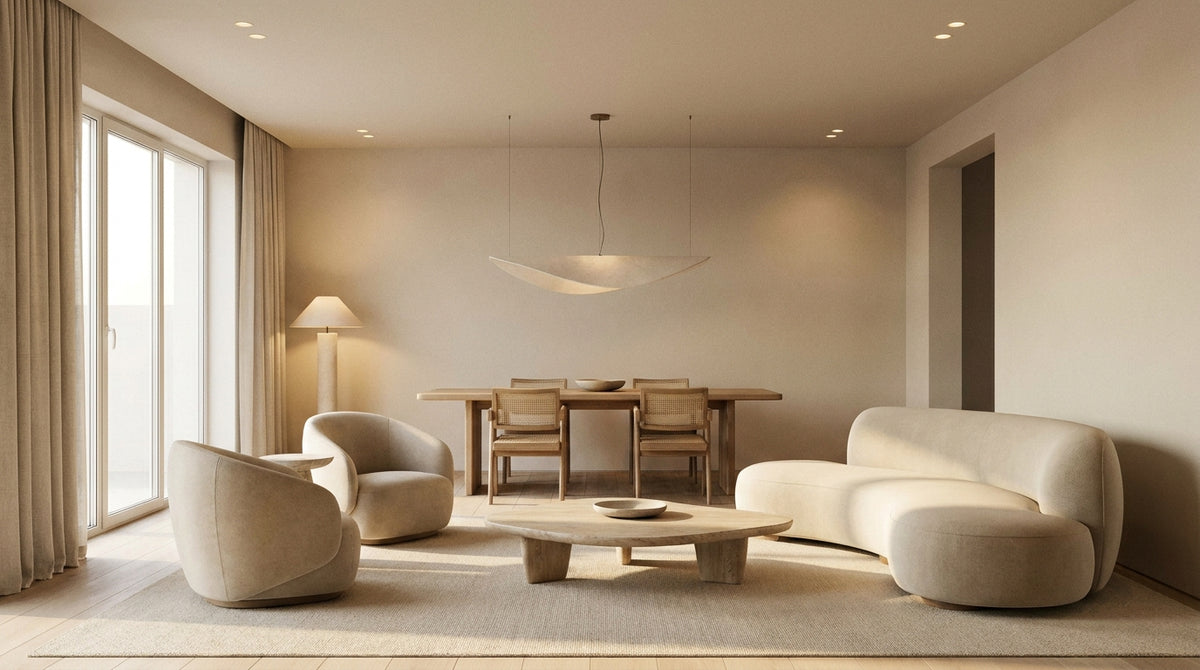
Multiply the surface area in m² by the recommended lux: count 3,000 lm for a 15 m² living room (200 lux), 4,500 lm for a 15 m² kitchen (300 lux). Then divide this total by the output of a single source to determine the number of light points to distribute.
How to calculate the amount of lighting needed in a room?
Apply the formula: lumens = surface area (m²) × recommended lux. For a 20 m² living room at 200 lux, aim for a total of 4,000 lm. Then add up the output of each source—ceiling light, floor lamp, and accent lamp—until you reach this figure, rather than relying on a single central point.
Lighting is the set of all sources that provide light to a space: flux emitted is measured in lumens and light received in lux (1 lux = 1 lumen per m²). Flux is read on the packaging, never in watts, which only indicate consumption. For a result without shadows, it is better to choose your light fixtures based on their actual flux and combine several light heights.
How to calculate the total luminous flux?
Add the lumens of all sources in a single room to get the total luminous flux. A 15 m² living room at 200 lux requires 3,000 lm: one 1,800 lm pendant light plus two 600 lm lamps are sufficient, without overloading a single point.
How to calculate illuminance in lux?
Divide the lumens received by the surface area: 4,000 lm over 20 m² gives 200 lux. To size your lighting, invert the formula: desired lux × surface area = lumens to install. A simple reminder to understand lux helps avoid confusing emitted light with received light.
Why does the received lux differ from the emitted lumens?
The lux measured on the floor is always lower than the emitted lumens because light disperses and is absorbed. Plan for 10% to 15% more flux per meter beyond a 2.5 m ceiling height, and up to a 20% margin for dark walls, which reflect less than light-colored walls.
Once you know your total lumens, you can check with an advisor to distribute these sources without creating dark spots.
How many lumens per m² depending on the room?
Plan for 100 to 200 lux for a living room or bedroom, 300 lux for a kitchen, 300 to 500 lux for an office, and 150 to 200 lux for a dining room. Multiply these lux by the surface area: the same room requires twice as many lumens in the kitchen as in the bedroom.
- 15 m² bedroom, 100 lux: 1,500 lm
- 15 m² living room, 200 lux: 3,000 lm
- 15 m² kitchen, 300 lux: 4,500 lm
- 15 m² office, 400 lux: 6,000 lm
For equal flux, the result depends on the type of source: based on a review of 219 items in our catalog as of September 23, 2026, 79% are labeled LED, which are more stable in lumens than old filament bulbs.
Sources to reach your lumen target
 Glass ball pendant light, modern gold and black design | Sphère Céleste
 Danish pendant light | Cocoon
 Tree pendant light | Lueur Sylvestre
 Modern black and gold designer wall light for living room | Gravity
 Pendant Light | Lotus
 Wine Glass Pendant Light | Esprit Vinicole
See the whole selection: Decor by Room, Living Space Planning, Decor Ideas
How many lumens per m² for a dining room?
For a dining room, count 150 to 200 lux: an 8 m² table in a 12 m² room aims for about 2,400 lm above the tabletop, supplemented by softer ambient lighting on the sides.
A dining room chandelier suspended 75 to 85 cm from the tabletop concentrates the flux where you eat without dazzling guests.
What lighting for a 20 m² room?
A 20 m² room at 200 lux requires 4,000 lm. Distribute them between a central ceiling light and two accent sources rather than just one point to eliminate shadows in the corners.
Flux depends on the bulb: checking which bulb wattage to choose based on the base helps avoid installing a source that is too weak for the surface area.
How to calculate the number of ceiling spotlights?
Divide the total desired flux by the flux of one spotlight, then distribute the result in a regular grid. For 4,000 lm with 400 lm spotlights, install 10 spotlights spaced approximately 1 to 1.5 m apart, 30 cm from the walls to avoid dark zones.
How many spotlights per m²?
Count on average one 300 to 400 lm spotlight per m² for general lighting, more for a work surface. A 20 m² living room works with 8 to 10 spotlights; a kitchen, which is more demanding, requires a third more.
Choose the flux before the design: LED spotlights with homogeneous flux avoid dark spots between two points.
How many spotlights are needed for 50 m²?
For 50 m² at 200 lux, you need 10,000 lm: approximately 25 spotlights of 400 lm, or fewer if you combine spotlights with pendant lights. On a low ceiling, use many low-flux points rather than one powerful light source.
In a large space, an LED ceiling light as a supplement to spotlights raises the general level without multiplying drilling.
Which room are you looking to light?
How many lumens for outdoor lighting?
Count 300 to 500 lumens for an entrance or doorway, 100 to 200 lumens per pathway bollard, and 700 to 1,300 lumens to light a terrace. Direct the flux toward the ground to limit glare and unnecessary light pollution toward the sky.
What LED wattage for outdoor lighting?
An 8 to 15 W LED delivers 800 to 1,500 lumens, sufficient for most facades. Above all, the ingress protection (IP) rating is paramount: on our list of 219 references as of September 23, 2026, 84% show an IP20 rating reserved for dry interiors, while outdoor use requires at least an IP44, and an IP65 for areas exposed to heavy rain.
To create a consistent outdoor terrace lighting scheme, alternate low-level path lighting with grazing light on walls.
How many lumens per room and per space should be planned?
The right benchmark per room is quickly summarized: about 1,500 lm for a 15 m² bedroom, 3,000 lm for a living room, 4,500 lm for a kitchen, and nearly 100 lm per square meter of hallway or stairwell.
If you have any hesitation about a light source, the Designix Google profile gathers feedback from buyers on our light fixtures.
In stock · shipping costs shown at checkout · up to 30% off in your cart


Ready to turn inspiration into reality?
Tell us about your room, your style and your budget, and we will show you the pieces that truly suit your project.
Get guidance in 30 seconds →


