Pendant or ceiling light in the kitchen: the right light for each zone
This article is also available in French: Suspension ou plafonnier cuisine
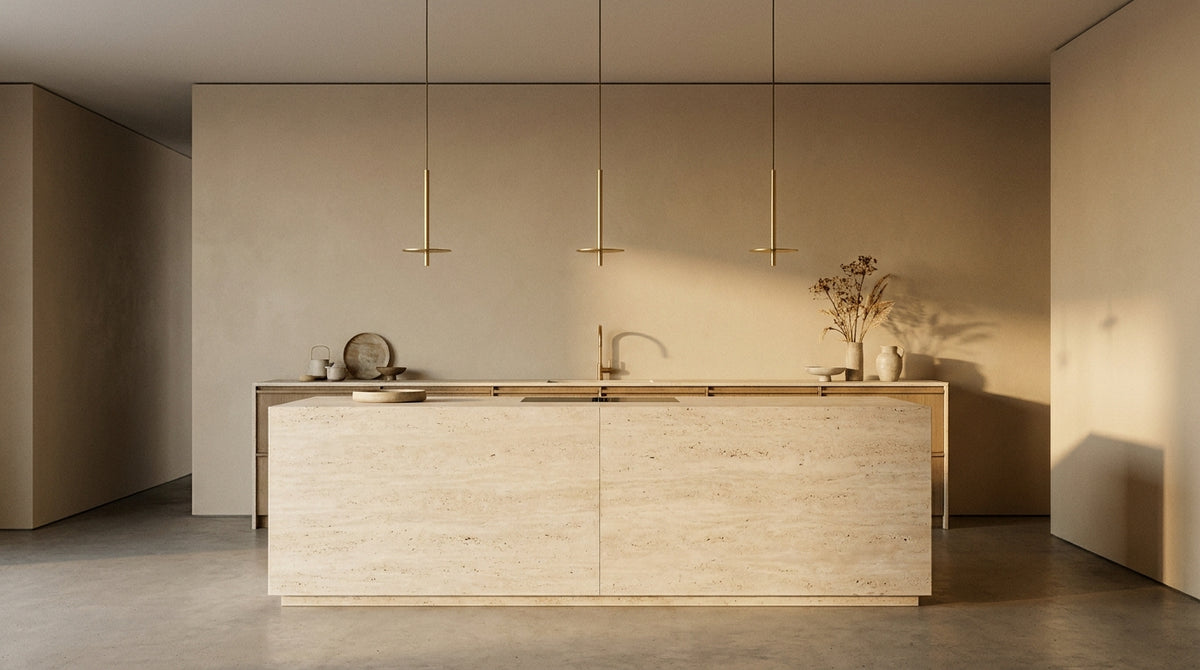
Hang a pendant above each work zone, 75 cm from the worktop and 60 to 70 cm above a table, and keep the ceiling light for walkways, small kitchens and low ceilings. A kitchen is lit zone by zone, not with a single point in the centre.
Pendant or ceiling light in the kitchen: what to choose for your layout?
The pendant hangs above the island and the worktop, the ceiling light stays above walkways and in low rooms. Decide zone by zone: each light point answers a task. Before comparing shapes, check the adjustable cable, the first criterion in a selection of kitchen chandeliers.
What the pendant changes above an island
It brings the light down within reach of your hands, where your eyes and the knife work. It also draws a boundary in an open room without putting up a partition.
- 75 cm between the bottom of the shade and the worktop, adjusted to the height of the people using it
- Shade closed at the bottom: the light falls on the prep area instead of spilling into the room
- Landmark effect: three aligned points separate the kitchen from the living room better than a change of floor
- Constraint: you need a ceiling anchor point, or a false ceiling to run the cable
What the ceiling light handles in a kitchen you walk through
Fixed to the ceiling, it drops nothing into your field of view and leaves the passage clear between units. It is the choice that avoids bumping your head and lights broadly, with no harsh point.
- Clearance: nothing below 2 m, decisive in a narrow kitchen corridor
- Spread light: the light covers the whole room, not just the worktop
- Maintenance: little grease splatter up high, a cloth is enough
- Style: the LED ceiling light with a flat diffuser blends into the ceiling, letting the units take centre stage
What is the ideal pendant height for a kitchen?
Allow 75 to 80 cm between the bottom of the shade and the worktop, and 60 to 70 cm above a table. Measure with the shade in place, never from the top of the cable. Under a 2.50 m ceiling, that leaves about 1.70 m of cable to store.
| Zone | Height below the shade | Measuring reference |
|---|---|---|
| Worktop and island | 75 to 80 cm | shade mounted, tape measure on the worktop |
| Kitchen table | 60 to 70 cm | above the tabletop, not the knees |
| Walkway | no object below 2 m | ceiling light or wall light rather than pendant |
Above a worktop or an island
A low point lights the prep and cooking area provided it stays out of your field of view when you stand. Too high, it lights the room; too low, it gets in the way of your movements.
- Wide shade: the wider it opens, the lower it must hang to keep light on the worktop
- Anchor point: check its position before drilling, a 20 cm offset shows
- Adjustment: a height-adjustable pendant can be corrected after installation, without removing the fixing
On a side wall, a kitchen wall light complements the pendant and avoids a second ceiling point above the same worktop. The collection has 1,578 references as of 16 November 2026, enough to find the right projection when the wall is close to the worktop.
Above a table and in a passage
When the kitchen opens onto the dining room, the tabletop sets the measure, not the worktop.
- 60 to 70 cm above the tabletop, raising to 80 cm if the table doubles as a desk
- Passage: nothing hanging below 2 m between two units
- Cooking zone: the pendant stays clear of the extractor hood, never in its axis
An open kitchen is treated as a single room, with two circuits: one above the island, one above the table. That is the basic principle of a kitchen and dining room lighting project, which avoids multiplying points without logic.
Installation comes down to two steps: fix in the right place and run the cable without kinking it. Installing a hanging light on the ceiling is therefore prepared before drilling, not after.
Is your ceiling sloped or does the anchor point fall beside the worktop? Take the time to describe your kitchen to us: we answer on the fixing before you buy.
Which type of ceiling light for a kitchen?
An LED ceiling light with a wide diffuser, in neutral white light, covers an average kitchen without leaving shadows under the units. Choose it for walkways and the centre of the room, not to replace the point above the worktop. Useful light output is read in lumens, never in watts.
The LED ceiling light above worktops
Mounted in the centre, it mainly lights the floor. For it to serve the worktops too, it must come down a little or be paired with a low point above the work area.
- Diffuser: opal glass softens hard shadows and glare when you look up
- Temperature: 3000 K remains the best compromise between readability and warmth in a kitchen
- Dimming: a dimmer makes the same fixture useful for prep and for dinner
Across a sample of 131 references from our catalogue as of 16 November 2026, 96% state LED technology and 98% an IP20 protection rating. Sockets are split between G9 (37%), E27 (21%) and GU10 (19%): three bulb families that are easy to replace.
Light output is calculated room by room, and how many lumens for a kitchen depends above all on wall colour and whether there is an island.
Small kitchen and low ceiling, the case where it wins
Below 2.30 m, the pendant becomes an obstacle and the ceiling light is no longer a compromise, it is the only comfortable option.
- Under 6 m²: a single ceiling light is enough, complemented by light under the wall units
- Ceiling below 2.30 m: no protruding object above the passage
- Through room: two small-diameter ceiling lights are better than one large one in the centre
Above 2.60 m, the gap between units and ceiling is filled differently: a large-diameter designer ceiling light fills the height without dropping into the walkway.
How many pendants above an island, and at what spacing?
One pendant every 60 to 80 cm, in an odd number: two for a 1.60 m island, three beyond 2 m. Keep at least 40 cm between two shade edges. The number is decided by the usable length of the island, not the floor area of the room.
| Island length | Number of points | Spacing between centres |
|---|---|---|
| 1.20 m to 1.60 m | 2 | about 70 cm |
| 1.80 m to 2.40 m | 3 | 70 to 80 cm |
| over 2.60 m | 3 or 5 | 65 to 75 cm, never 4 |
The trio of aligned lamps
Three evenly spaced points create a rhythm and light each work station on the island, sink included. Alignment matters more than the shape of the shades.
- Centres: measure from the ends of the island, not from the wall
- Identical height: a 3 cm difference between three lamps is immediately visible
- Diameter: the wider the shade, the more the spacing must follow
Long island, two points or three
On a narrow island, two wide pendants balance better than three small ones. On a deep island, the question changes: two rows are justified.
- Island less than 80 cm deep: a single row, centred
- Deep island: two points per row, offset by the width of a shade
- Reference: the light must fall flat on the worktop, with no visible cone on the sides
When the points multiply, even spacing holds it all together: balancing several pendants above an island is a matter of centimetres, not intuition.
Which pendant for a kitchen: wood, black metal or glass?
Wood warms a bright kitchen without darkening it, black metal structures a mineral worktop, glass lets light through and fades above a bar. The choice is above all a matter of decor: all three materials exist in LED versions, so the technical side does not decide.
Wood that warms without darkening
A light wood shade diffuses a warm, matte light with no reflection on the worktop. It works well above a white kitchen or a light laminate worktop.
- Light wood: oak, ash, bamboo, they brighten a north-facing room
- Shape: round shapes and openwork cast soft shadows, never hard spots
- Maintenance: a dry cloth, no greasy product that marks the grain
To warm the room without changing the whole space, kitchen floor lamps and wooden pendants combine well with a mineral worktop.
Metal and glass above a worktop
Black metal draws a clean line and suits industrial or very graphic kitchens. Glass, on the other hand, fades away and lets the ceiling show through.
- Black metal: strong contrast, best kept for rooms that are already bright
- Clear glass: no cast shadow, ideal above a bar
- Smoked glass: reduces glare from a visible bulb
- Mix: an industrial metal and wood pendant softens an overly mineral interior
Pendants and ceiling lights for the kitchen


The extractor hood, the sink and steam
Around the sink and the hob, grease and steam rise. A low pendant loses its shine there within a few months.
- Extractor hood: no fixture in its axis, the pendant stays at least 40 cm away
- Sink: splashes wet a low shade, a protected wall point is safer
- Protection rating: 98% of the sample of 131 references state IP20, sufficient away from splashes, not right above the sink
- Reliability: in the same sample, 82% state a 5-year warranty and 100% CE certification
Unsure how a specific model will hold up? The Designix Google listing gives up-to-date buyer feedback, without frozen figures in this article.
Sloped ceiling or off-centre anchor point
A slope means lengthening the cable on one side and shortening it on the other. The anchor point, for its part, cannot be moved without work.
- Slight slope: an adjustable cable per point brings the shades back level
- Steep slope: an angled ceiling rose or a rigid rod avoids a cable that sags
- Off-centre point: a rail or a multi-point ceiling rose recentres the line without drilling elsewhere
- Partition: the cable is hidden in a painted trunking, never left loose
In stock · shipping costs shown at checkout · up to 30% off in your cart


Ready to turn inspiration into reality?
Tell us about your room, your style and your budget, and we will show you the pieces that truly suit your project.
Get guidance in 30 seconds →