Best powerful solar floodlight: how to recognise it
This article is also available in French: Meilleur projecteur solaire puissant

Aim for 1000 to 1500 useful lumens to light an entrance or a courtyard, and up to 3000 if the beam must cover a whole driveway. Then check two details on the spec sheet, IP65 and the runtime calculated on your facade's actual exposure. The rest is decided at installation.
How many lumens do you really need for a powerful solar floodlight?
To secure an entrance, a courtyard or a garage, aim for 1000 to 2000 sustained lumens. A powerful solar floodlight is not the one showing the biggest number, it is the one still holding that brightness three hours after nightfall.
Out of the 37,363 references in our Top Best Sellers selection as of 29 September 2026, we reviewed 219 listings, and 3% of them carry the IP65 rating. Weatherproofing is therefore read on the spec sheet, it is not assumed. It is the first filter before looking at an outdoor light more closely.
| The figure shown | What it actually means |
|---|---|
| Lumens | Maximum flux, often measured in boost mode, for a few seconds |
| Panel watts | Recharging capacity at midday, not brightness |
| Stated runtime | Duration at reduced power, rarely at full intensity |
| IP65 | The rating that allows durable outdoor installation |
20,000-lumen solar floodlight: what does that figure really mean?
It describes a peak measurement, obtained for a few seconds, often taken without the battery in the loop. Sustaining that flux all night would require a reserve that a facade panel cannot rebuild in December. Ask for the sustained flux, and how long it holds at that level.
What is the difference between panel watts and delivered lumens?
Watts measure what the panel harvests during the day, lumens what comes out of the fixture at night. Between the two there is a battery and a conversion efficiency.
- Panel watts: the possible recharge at midday, under a clear sky.
- Battery capacity: the reserve actually available for the evening.
- Sustained lumens: the only figure that describes what you will see from your table.
A 30 m² courtyard and a simple landing do not call for the same answer, and how many lumens for outdoor lighting gives the reference per surface area.
These three values are read together, because their ratio sets the LED power for outdoor use that the battery genuinely sustains, evening after evening.
Which solar floodlight with motion sensor should you choose?
Look for a 180-degree detection angle and a range of 6 to 8 metres for a driveway, gate or garage. Below that, blind spots remain. Beyond it, the light switches on for a passing cat. Then set the hold time and the sensitivity threshold, those are what make it comfortable.
What range covers a driveway without blind spots?
Measure the distance between the mounting point and the far end of the area to watch, then subtract one metre, that is the useful range. On a long property entrance, a long-range sensor floodlight switches on before the person walks into the dark. Two well-placed units often do better than a single one pushed to the max.
What should you do when the facade faces north or the panel is in shade?
Move the panel, not the floodlight. A panel relocated onto a pole or a better-exposed wall powers a unit installed elsewhere, if the cable allows. Without proper exposure, a powerful solar outdoor light with sensor remains a mid-season backup, never a winter security solution.
- North-facing facade: relocated panel, or wired power as a backup.
- Tree shade: shifting the panel by two metres is often enough.
- Winter: runtime drops with sunshine, plan a second light point.
What is the most powerful solar floodlight for a facade?
The most powerful is not the brightest, it is the one whose battery recharges in your actual exposure. A south-facing facade with no obstruction keeps the promise of a 2000-lumen unit. The same reference on a north wall becomes a night light.
That is why a well-exposed solar outdoor lamp often beats a model twice as powerful placed at the wrong angle.
How do you calculate real runtime based on your sunshine?
Note the hours of direct sun the panel receives in December, the least favourable month. Remove overcast days, then compare the recharge obtained with the night-time consumption you want. If the maths does not work out, add a light point or go back to wired.
If you are hesitating between two power levels, or between a facade installation and a pole installation, describe your site and we will reply with a reasoned recommendation. Simply write to us with the exposure, the area and the intended height.
Why do two small floodlights beat a single very powerful one?
Because light adds up. Two well-aimed 1000-lumen points cover two areas without blinding anyone, whereas a single very powerful unit creates a harsh contrast and drains its reserve early in the evening.
Outdoor and solar lights from the selection
 Glass sphere pendant light, modern gold and black design | Sphère Céleste
 Danish pendant light | Cocoon
 Tree pendant light | Lueur Sylvestre
 Modern black and gold designer living room wall light | Gravity
 Pendant Light | Lotus
 Wine Glass Pendant Light | Esprit Vinicole
See the whole selection: Designix Top Best Sellers and Best Seller Decoration
Where and at what height should you install a solar floodlight?
Mount the floodlight between 2.50 and 3 metres for an entrance, angled towards the ground. Higher, the beam flattens out and spills onto the street. Lower, it blinds whoever arrives. The panel, for its part, goes above the traffic area or on an unobstructed support, never under a roof overhang.
At what height should you mount it to light without blinding?
- 2.50 to 3 metres: a comfortable height for an entrance or a gate.
- Downward tilt: the beam stays on the ground, not in people's eyes.
- Standing off the wall: 20 to 30 cm avoids the shadow cast by a gutter.
- Test from the driveway: the detection field is adjusted from below, not from the ladder.
Solar wall light or pole-mounted floodlight?
The wall light goes where no cable reaches and creates a light point close to the door. The pole-mounted floodlight lights a wider area, but requires a support and clear exposure.
| Criterion | Solar wall light | Pole-mounted floodlight |
|---|---|---|
| Lit area | Entrance, landing, terrace corner | Courtyard, driveway, car park |
| Installation | On the wall, no cable or chasing | On a pole or post, adjustable orientation |
| Panel exposure | Tied to the wall that carries it | Can be relocated, so easier to optimise |
On a balcony, this choice fits into a broader balcony or terrace renovation, where lighting is planned along with everything else.
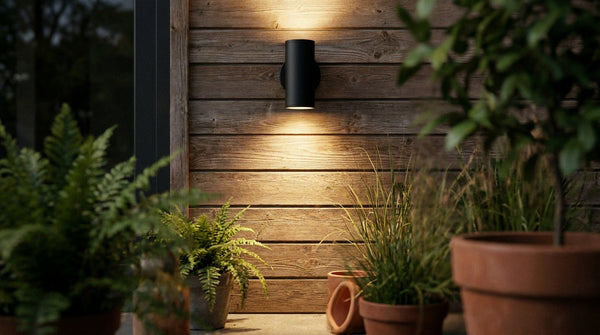
When the wall must stay understated, an outdoor wall lamp settles for a wall light and avoids the pole.
For a door or a landing, a solar wall light does the job without cutting any chasing.
Which use do you want to cover first?
Should you choose a solar floodlight or a wired outdoor light?
Solar suits an entrance, a gate or occasional passage. As soon as six hours of light are needed every winter evening, wired takes the advantage back. The most robust solution combines both: solar for detection and passage, wired for the ambience that stays on.
| Criterion | Solar | Wired |
|---|---|---|
| Installation | No cable to run | Power supply to bring in |
| Consistency | Depends on sunshine | Constant all year round |
| Ideal use | Detection, gate, supplementary | Ambience, long driveway, occupied terrace |
- Low-traffic entrance: solar is enough, even a modest one.
- 15-metre driveway: two solar points, or one well-placed wired light.
- Terrace used in the evening: wired, for light that does not go out.
- Rented balcony: solar, without drilling.
An occupied terrace calls for several weak sources rather than a single floodlight, and our page on outdoor lighting for the terrace details this distribution.
An outdoor lamp post brings that continuous light when the driveway stretches out.
The rest comes down to garden and balcony decoration, which dresses what the light reveals.
In stock · shipping costs shown at checkout · up to 30% off in your cart


Ready to turn inspiration into reality?
Tell us about your room, your style and your budget, and we will show you the pieces that truly suit your project.
Get guidance in 30 seconds →