
2026 interior design trends: lighting with style
This article is also available in French: Tendances déco intérieure 2026 : éclairer avec style
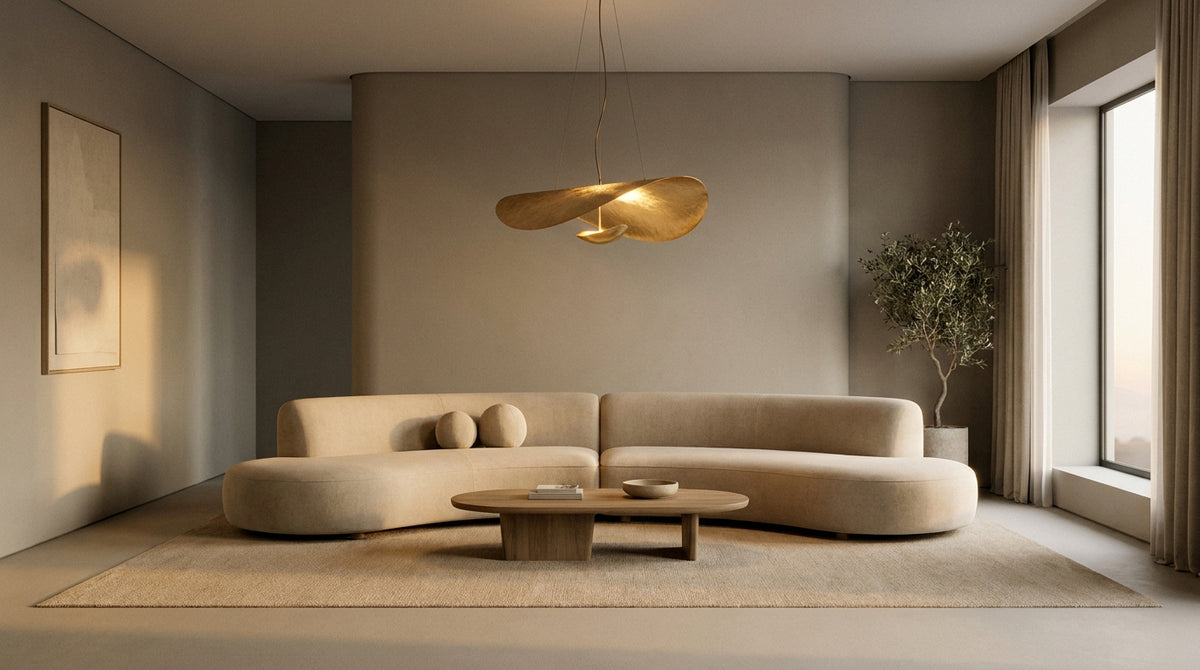
You’ve spotted the shades and materials that will define 2026, but your room falls flat as soon as the daylight fades. The issue rarely lies with the wall color: it is the lighting that reveals or dims it.
Every decor trend plays out as much in the light bulb as it does in the color palette. The same ochre wall will appear enveloping under warm light and dull under cool white light. Our designer lighting collection therefore serves as a concrete starting point, even before you take out the paint roller.
Translating a trend into lighting choices prevents disappointment. To situate the movement, the lighting trends that will define 2026 provide the general framework before getting into the details.
What are the current interior design trends?
Three lines dominate: warm minimalism, organic shapes, and enveloping natural shades. We keep spaces clean, yet warmed up by raw materials and soft curves. Lighting follows suit: more dimmed, more amber, and less uniform than five years ago.
Warm minimalism does not mean empty. A fixture with a simple design, in matte metal or opal glass, structures the room without cluttering it. To go further, the minimalist spirit relies on the principle of "less, but better."
Organic shapes arrive via lighting before furniture: globes, rounded lampshades, sphere pendants. This is the domain of curves and rounded shapes, which are easy to incorporate without changing everything.
As for materials, rattan, wicker, and light wood diffuse warm, textured light. A woven lampshade casts graphic shadows on the ceiling, an asset detailed piece by piece in natural materials like rattan. The Japandi style blends these codes with Japanese simplicity.
What are the 2026 interior design color trends?
Cool white is receding in favor of soft nuances: sand, greige, linen, and light ochre. Walls are welcoming deep shades like teal, plum, or burgundy, warmed by yellow accents. These colors require warm light to prevent them from turning gray.
The choice of lighting is not neutral within this palette. In a survey of 54 pendant lights from our catalog as of September 13, 2026, white appears on 74%, gold on 48%, and black on 46%. Gold and brass, which are very present, warm up deep shades and catch evening light beautifully.
A gold finish on a teal wall creates a cozy atmosphere; a matte black lampshade adds a graphic accent against a sand background. To harmonize shades, the colors of 2026 help build a coherent palette, for both living and dining rooms.
What lighting should you use to follow these trends?
Opt for warm, dimmable sources rather than a single ceiling light. A low pendant over the table, a table lamp for ambiance, a reading floor lamp: three light sources are better than one single ceiling light. Warm white LED reveals natural shades without washing them out.
To choose without making mistakes, check the socket before the aesthetics. In our survey, E27 and G9 dominate—two easy-to-replace standards—and LED technology is mentioned in a large portion of the product sheets. The IP20 rating is suitable for dry rooms; bathrooms require a higher rating.
Our designer lighting to follow the trends
 Danish Pendant | Cocoon
 Modern Black and Gold Designer Living Room Wall Light | Gravity
 Large Modern LED Ceiling Light - Powerful and Adjustable Lighting | Zenith Light
 Round Gold Ceiling Light | Scintilla Sky
 Glass & Iron Designer Globe Wall Light | Celestial Light
 Arc & Sphere Wall Light | Modern Radiance
See the entire selection: Minimalist Decoration, Minimalist Designer Interior Style
Which room do you want to reinvent with light?
These technical benchmarks matter just as much as style. A well-chosen trendy light fixture lasts ten years; a model with an impossible-to-find socket ends up in the closet after the first light bulb burns out. Also, consider dimming options to transition from task lighting to a soft ambiance.
What is the "rule of 3" in decoration?
The rule of 3 suggests composing with odd numbers and sticking to three colors: a dominant one (about 60%), a secondary one (30%), and an accent touch (10%). In lighting, it translates to three sources per room: general, functional, and ambient.
This logic avoids interiors that are flat or overloaded. Three colors that work well together often rely on a neutral base highlighted by a deep tone and a metal, which is exactly what creating a warm atmosphere with light puts into practice.
Applied to lighting, the rule of 3 prevents "everything on the ceiling." You layer heights: pendant, wall light, low lamp. Each level defines an area and adds depth to the room, from the living room to the office corner.
How can you adopt these trends without making mistakes?
Start with the actual use of the room, not an inspiration photo. First, identify where you lack light in the evening, then choose the style. A simple test: change just one light bulb to warm white before any purchase; the effect on color is immediate.
Reliability often resolves hesitation. In that same survey of 54 pendant lights, a 2-year warranty and CE marking appear on 83% of the detailed product sheets, a useful benchmark when comparing two similar models. Our minimalist collection, for its part, includes 3,313 references as of September 13, 2026—plenty to match a fixture to almost every project.
To mix styles and eras without a false note, mixing styles without false notes remains the best lesson. If you are unsure about a combination, the Designix Google profile gathers verifiable buyer feedback.
For a complete project, our consultants based in Vaulx-en-Velin help you match lighting and shades piece by piece; talk to our decor consultants before getting started.
On the same topic
In stock · shipping costs shown at checkout · up to 30% off in your cart


Ready to turn inspiration into reality?
Tell us about your room, your style and your budget, and we will show you the pieces that truly suit your project.
Get guidance in 30 seconds →


