
Zen table lamps
This selection is also available in our French store: Lampes à poser zen


- Tracked delivery to your country Tracked delivery
- Secure payment at checkout Multiple payment methods
- 14 days to change your mind 14-day returns
- Secure payment Secure payment
Not sure of your style? Find it in 30 seconds
A few questions, and we will show you the pieces made for you.
Frequently asked questions
What table size for how many people?
Which tabletop material should I choose?
Extendable or fixed?
How do I care for the tabletop?
The right furniture, in the right place
Check the dimensions with our fit checker and receive pieces made to last. Unsure? Our team will answer your questions.
- Tracked delivery
- Pay in instalments, where available
- 14 days to change your mind
- Advice & showroom in Lyon, France
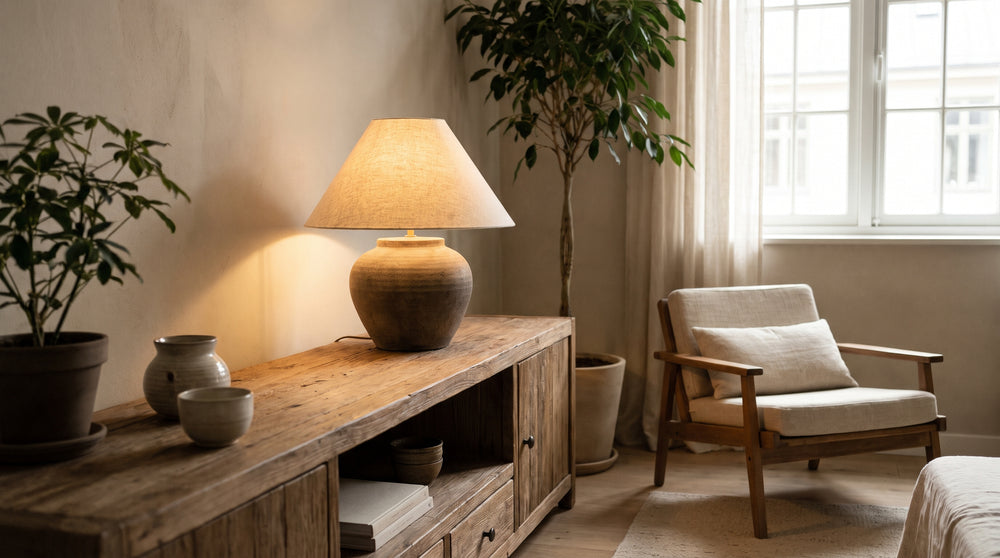
Count on one low, warm point per room: a zen table lamp on the bedside table, another on the living room console. These small lights cast a halo at hand height, without lighting the whole room, and that is precisely what softens the light in the evening.
What is a zen table lamp and what light does it give in a room?
A zen table lamp serves as accent lighting: placed on a bedside table, a console or a shelf, it casts a low, soft halo without lighting the whole room. Its contained height, 25.5 cm for the Albert and 30 cm for the Bodhio, keeps it at hand height.
Zen table lamps: a small light that stays on in the evening
In the evening, you don't switch on a ceiling light to read two pages: you switch on a low point. The halo stays at furniture level, it lights the book, the glass of water, the phone, and leaves the walls in the background. It is this contrast between a nearby zone and a darker room that gives the impression of calm, far more than a powerful source.
Material plays a part in the rendering. White ceramic like the Bodhio's reflects a matte light, without harsh reflection, whereas a plastic shell is more neutral. To compare the available finishes, browse ceramic table lamps, and if the living room is already very bright, white design shows what a white object looks like on a white wall.
Integrated LED or 40 W E14 bulb: what it changes
Two approaches coexist. The Albert bedside lamp has an integrated 0.13 W LED source: nothing to buy, nothing to choose, you plug it in and it lights up. The Bodhio model takes an E14 socket bulb up to 40 W, so you decide the shade: around 2700 K for a very orangey warm white, towards 3000 K for a more neutral warm white. This latitude matters when the lamp already sits next to another light point.
Where to place a zen table lamp in the living room and bedroom?
In the bedroom, the zen table lamp goes on the bedside table, within reach to switch it off without getting up. In the living room, it finds its place on a console, a shelf edge or a piece of furniture, where it stays visible even when switched off, unlike a fixed wall light.
On a bedside table, at hand height
A bedside table top is often 40 to 45 cm wide: the Albert, with its 8.3 cm side, leaves room for the book, glasses and glass of water. The Bodhio, wider at the base and 30 cm tall, requires checking what is above it, a shelf or a wall switch. Measure the free height before choosing, it is the only criterion that really blocks.
For two beds or two sides, two identical lamps are better than two different models. The rest of the catalogue is in models designed for the bedroom.
On a console or a living room shelf
On a console, the lamp becomes an object: the Bodhio in the shape of a buddha reads as a white sculpture, and its presence counts as much off as on. On a shelf, the Albert slips between two rows of books without saturating the niche. The entire lighting catalogue lets you keep the same family of materials from one room to another.
A zen wall light frees the surface but stays fixed. The table lamp, on the other hand, moves from the living room to the bedroom as needed, which remains its main advantage in a home where furniture moves.
How to choose between an LED bedside lamp and a ceramic lamp with E14 socket?
The Bodhio takes an E14 socket bulb up to 40 W: you choose the light shade and replace the bulb. The Albert works with an integrated LED source, with no bulb to plan for. In terms of size, the Albert measures 8.3 cm on the side and 25.5 cm high, the Bodhio peaks at 30 cm.
| Model | Material | Light source | Dimensions | Protection rating | Room |
|---|---|---|---|---|---|
| Albert | Plastic | Integrated LED, 0.13 W | W 8.3 × D 8.3 × H 25.5 cm | not disclosed | Living room, bedroom |
| Bodhio | White ceramic | E14 socket, bulb up to 40 W | H 30 cm | IP20 | Living room, bedroom |
E14 socket up to 40 W or integrated LED: what it changes day to day
With a socket, you keep control of the light: a filament bulb gives a warmer, more contrasted rendering, an opaque bulb diffuses more softly. You also replace the source when it weakens, without changing the lamp. With an integrated LED, there is no bulb stock and no shade question, but the light fixture follows its source to the end.
The design LED table lamps show what integrated sources look like in a designed version, and LED lighting for the bedroom groups the low formats.
Measure before placing: 8.3 cm on the side versus 30 cm high
Three dimensions are enough to avoid the mistake: the free width of the furniture, the height under the shelf or picture, and the distance to the edge if the lamp is near a passage. A narrow model like the Albert forgives a cluttered top; a tall model like the Bodhio needs air above it so as not to look squashed.
What are the most beautiful living room lamps?
The most beautiful living room lamps are those that hold their role once switched off. A white ceramic in the shape of a buddha becomes a sculptural object on a console, a compact bedside lamp slips onto a shelf without saturating it. Italian design and Nordic style seek the same sobriety, through different paths.
A lamp that stays beautiful once switched off
An accent light spends most of its life switched off. Its silhouette therefore counts more than its flux. Look for a stable base, a material that does not mark fingerprints, a proportion that does not compete with what surrounds it. A sphere, a buddha, a cylindrical stem: simple shapes age better than fashionable cut-outs.
To compare round silhouettes, see the modern living room lamps, and for softer volumes, Nordic lines shows low bases and light tones.
Italian design, Nordic style, zen: three readings of the same sobriety
Italian design embraces bold shapes and worked materials; Nordic style prefers light wood and off-white; the zen spirit seeks a discreet presence, often a single material. None of these families is more right than another: choose the one that dialogues with your furniture. A light wood interior supports matte white, a darker living room calls for a ceramic that stands out.
How to match a zen table lamp with the rest of the room?
A zen table lamp matches matte and natural materials: wood, linen, ceramic. White ceramic dialogues with a light wall or wooden furniture. One well-placed accent point is better than an accumulation of small sources that flatten the room and erase contrasts.
White ceramic and light wood: the duo that works
The matte white of ceramic and the grain of light wood share the same restraint: neither reflects a sharp image. Add a linen shade and the light diffuses even more softly. If the room is rather raw or metallic, wood lamps warm it without weighing it down.
For matte white ceramic, white ceramic gives the complete series.
How many light points to keep in a living room
The useful principle is to separate a base and an accent: the ceiling light or spots provide the base, the table lamp provides the low point. Two accent points are enough in a standard-sized living room, one near the sofa, one near a corner or a plant. Beyond that, the eye no longer distinguishes the sources and the room loses its depth.
How to connect several lamps to a single electrical supply?
A table lamp plugs into a socket, with no wiring: for several lamps on the same supply, a power strip or a socket rail is enough. If the lamps are fixed, the connection is made in parallel in a junction box, each phase and each neutral connected to the same terminal block, with the power off.
Connecting several lamps in parallel: the principle
In parallel, each lamp receives its own branch from the main line: all phases are connected together, all neutrals together. Each light fixture then works independently, and switching one off does not switch off the others. For table lamps, this setup is not needed: a power strip plugged into the wall socket does the same job, without tools.
Power strip, socket rail or junction box: three different uses
The power strip suits table lamps side by side, with a switch per lamp. The socket rail is fixed under a piece of furniture or at the headboard and keeps the cables tidy. The junction box concerns fixed light fixtures and requires working on the circuit: with the power off, and preferably by an electrician. The catalogue also includes adjustable lamps if you prefer to direct the beam rather than multiply the sources.
How to arrange ceiling spots without crushing a table lamp's light?
Recessed spots are distributed in regular lines, away from the walls, to avoid shadow zones and glare. A zen table lamp complements this light base: the spots light the room, the lamp brings the low, warm point near the sofa or the bed.
Distributing spots without creating glare
Align the spots rather than scattering them, keep a margin from the walls so as not to wash the paint in a band, and aim the adjustable models towards circulation areas or a load-bearing wall. A regular ceiling reads as a base; a messy ceiling draws the eye before the rest of the room.
Ceiling spot and low lamp: sharing the roles
The spot lights wide and cool, the lamp lights near and warm. It is this sharing that makes a room readable in the evening. For a reading corner or a desk, complete with a desk corner or a low source for the bedroom, without ever stacking three points in the same direction.
How to maintain and make a zen table lamp last?
A soft cloth is enough: ceramic is dusted dry, plastic with warm water without abrasive product. Always unplug before changing the bulb. The Bodhio is rated IP20: it stays indoors, on a piece of furniture, and must not be exposed to bathroom humidity.
Cleaning ceramic and plastic without damaging them
On glazed ceramic, a dry microfibre cloth removes dust; warm water is enough for a mark, never scouring powder or an abrasive sponge. Plastic is cleaned the same way, with a soft sponge. Let it dry before plugging back in, and do not place the lamp near a direct heat source.
Changing the E14 bulb safely
Unplug, let it cool if the bulb has been on, then unscrew. Respect the maximum power indicated on the socket, here 40 W, and choose a bulb suited to the shape of the diffuser so that it fits in the volume. If the light fixture is high up, place it back on a stable surface before plugging back in.
To equip a complete bedroom, bedside ceramics extend this logic of materials. Other bases are found among the design table lamps for the living room.
Order from Designix: secure payment, tracked delivery, possible returns and customer service for any dimension question. See the Bodhio lamp in detail or discover the Albert lamp.
Frequently asked questions
How to wire 3 lamps to 1 switch?
The three lamps are connected in parallel on the same circuit: the three phases meet on the switch output, the three neutrals on the neutral terminal block. The switch then controls the three lamps together. Cut the power before working and have the setup validated by an electrician.
What is a design ball table lamp?
It is a lamp whose diffuser is a sphere, placed on a base or directly on a piece of furniture. The round shape reflects light in all directions and remains readable as a decorative object. Depending on the material, it lights widely or remains a simple ambient point.
What is a zen wall light?
A zen wall light is a light fixture fixed to the wall, often in a simple shape and matte material, which diffuses grazing light without taking up surface. It frees the bedside table but stays in a fixed location, whereas a table lamp moves from one room to another.
What is an Italian design table lamp?
Italian design refers to a way of designing light objects: bold shapes, worked materials, a silhouette recognisable once switched off. The result sought joins that of the zen style, a discreet presence that structures the room without capturing all the attention. The style is read in the shape, not in the power.
How many light points are needed in a living room or bedroom?
There is no universal number: it depends on the surface, the openings and the use. The useful principle is to separate a light base and a low accent point. A well-placed zen table lamp complements a ceiling light or a few spots without having to multiply the sources.




