
Yellow filament bulbs
This selection is also available in our French store: Ampoules à filament coloris jaune
No products in this selection.
- Tracked delivery to your country Tracked delivery
- Secure payment at checkout Multiple payment methods
- 14 days to change your mind 14-day returns
- Secure payment Secure payment
Not sure of your style? Find it in 30 seconds
A few questions, and we will show you the pieces made for you.
Frequently asked questions
How do I choose the right product?
What are the delivery times?
Can I return an item?
Can I pay in instalments?
An interior that reflects who you are
Carefully selected pieces, shipped from our warehouses. Our team advises you before you buy, so you choose with confidence.
- Tracked delivery
- Pay in instalments, where available
- 14 days to change your mind
- Advice & showroom in Lyon, France
A yellow filament light bulb gives a warm, golden light, with a clearly visible filament through tinted glass that stays yellow when switched off. You choose it for that look and for the object it becomes in a pendant, a bedside lamp or an exposed socket, most often with an E27 or E14 base.
What light does a yellow filament bulb give?
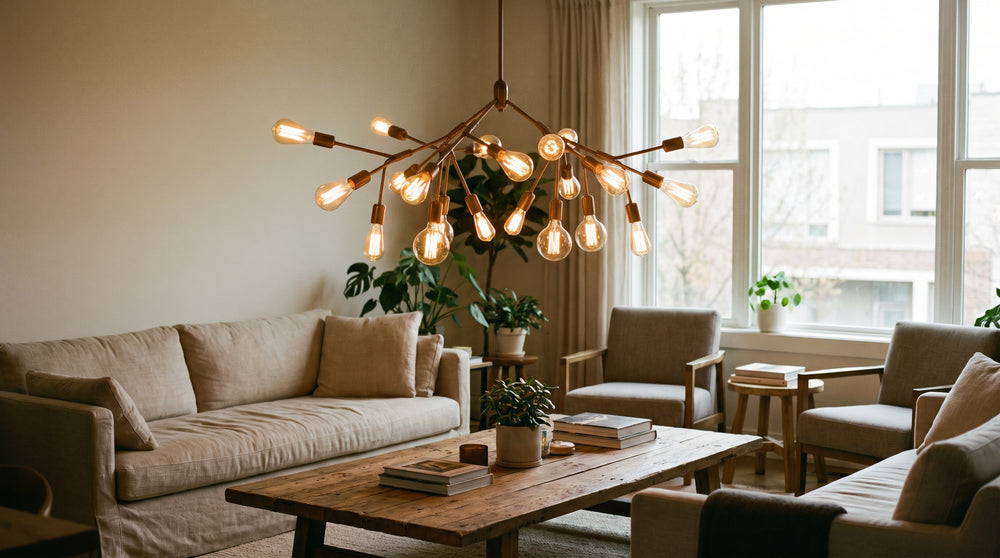
Expect a warm, slightly golden halo that shifts whites towards cream and brings out wood and raw linen. The filament stays crisp through the glass, like a glowing line: that detail is what people come for. The glass tint decides the rest of the effect.
Yellow filament light bulbs: what changes in a room
In a living room or hallway, the light gathers around the fixture: the mood is softer, never washed out. The beam stays directional, so the bulb shines brightly just below and leaves the rest in half-light. For a large surface, one point is not enough; add a more neutral living room bulb on a second fixture.
Tinted or clear glass: the look when switched off
Yellow tinted glass keeps its colour with the light off, a deliberate decorative choice. Clear glass leaves the filament bare and turns transparent again. Glass bulbs tinted through the mass hold their colour better than a surface varnish. Shape matters too: globe for a pendant, elongated bulb for a table lamp. Our filament bulb range is recognisable by that visible filament.
What is the difference between an LED bulb and a filament bulb?
A classic filament bulb heats an incandescent filament, while a filament LED imitates that look with diodes placed inside a shaped glass. A standard LED hides its source behind an opaque diffuser. The choice therefore comes down to the visible effect and the heat given off, not appearance alone.
Filament LED bulb: the same look, another technology
The filament is decorative, but the light comes from diodes: the bulb stays lukewarm to the touch and copes better with enclosed fixtures. E27 filament LED bulbs are the easiest to slip into an existing pendant. The effect is warm and directional, close to a classic filament.
What the classic filament changes in touch and heat
A classic filament really heats up: handle it once cooled, by the base. It brings out reliefs and materials more strongly, which works well on a brick wall or a trowelled plaster. The four families to know are classic filament, filament LED, standard LED and halogen or low-voltage models, including 12V bulbs for small fixtures.
Which base to choose for a yellow filament bulb: E27, E14 or G9?
The base is chosen according to the fixture's socket, never according to the bulb. E27 is a large screw thread, E14 a small screw thread, G9 and GU10 fit with pins. Check the socket and the maximum wattage written on it before ordering: that is the only reliable information.
| Base | Socket type | Where you find it | To check before buying |
|---|---|---|---|
| E27 | Large screw thread | Pendants, floor lamps, ceiling lights | Max wattage indicated, space under the shade |
| E14 | Small screw thread | Wall lights, chandeliers, small bedside lamps | Bulb diameter relative to the shade |
| G9 | Pins | Small fixtures, decorative spots | Pin spacing, max wattage |
| GU10 | Two pins | Recessed or track spots | Spot orientation, recess depth |
| G4, GU5, 12V | Low voltage | Fixture on a transformer | Presence and type of transformer |
How to recognise the bulb type on a socket
Unscrew the old bulb and compare: a large thread means an E27 base, a fine thread a small E14 base. Two holes for pins, and you are on G9 and other pin bases.
Dimmer socket: what to check before buying
A classic filament bulb often dims without trouble, a filament LED much less so. Check the dimmer mention on the packaging and look at dimmer-compatible bulbs if the fixture is equipped with one.
Where to install a yellow filament bulb in the home?
Place it where the bulb stays visible: pendant above a table, bedside lamp, wall light, fixture with an exposed socket. In a living room, it warms the dining corner and the reading corner. In a bedroom, it suits bedside lamps and small wall lights, provided it stays at a good distance from the bed.
In a pendant above a dining table
Allow around 75 to 85 cm between the bottom of the fixture and the tabletop, depending on the height of the guests. A globe or a wide bulb sits better in a large shade than a narrow bulb, which looks lost. The fixture itself is chosen from the Designix lighting catalogue.
As a bedside lamp or wall light: which bulb shape
On a small bedside lamp, an elongated bulb or a mini-globe avoids touching the shade. As a wall light, the grazing yellow light suits a hallway or a headboard. Bedroom bulbs are generally limited to one point per fixture: five types of fixture share the home, pendant, ceiling light, floor lamp, table lamp and wall light.
How to match a yellow filament bulb with its fixture?
Yellow glass matches brass, light wood, rattan and off-white walls; on black metal, it brings the only warm touch. Keep the same tint on a fixture with several bulbs and check that the bulb does not touch the shade once screwed in.
Yellow filament light bulbs and exposed sockets
The visible socket is part of the decor: brushed brass with yellow glass is the simplest and most lasting match. A wooden or rattan fixture calls for a rather round bulb, whose filament can be read in full. Retro bulbs follow the same logic on older shapes.
Several bulbs on the same fixture: keep the same colour
On a chandelier or a track, a different colour per socket shows immediately and breaks the reading. Stick to a single tint and a single socket colour. For the ambient tint, 2700K bulbs give the closest reference to evening light.
How to wire 3 bulbs in parallel?
Wiring three bulbs in parallel means connecting each socket to the same live and the same neutral, branched from the supply line: all three light up together and remain independent of the rest of the circuit. Switch off the power, work in a junction box and check the total wattage supported.
What parallel wiring changes for switching on
Each socket receives the full voltage: if one bulb blows, the other two keep working, unlike a series wiring. The switch cuts the line upstream and controls all three points in one go.
Safety: switch off the power and check the total wattage
Switch off the breaker, identify live and neutral, use an accessible junction box and connectors suited to the cable cross-section. Add up the wattages of the three bulbs and compare with what the socket and the circuit support. If in doubt about the transformer, go for 220V LED bulbs.
Which glass colour to choose: yellow, amber, white or smoked?
Yellow gives a very readable golden halo, amber leans towards the orange of a flame, white stays neutral and smoked glass dims the light. Choose yellow to warm a living room, amber for a table pendant, white for cooking or working.
| Colour | Effect when lit | Rooms and uses | To pair with |
|---|---|---|---|
| Yellow | Warm golden halo, visible filament | Living room, hallway, reading corner | Exposed sockets, brass, light wood |
| Amber | More orange tint, close to a flame | Pendant above a table, bar | Black metal, smoked glass, rattan |
| White | Neutral light, no dominant tone | Kitchen, office, bathroom | Opal shades, white sockets |
| Black or smoked | Dimmed light, graphic glass when off | Bedside lamp, hallway | Black metal, concrete, dark wood |
| Green, red | Bold colour, deliberate effect | Mood, shop window, decoration | Neutral fixture |
Yellow or amber: what difference when lit
Yellow lights more brightly, amber steps down towards orange and gives a late-evening mood. For a restaurant table or a bar, amber finishes work better than a strong yellow.
White or smoked glass for a more neutral effect
White is the choice for rooms where colours must be distinguished: kitchen, office, bathroom. See the white bulbs for this use. Smoked glass, on the other hand, dims without colouring: it can be found among the black smoked glass bulbs and suits graphic fixtures.
How to care for and make a filament bulb last?
Let the bulb cool before handling it, hold it by the base and dust the glass dry. Avoid knocks against the shade and repeated vibrations, which wear out the filament. A filament LED bulb is taken to a collection point, never in the household bin.
Cleaning a tinted glass bulb without scratching it
A soft, dry cloth is enough; alcohol can attack a surface varnish. On glass tinted through the mass, clean with the bulb removed, with the power off, never with an abrasive product.
Dimmer: the bulbs designed for it
A poorly matched dimmer causes buzzing or flickering. Check the mention on the fixture and bulb packaging before changing model, and test the setting at the lowest position.
Before ordering, check the base of your socket and the space available under the shade: that is what decides between a pear, a globe or an elongated bulb. Secure payment, tracked delivery, returns and Designix customer service accompany every order. To broaden your view, the lighting catalogue and the bulb section complete the range, with E27 filament models to compare at leisure.
Frequently asked questions
Which is the best lighting choice, yellow or white?
Yellow warms a living room and brings out wood and raw fabrics; white stays neutral and is better suited to a kitchen, an office or a bathroom where colours must be distinguished. The best choice depends on the room and what you do in it, not on a hierarchy between the two.
What is the equivalence between LED bulbs and filament bulbs?
It is read on the packaging, not in a universal table: at equal wattage, a filament LED gives much more light than an incandescent bulb. Compare the wattage indicated on your old bulb with that of the equivalent filament LED, then adjust according to the desired effect.
Where to dispose of a filament bulb?
A filament LED bulb contains electronics: take it to a collection point, in a shop or at a recycling centre, never in the household bin. A classic incandescent bulb is mostly glass and metal; follow your local authority's instructions for non-recyclable waste.
What material is a bulb made of?
The body is glass, clear, tinted or smoked, sometimes shaped to imitate old bulbs. The base is metal, with a screw thread or pins, and the insulator separating it from the glass is ceramic or composite. These elements determine the weight and the grip.
Which bulbs give the best light?
Better lighting does not mean lighting more strongly: an LED offers a wider output for less heat given off, while a filament bulb concentrates the light and brings out reliefs. In a living room, a yellow filament is enough for the mood; for working, prefer a more neutral light.




