
Wooden LED strips for decking
This selection is also available in our French store: Rubans LED en bois pour terrasse
No products in this selection.
- Tracked delivery to your country Tracked delivery
- Secure payment at checkout Multiple payment methods
- 14 days to change your mind 14-day returns
- Secure payment Secure payment
Not sure of your style? Find it in 30 seconds
A few questions, and we will show you the pieces made for you.
Frequently asked questions
How do I choose the right product?
What are the delivery times?
Can I return an item?
Can I pay in instalments?
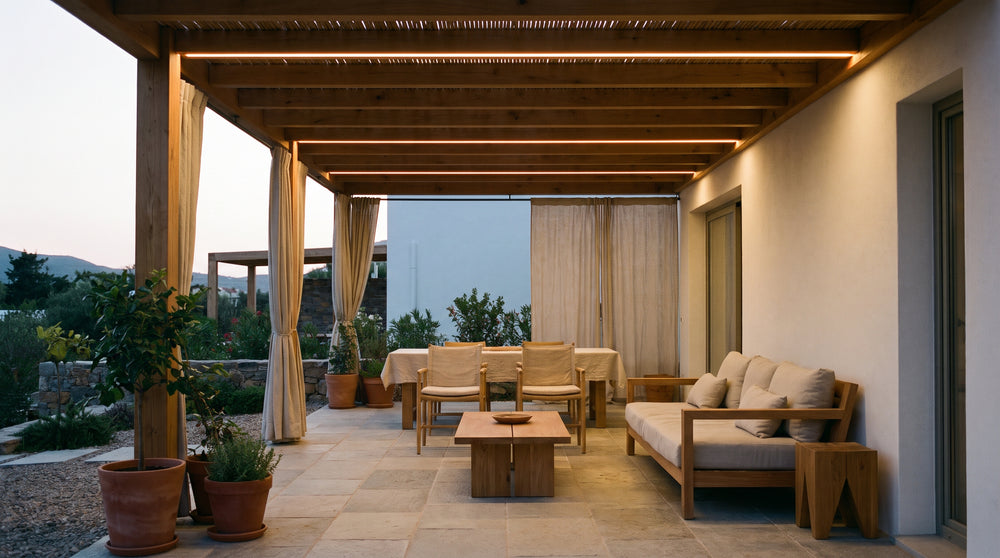
An interior that reflects who you are
Carefully selected pieces, shipped from our warehouses. Our team advises you before you buy, so you choose with confidence.
- Tracked delivery
- Pay in instalments, where available
- 14 days to change your mind
- Advice & showroom in Lyon, France
Three things decide the result on a wooden deck: a water-protected strip housed in a recessed profile on the joists or under a handrail, in warm white between 2700 K and 3000 K. Supply voltage and mounting method come next, depending on the actual exposure of the area to be fitted.
Which LED strip should you choose for an outdoor deck?
An LED strip for an outdoor deck is chosen first on its exposure: a wooden deck gets rain, UV and cleaning, so the strip must be protected and housed in a support that does not hold water. Next come supply voltage, colour temperature and fixing to the boards.
Wooden LED strip lights for decking: what changes the look
Set back, the strip grazes the board instead of lighting it face-on: the wood grain stands out, the deck looks longer in the evening and no bright patch appears on the ground. It is the recess that produces this effect, not the power. The LED strip range comes in several profile widths so the strip can be housed without sitting flush.
LED strip for an outdoor deck: the criteria to check before buying
- Water protection, including strip and connections: see waterproof LED strips.
- Supply voltage, which decides where the driver goes: 24V strips and their power supply.
- Colour temperature, chosen for the wood and not for the room.
- Mounting method: profile, recessed groove or bracket screwed to the structure.
Where to install a deck strip: steps, plinth, pergola or railing?
The most useful positions are the step nosing, the plinth and the underside of the handrail: the light there is grazing and does not dazzle. Under a pergola or along the deck edge, the strip highlights the structure. Each position brings its own water and impact constraints, to be dealt with before installation.
| Position | Intended effect | Water exposure | Point to watch |
|---|---|---|---|
| Step nosing | Mark the step without lighting it face-on | Run-off and foot traffic | House the strip in a recess, never on the tread surface |
| Plinth and base | Highlight the facade and the deck | Splashes and cleaning | Protect the connections, prefer a closed profile |
| Under pergola | Light the table indirectly | Sideways rain and condensation | Fix to the structure, not to the canvas |
| Railing and handrail | Draw the edge of the deck | Wind and direct rain | Choose a waterproof version and take care with the joints |
| Deck edge | Mark the way to the garden | Contact with soil and damp | Raise it slightly, avoid contact with the ground |
Under the handrail and along the steps
The handrail keeps the strip out of reach of hands and sprinklers, provided a groove or closed profile is planned. On steps, the strip goes under the nosing, on the shaded side: it marks the step without throwing light into the eyes of anyone climbing.
Top of wall, under pergola and along the deck edge
A strip at the top of a wall, under a facade return, lights the deck by reflection and leaves the night sky visible. Under a pergola, it is fixed to the beams, never to the canvas, and kept away from condensation zones. At the edge, deck strips must stay raised so they do not soak in damp soil.
Which colour temperature for lighting a wooden deck in the evening?
On a wooden deck, warm light around 2700 K to 3000 K brings out the grain of the boards without turning yellow and stays comfortable in the evening. A cooler white makes the deck look more technical and tires the eye more. RGB and RGBW versions are for changing the mood, not for lighting.
| Colour temperature | Mood | On a wooden deck | Best for |
|---|---|---|---|
| 2700 K | Warm white, close to halogen | Warms brown woods and dark boards | Evenings and outdoor meals |
| 3000 K | Bright warm white | Keeps natural wood without yellowing it | Steps and circulation |
| 4000 K and above | Neutral to cool white | Cools the tone of the wood | Technical areas and stairs |
| RGB and RGBW | Changing colour, adjustable white on RGBW | Warm white remains the most accurate on wood | Parties and summer mood |
The choice therefore comes down to the tone of the wood and the use: 2700 K strips suit dark boards and dinners, 3000 K ones suit circulation areas where you want to see clearly without harshness. For a deck that changes mood through the summer, RGB strips bring the structure to life, while RGBW models keep an adjustable warm white and remain accurate on wood.
Which IP rating is needed for an LED strip outdoors?
An LED strip intended for outdoor use must be protected against water and damp. Under a shelter or pergola, moderate protection is enough; exposed to rain or beside a pool, a waterproof version is needed, with connections that are protected too. Protecting the strip never replaces protecting the power supply.
Sheltered strip, exposed strip: two levels of protection
Under a roof overhang, the strip mainly gets damp and dust: a flexible sleeve is often enough. In direct exposure, on a railing or near a pool, a solid sleeve and end caps sealed in resin are needed, as on the versions designed for exposed outdoor use. At the poolside, underwater lighting and coping strips fall under pool lighting, with its own constraints.
Connections and power supply, the real weak point
Water rarely gets in through the strip: it gets in through junctions, terminals and the cable gland of the driver. Everything that connects must be accessible, protected and raised above run-off. A transformer housed in a dry, ventilated space lasts longer than a box sealed under the rain.
How do you fix an LED strip to a wooden deck without damaging the boards?
The strip is housed in a profile or bracket fixed to the structure, not directly to the board that is walked on. Screw into the joists or posts, leave a gap so the wood can move, and place the connections in an accessible box. The strip can be removed without marking the deck.
Profile or wooden bracket: where to house the strip
An aluminium profile screwed under the overhang of a board protects the strip from impacts and diffuses the light without bright spots. A recessed wooden bracket, cheaper, needs a little more care with the cuts: if the groove holds water, the strip sits in it. The ideal remains a groove open downwards, which drains water and keeps the strip invisible.
Cable routing, power supply and wood movement
The cable runs behind the joists, under a plinth or in a discreet conduit, never across the walkway. Wood expands: allow a gap at the ends of the profile and use fixings that tolerate movement. The power supply box stays accessible for a check, without tools.
Once the area is defined and the profile chosen, the purchase comes down to length, voltage and protection: 24V strips and their power supply or 220V LED strips depending on the distance to the mains. Secure payment, tracked delivery, returns and Designix customer service support you before and after your order.
How do you match an LED strip with a modern kitchen decor open to the deck?
When the kitchen opens onto the deck, keep the same family of warm white on both sides of the bay so the whole reads as a single room. A discreet strip at the edge extends the kitchen decor without competing with the worktop lighting. Continuity matters more than quantity.
Keep the same family of white inside and out
A kitchen fitted with warm white and a deck lit in cool white create a visible break as soon as night falls. Align both on the same range, around 2700 K to 3000 K: the eye no longer sees the bay as a boundary. 2700 K strips maintain this continuity effortlessly.
Extend the kitchen decor without over-lighting
The deck does not have to light the worktop: it extends the modern kitchen decor by keeping a low line, under the step nosing or at the edge of a board. Functional lighting stays indoors, on the worktop and the extractor hood. To harmonise the rest of the room, our lighting range brings together pendant lights and wall lights from the same family of white.
220V or 24V LED strip for a deck: which power supply should you choose?
220V connects directly to the mains and simplifies long runs, but requires perfectly water-protected connections. 24V needs a transformer, housed dry and close to the strip. On an exposed deck, the quality of the connections matters more than the choice between the two voltages.
- Deck with no nearby utility room: 220V LED strips avoid running an extra box.
- Covered point available for the power supply: 24V models, with voltage drop to watch on long runs.
- In both cases, protected connections and an accessible box matter more than the voltage chosen.
How do you maintain an LED strip on wood exposed to the weather?
Cleaning with clear water and a soft cloth on the support, without a direct jet on the connections, removes dust and pollen. In spring, check the fixings, the seals and the power supply box. A strip that flickers or goes out in sections almost always signals damp getting into a connection, not a usage fault.
The spring check in three points
First look at the fixings: a profile that has moved rubs against the board. Then the seals and cable glands, which harden with frost. Finally the power supply box: a trace of water inside can be spotted by smell and a film of condensation. Three minutes a year are enough to avoid a breakdown at the end of summer.
What flickering or a dead section tells you
Localised flickering comes from a damp junction or a loose terminal; a whole dead section often indicates a break at the cut mark or a corroded connector. Dry, clean and replace the connection before concluding the strip needs replacing. More of our advice can be found in the Designix lighting catalogue.
Frequently asked questions about wooden LED strip lights for decking
Which LED strip for a wooden deck?
Choose a strip protected against damp, designed for mounting on or under a wooden support, with a warm colour temperature so the boards do not turn grey. Above all, check the mounting method and access to the connections: on a deck, water gets in through the joints as much as through the strip.
Can an LED strip for an outdoor deck be left outside all year?
Yes, if the strip is protected against water and the connections and power supply are too. The strip itself often holds up better than its connections: an accessible, sheltered box clearly extends the life of the whole. Check the junctions after the bad season.
How do you hide a deck strip?
House it in a recessed profile or groove, under the handrail, under the overhang of a board or at the top of a wall under a facade return. The light must hit a surface, not the eye: it is the recess that makes the strip invisible, not the power.
How do you install an LED strip on a wooden deck?
First fix a bracket or profile to the joists or posts, never to the board that is walked on. Cut the strip at the marked points, clip it in, then run the cable back to an accessible, protected box. Leave a gap for the wood to expand.
Does an LED strip get hot under a deck board?
The LED strip gives off little heat, but the power supply does and needs air. Do not enclose it in a sealed box without ventilation: place it in a dry, ventilated and accessible space, sheltered from run-off and watering spray.
How do you light a wooden deck without dazzling guests?
Set the source back and point it at a wooden surface or a wall, never at eyes or the table. The indirect light obtained is enough to move around and dine outside, while keeping the night sky visible, which makes the deck more pleasant.
To compare colour temperatures, voltages and profiles before ordering, browse all our light fittings and the matching strips. Secure payment, tracked delivery, returns and Designix customer service remain available at every stage.




