White metal pendant lights
- Tracked delivery to your country Tracked delivery
- Secure payment at checkout Multiple payment methods
- 14 days to change your mind 14-day returns
- Secure payment Secure payment


Not sure of your style? Find it in 30 seconds
A few questions, and we will show you the pieces made for you.






Frequently asked questions
How do I choose the right product?
What are the delivery times?
Can I return an item?
Can I pay in instalments?
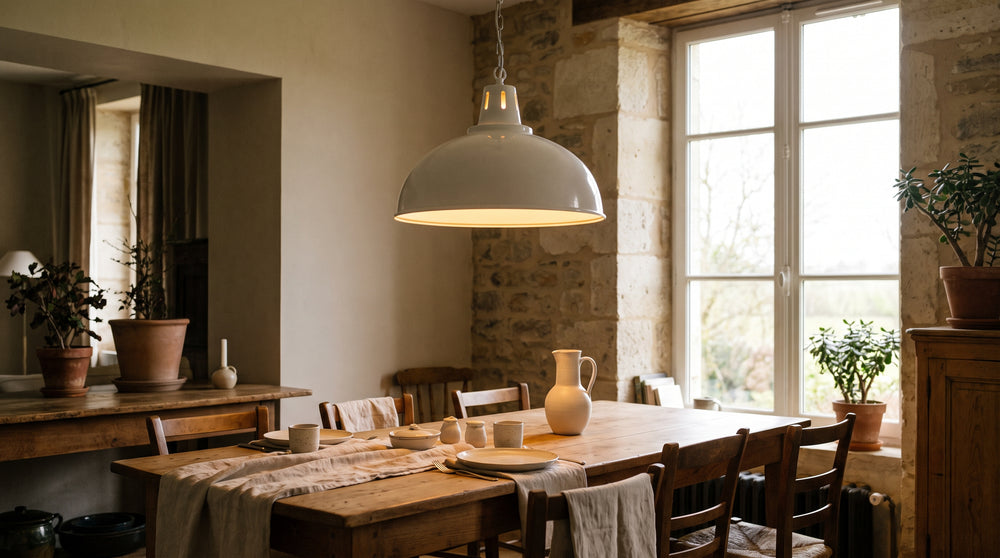
An interior that reflects who you are
Carefully selected pieces, shipped from our warehouses. Our team advises you before you buy, so you choose with confidence.
- Tracked delivery
- Pay in instalments, where available
- 14 days to change your mind
- Advice & showroom in Lyon, France
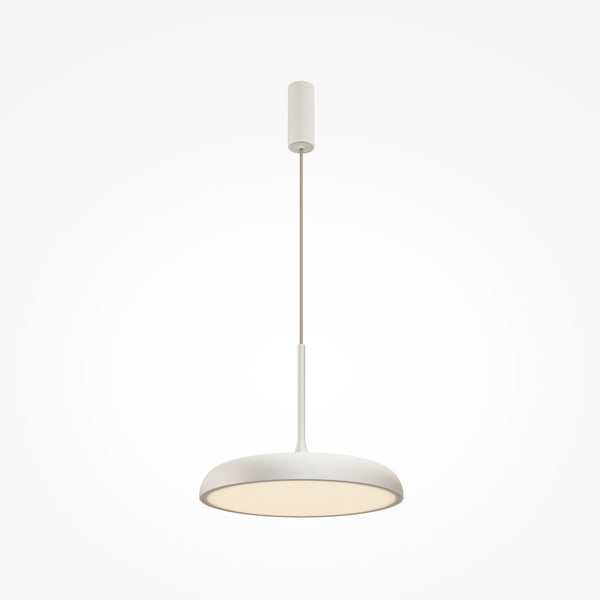
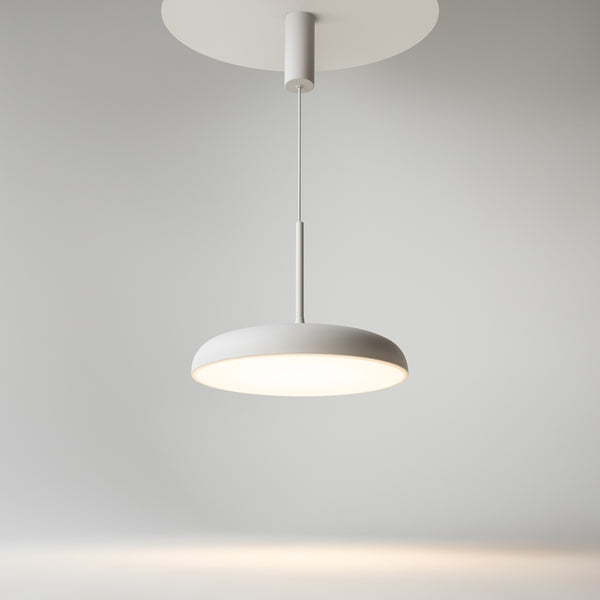
First count the room and the height: a white metal pendant light is chosen between a small shade and a large format, from Ø 45 mm to Ø 800 mm. White metal reflects light instead of absorbing it, stays discreet on the ceiling and leaves the choice between a warm white around 2700 to 3500 K and a cooler white depending on the source installed.
- The light it gives
- Choosing by room
- Recognising a design model
- Diameter and height
- Bases and sources
- Installation and care
- Furniture pairings
- Models to see
What light does a white metal pendant give?
White metal reflects light instead of absorbing it: the room appears brighter and the fixture stays discreet on the ceiling. Depending on the model, the lighting is warm white, from 2700 to 3500 K, for a calm atmosphere, or cool white, from 4500 to 6500 K, for a crisp light. Many models are supplied without a source: the bulb chosen sets the final rendering.
White metal pendant lights: open or closed shade, what it changes
An open shade projects light downwards and creates a sharp contrast above a table, while the white metal remains visible and structures the room. A closed shade, in glass or acrylic, diffuses more softly and also lights the ceiling. Models that mix glass and metal can be found among the white glass pendant lights, where light passes through the material instead of bouncing off it.
Warm white or cool white: how to decide?
In general, warm white, around 2700 to 3500 K, remains reserved for rest rooms and meals: it softens tones and is less tiring in the evening. Cool white, from 4500 to 6500 K, lights a worktop or an entrance more sharply. A 3000 K serves as a safe compromise in a living room. Here, both temperatures exist only on certain references.
Which fixture for which room: living room, bedroom, kitchen or entrance?
In the living room and dining room, a large diameter above the table creates the room's light point; in the bedroom, a small format or a fine shape sits near the bed; in the kitchen and entrance, an elongated shape or a compact model lights without crowding the passage.
White chandelier living room: which format above the table?
Above a table, a Ø 490 or 640 mm lights a group without taking up the whole view, and a Ø 800 mm suits a large table or a room with high volume. Long shapes, from 694 mm to 2 020 mm, align over an island or a sideboard. For a more marked contrast, the black metal pendant lights use the same designs.
White chandelier bedroom: how to light without dazzling?
In a bedroom, aim for small or fine: Ø 45, 50, 130 or 300 mm, with a warm white source. A dimmer-compatible model lets you lower the intensity in the evening without changing the bulb. The white models designed for the bedroom bring these formats together. For the kitchen, the white kitchen pendant lights favour compact shapes or long pendants above the worktop.
Which white metal pendant light for each room
| Room | Format to aim for | Light temperature | To check before buying |
|---|---|---|---|
| Bedroom | Ø 45 to 300 mm or fine shape | Warm white 2700 to 3500 K when the model offers it | Dimmer for soft light in the evening |
| Living room | Large diameter up to Ø 800 mm or low shape | Warm white or cool white depending on the model | Footprint and dimmer compatibility |
| Dining room | Ø 490 mm or long shape from 694 to 2 020 mm | Depending on the model | Suspension height above the surface |
| Kitchen | Compact format Ø 300 to 340 mm or length | Cool white 4500 to 6500 K if available | IP20: dry room only |
| Entrance | Small diameter or discreet hanging shape | Depending on the model | Passage left clear under the fixture |
How to recognise a design white chandelier?
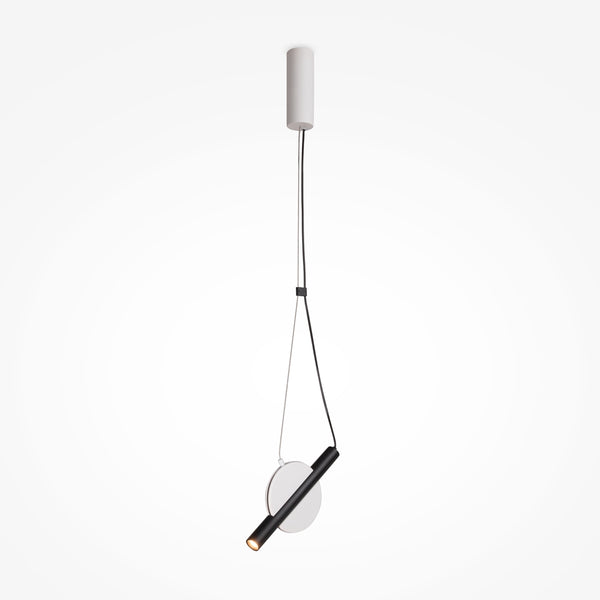
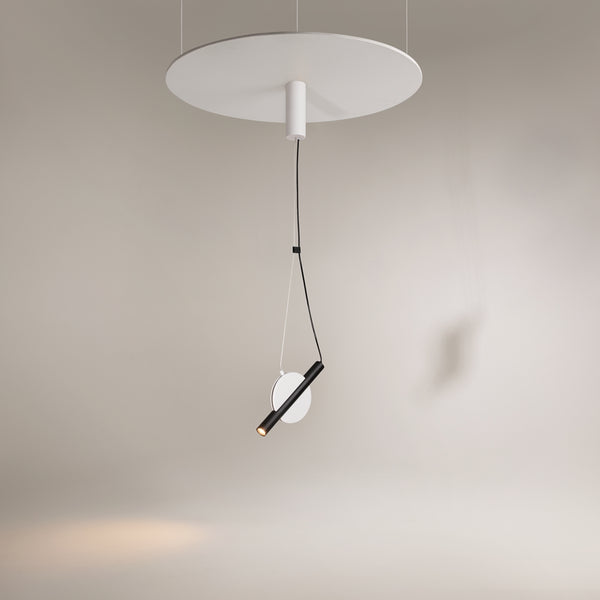
A design white chandelier is read in its lines: geometric shade, tube, oval or continuous curve, fine metal and satin paint. What makes it current is the sobriety of the design and the quality of diffusion, not the amount of decorative detail.
Modern white chandelier: shapes that never date
The oval and the tube cross the years because they let light out frankly and slip as easily above a table as in a corridor. A wide circle set low, a fine sphere or a long horizontal line give the same calm. The design white pendant lights bring these designs together. The contemporary style white pendant lights are the most current version.
Contemporary or luxury finish: what level of finish to aim for?
The vast majority of models in the collection are contemporary in style: painted metal, clean lines, matt or satin white. A few pieces go up a notch with a luxury finish, a brass collar or an alabaster shade that warms the white, like the gold versions of the metal pendant light. On the opposite side, a handful of references lean towards industrial style metal pendant lights, with a more graphic design.
What diameter and height for a white metal pendant light?
The models in the collection range from the small Ø 45 or 50 mm shade to the large Ø 800 mm format. The diameter is chosen according to the surface to be lit, the suspension height is adjusted above the table.
At what height should a pendant be hung above the dining table?
In general, lower the fixture between 75 and 85 cm above the tabletop: low enough for the light to fall on the plates, high enough to look at your guests without lowering your head. Above a worktop, allow 75 to 90 cm. In an entrance or corridor, keep the passage clear, often from 2.10 m from the floor.
Small or large diameter: what size for which room?
A Ø 45 to 300 mm is enough for a corner of a bedroom, an entrance or a row of pendants. A Ø 340 to 490 mm fits above a table for several covers. Beyond that, Ø 640 and Ø 800 mm require ceiling height and a large table, otherwise the fixture overwhelms the room. The precise dimensions of each model can be read in the Designix lighting catalogue.
E27, G9 or LED module base: which source for a white pendant?
The E27 base is the most common in this selection: the bulb screws in, can be replaced and chosen according to the desired colour temperature. Other models accept a G9 or GU10 base, and some include an integrated LED source, not replaceable.
Pendant without source: how to choose your bulb?
On a pendant sold without a source, the power of the listed references ranges from 7 W to 45 W depending on the model, and the bulb sets the rest: base, colour temperature, intensity. Above a table, a wide-diffuser bulb avoids hot spots visible in a white shade. For a living room, better to use a bulb of a single shade rather than mixing temperatures.
Integrated LED or replaceable bulb: what maintenance?
An integrated LED cannot be replaced: you don't touch it during its lifespan, but a failure means changing the fixture. A replaceable bulb costs little to replace and allows switching from warm white to cooler white without buying a new pendant. The choice is between comfort of use and flexibility.
Bases and sources available in the collection
| Source | Operation | What to plan | Presence in the collection |
|---|---|---|---|
| E27 base | Screw-in bulb | Choose power and colour temperature yourself | Most common |
| G9 base | Small pin bulb | Respect the intended socket type | On certain models |
| GU10 base | Spot type bulb | Direct the light as needed | On certain models |
| Integrated LED | Non-replaceable source | No bulb to buy | On a few models |
How to install and care for a white metal pendant light?
Above a table, allow enough space between the bottom of the fixture and the tabletop so as not to obstruct the view; in a passage, keep a comfortable clear height. Fix the support to the ceiling with plugs suited to the material, cut the power before connecting and call an electrician if in doubt. For care, a soft slightly damp cloth is enough on painted metal.