
White glass lampshades
This selection is also available in our French store: Abat jours en verre coloris blanc
No products in this selection.
- Tracked delivery to your country Tracked delivery
- Secure payment at checkout Multiple payment methods
- 14 days to change your mind 14-day returns
- Secure payment Secure payment
Not sure of your style? Find it in 30 seconds
A few questions, and we will show you the pieces made for you.
Frequently asked questions
How do I choose the right product?
What are the delivery times?
Can I return an item?
Can I pay in instalments?
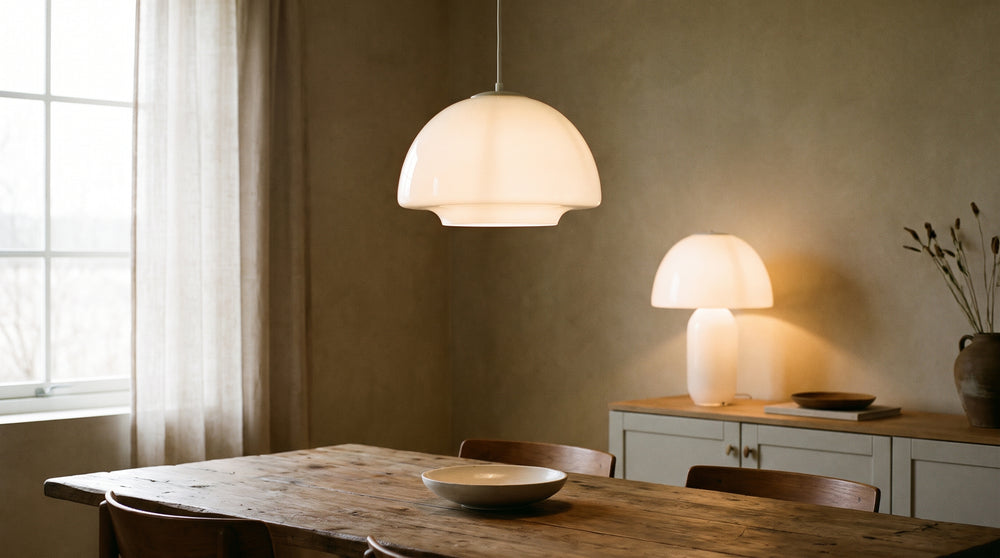
An interior that reflects who you are
Carefully selected pieces, shipped from our warehouses. Our team advises you before you buy, so you choose with confidence.
- Tracked delivery
- Pay in instalments, where available
- 14 days to change your mind
- Advice & showroom in Lyon, France
A white glass lampshade diffuses light instead of directing it into a beam: the room is lit more broadly, edges are softened and the bulb stays discreet. Before ordering, check your lamp's socket, the lampshade's fitting method and the diameter available around the bulb.
What light does a white glass lampshade give?
White glass diffuses light instead of directing it into a beam: the room receives an even brightness and edges are softened. Opal glass distributes light evenly, while clearer glass lets the bulb show and brings out contrasts more strongly.
Opal glass or clear glass: what it changes
Opal is glass made milky in the mass or by sandblasting: you cannot see the filament, and the light comes out like a uniform disc. Clear glass lets the source show, which gives more life and a sharper pattern on the wall. For a bedside lamp, opal remains more comfortable; for a hallway or a desk, clear glass embraces the contrast.
A white that lights without tinting the room
White glass does not colour the light, it keeps it neutral, whereas smoked glass leans towards amber and warms the halo. That is what makes this colour easy to pair with light wood, a grey wall or ecru fabric. If you want a more enveloping effect, compare with the black lampshades before deciding. Then browse the lampshade collection to see the available shapes, or go back to the Designix lighting catalogue if you are also looking for the base or the pendant.
How do I know if a glass lampshade will fit my lamp?
Three checks are enough: the lamp's socket type, the lampshade's fitting method and the space available around the bulb. Measure the base or the pendant before ordering, then compare them with the dimensions given on the model's page.
Check the socket and the fitting method before buying
An E27 socket and an E14 socket do not take the same collar, and a socket lampshade is not fitted like a clip-on lampshade on the bulb. Look at what is already in place on your lamp: screws, washer, clip or free-standing on a support. That detail decides compatibility, not the colour of the glass. The dimensions of each model appear on its page, in all the lampshades.
Measure the available diameter and height
Note the top and bottom diameter of the current lampshade, then the height between the socket and the top of the base. Glass weighs more than fabric: keep some clearance around the bulb so it is not pinched, and check that the shape does not exceed the width of the base, otherwise the whole looks perched too high.
| Light | Suitable shape | Direction of light | To check |
|---|---|---|---|
| Bedside lamp | Compact size, opal glass | Upwards and to the sides | Socket and stability of the base |
| Floor lamp | Large size, proportionate to the base | Upwards and around | Balance of the light |
| Pendant | Closed shape under the bulb | Downwards, onto the table | Hanging height |
| Wall light | Glass ball or tube | Towards the wall and the room | Wall fixing |
White and black glass lampshades: how do you match them in the same room?
White lights broadly and discreetly, black or smoked concentrates the light and highlights the lamp. In the same room, keep the same family of shape and change only the colour: white on the main light, black on a secondary point.
A white to diffuse, a black or smoked to highlight
A white glass lampshade goes unnoticed: it lights the wall without drawing the eye to itself. Black glass does the opposite, it cuts a sharp halo and becomes an object in the room. Smoked sits in the middle, it dims and warms. Only pair the two if the silhouettes echo each other, with the same curve and the same proportion.
Glass ball wall light, glass tube wall light: stay in the same family
A glass ball wall light and a glass tube wall light share the material and the transparency: it is the silhouette that changes, not the quality of light. Stick to a single shade of glass on the same wall, the difference shows when the bulb is on. For a bolder design, the modern selection plays with the same volumes using more graphic lines.
| Colour | Diffused light | Mood | Room |
|---|---|---|---|
| Opal white | Even, bulb invisible | Bright and calm | Bedroom, bedside, living room |
| Clear white | Contrasted, bulb visible | Lively and graphic | Hallway, desk, reading corner |
| Smoked glass | Tinted towards amber | Soft and enveloping | Mood wall, living room |
| Black | Marked halo, concentrated light | Sober and assertive | Living room, floor lamp |
Which glass lampshade for a bedside lamp?
On a bedside lamp, white glass should above all avoid glare: opal or slightly frosted glass works better than very clear glass when the lamp is at reading height. A compact format that lets light through upwards and to the sides remains the most comfortable.
Evening light in the bedroom
In the evening, the eye copes poorly with a direct source. Diffusing glass turns the bulb into a luminous surface: you read without having the hot spot in your field of vision. Avoid very clear thin glass on a low lamp, it reflects the bulb as it is. To match the rest of the room, see the bedroom lampshades.
Baby's room: what to check
Three points matter more than style: the stability of the light, the absence of an accessible edge at bed height and a lampshade fitting that cannot come loose. Opal glass gives a softer light than clear glass. The guidance in the baby room lighting collection helps you choose without overloading the room.
Which glass lampshade for a floor lamp?
On a floor lamp, a white glass lampshade is chosen first for its size: it must stay proportionate to the base and let the bulb breathe. Diffusing glass throws light upwards and to the sides, which lights the room without lighting the floor directly.
Light upwards or downwards: what the shape changes
An open shape at the top sends light towards the ceiling and lights by reflection, handy in a living room without a ceiling light. A closed shape under the bulb throws the flow downwards, towards an armchair or a coffee table. White glass keeps this light neutral, without tinting it amber as smoked glass would.
The weight and balance of the light
Glass weighs more than a fabric lampshade of the same size: check that the stem bears the load and that the base does not become too light at the top. A large lampshade on a thin base gives a fragile silhouette. If in doubt, a more compact size holds the whole better, and the shapes of the contemporary-design lampshades suit it well.
How do you match a white glass lampshade with a white chandelier or a glass wall light?
A white chandelier and a white glass lampshade go well together if both diffuse the same quality of light: opal glass with opal glass, clear glass with clear glass. Avoid mixing very clear glass and milky glass in the same room.
White living room chandelier and white bedroom chandelier: the same family of light
A white living room chandelier structures the space, a white bedroom chandelier is more discreet: in both cases, the texture of the glass must stay consistent with the lampshade of the accent lamps. A very fine white design chandelier works well with a simple glass lampshade. It is the mixing of textures, more than the colour, that creates dissonance.
Apply the same rule to a glass ball wall light
A glass ball wall light in clear glass goes with an opal lampshade on an accent lamp, provided both stay discreet. Group sources by family of glass rather than by shape. To get a sense of the volumes, start from the living room lighting.
Glass lampshade or fabric lampshade: which to choose?
Glass lets light through and cleans in one wipe, which suits rooms where the lamp stays on for a long time. Fabric absorbs light and makes it softer; it is chosen when you want very dimmed light or a colour that plays a part in the decor.
What glass gives that fabric does not
Glass lets light through: the room is lit more broadly with the same bulb. It does not stain in the weave, dusts off with a cloth and returns to its original look. In return, it shows fingerprints and feels heavy in the hand when changing the bulb.
When linen and fabric remain the best choice
When you want a very low light level, a textile absorbs and brings the light down: that is what you want in a child's room or a reading corner. Fabric lampshades and linen models offer a matte colour that glass cannot produce. If you want the opposite, to light without losing any flow, stay with the white lampshades.
How do you care for a white glass lampshade?
Unplug the lamp, remove the lampshade and wipe the glass with a soft, slightly damp cloth, then dry it to avoid marks. Avoid abrasive sponges and products that leave a film: white glass quickly shows marks and drips.
Clean without scratching or leaving marks
A damp microfibre cloth is enough for greasy dust. For fingerprints, a drop of washing-up liquid in water, then dry immediately with a dry cloth. Do not immerse the lampshade and never spray directly onto the fittings or the socket.
What damages a glass lampshade
Strong alcohol and abrasive powders dull the glass, and water that stagnates near the joints ends up leaving marks. Always handle the lampshade with both hands, lamp unplugged, so as not to pull on the socket. The black finishes need the same care, they show marks even more.
How do you order a white glass lampshade from Designix?
Three measurements to take on your lamp before comparing shapes: the socket type (E27 or E14), the fitting method and the diameter around the bulb. If you are hesitating between two shapes, start again from your lamp's measurements rather than from a photo. The Designix lighting catalogue lets you compare bases, pendants and lampshades within the same family of material, and the lampshade collection gathers the shapes to fit on an existing lamp.
Frequently asked questions
How do you restyle a glass table?
A glass table can be restyled without replacing it: a wooden or linen table runner, opaque objects placed on it and a matte top change the perception of reflections. On the lighting side, a diffusing white glass lampshade avoids adding a harsh reflection on the top.
Can you cover a glass table with wood?
Yes, most often with a wooden top placed on the glass or a veneer. Check the flatness of the glass, the weight the base can bear and access to the fixings before laying a solid top. The logic is the same as with an opal lampshade: reduce reflections.
Does a smoked glass wall light give less light than a white glass ball wall light?
Smoked glass absorbs part of the light and tints the halo towards amber, whereas white glass lets through a clearer, more neutral light. With the same bulb, a smoked wall light therefore appears softer and less bright: keep it for a mood wall.
Which bulb should you choose for a glass lampshade?
Respect the maximum wattage indicated on your lamp's socket and the bulb shape that fits inside the lampshade. An LED bulb heats less, which limits heating near the glass. If in doubt, the light's page and Designix customer service give the compatibility.
Is a white glass lampshade suitable for a baby's room?
Opal glass that diffuses light is more comfortable than very bright clear glass. Above all, check the stability of the light, the absence of an accessible edge and the lampshade fitting, then keep the lamp out of reach of the bed.




