
Vintage wrought iron chandeliers
This selection is also available in our French store: Lustres en fer forgé vintage
No products in this selection.
- Tracked delivery to your country Tracked delivery
- Secure payment at checkout Multiple payment methods
- 14 days to change your mind 14-day returns
- Secure payment Secure payment
Not sure of your style? Find it in 30 seconds
A few questions, and we will show you the pieces made for you.
Frequently asked questions
How do I choose the right product?
What are the delivery times?
Can I return an item?
Can I pay in instalments?
An interior that reflects who you are
Carefully selected pieces, shipped from our warehouses. Our team advises you before you buy, so you choose with confidence.
- Tracked delivery
- Pay in instalments, where available
- 14 days to change your mind
- Advice & showroom in Lyon, France
A vintage wrought iron chandelier is chosen on three measurements: the diameter in relation to the room, the distance between the bottom of the arms and the table, and the clear height under the fixture. Once these dimensions are set, the shade of the metal and the type of bulb determine the warm, contrasted look expected from a metal chandelier with patinated arms.
What light does a vintage wrought iron chandelier give?
A vintage wrought iron chandelier diffuses a warm light, directed downwards and softened by the dark patina of the metal. The open arms let the light flow between the bulbs, which illuminates without creating hard shadow areas. The result depends above all on the type of bulb and the number of light points.
Vintage wrought iron chandelier: patinated metal and bulbs, what changes the look
Patinated metal reflects little light: it absorbs part of the flow and strengthens the contrast between the visible bulbs and the dark background of the arms. That is what gives this impression of drawn light rather than a uniform wash. A filament bulb, around 2200 to 2700 K, maintains this warmth; a clear frosted glass bulb spreads the light and erases overly bright points. On a glass model, compare the vintage glass models: glass adds a diffusion that metal alone does not give.
Several arms or a single light point: what effect in the room
Multiplying the light points spreads the light and reduces cast shadows, which suits a table where people sit for a long time. A single point, as on a ceiling fixture, concentrates the light in the centre and leaves the corners darker. The chandelier with arms gives volume to the room because it occupies the vertical space; the single point goes unnoticed.
In which room should you install a vintage wrought iron chandelier?
It finds its place above a dining table, in the centre of a living room or in a hallway with a high ceiling. In a kitchen, it is reserved for rooms large enough that the chandelier does not get in the way of movement and does not catch cooking splashes.
Living room chandeliers: where to hang it without blocking movement
In a living room, the suspension point is placed at the centre of the free volume, not at the geometric centre of the room if the sofa shifts the use. Keep at least two metres ten of clearance under the bottom of the fixture in areas where people walk. If the ceiling is low, a ceiling fixture works better than a hanging chandelier; otherwise, turn to the vintage living room chandeliers. For a hallway, a more compact model is enough, and a fixture mounted flush with the ceiling avoids bumping the door.
Open or closed kitchen: pendant or wrought iron ceiling fixture
Around the hob and the sink, a low chandelier with arms should be avoided: grease splashes and steam dirty the metal and the glass. A side pendant or a ceiling fixture is preferred, kept away from cooking areas. An open kitchen onto the living area can take a chandelier above an island, provided the clearance height is respected. See the vintage kitchen chandeliers and, for a staircase, the large staircase heights.
Antique or new wrought iron chandelier: how to tell the difference?
An antique chandelier is recognisable by its irregular welds, uneven patina and slightly deformed arms, traces of hand work. A new model shows regular assemblies and a uniform finish. The original patina cannot be recreated identically.
Antique wrought iron chandelier: recognising a period patina, the kind from the 1950s
The period patina can be read in the recesses: darker where air and hands have not rubbed, lighter on the edges. It is irregular, never a regular gradient. A metal that has simply been tinted shows a continuous colour, including in the corners. Look also at the welds and the joints of the arms: a hand assembly leaves visible traces, an industrial mould leaves none.
Antique wrought iron chandelier second-hand: what to check before buying
Three checks are enough: the condition of the welds and arms, the presence of the cable and the fixing system, the compatibility of the sockets with common bulbs. An irregular patina is not a defect; pierced, cracked or uniformly repainted metal is one. The most elaborate pieces are found in our exceptional pieces.
How to choose the size and height of a wrought iron chandelier?
The diameter is estimated by adding the width and depth of the room, then keeping a circulation margin around the furniture. Above a table, the bottom of the chandelier sits at seated eye level, without ever blocking the view of the guests.
What diameter for a 20 m² living room?
The collection has 9 models, and their dimensions and features are listed on each product page. Compare these values with the room and the table to be covered: a chandelier wider than the table visually crushes it. The ceiling height and the footprint of the furniture remain the references to check before choosing.
At what height should a chandelier be hung above the table?
Count generally seventy-five to eighty-five centimetres between the table top and the bottom of the fixture. This distance lets you see the guests opposite while keeping the chandelier in the field of vision. For a high ceiling or a low table, adjust downwards. In the dining room chandeliers, this dimension is the one that most changes comfort.
Ceiling fixture or wrought iron chandelier: which to choose?
The vintage wrought iron ceiling fixture suits low ceilings or passages where people move: it stays flush and does not get in the way. The chandelier with arms is chosen when you want to mark a volume, above a table or in a large living room, and you have clear height available.
Vintage wrought iron ceiling fixture: when height is lacking
Under a 2.40 m ceiling or in a corridor, a hanging fixture reduces the useful clearance. The ceiling fixture keeps the clear height, lights widely and is cleaned without a stepladder. It also suits rooms where the chandelier would be in line with a door. For a more diffused look in these volumes, the glass models for living rooms complete the comparison.
Metal chandelier: volume above a table
The chandelier structures a room: its arms draw a silhouette above the table and occupy the available height. It requires a solid fixing point and enough clearance so that it is not bumped when standing up. The Designix lighting catalogue brings together both families, pendant and ceiling fixture, in all our light fixtures.
How to match a wrought iron chandelier with vintage decor?
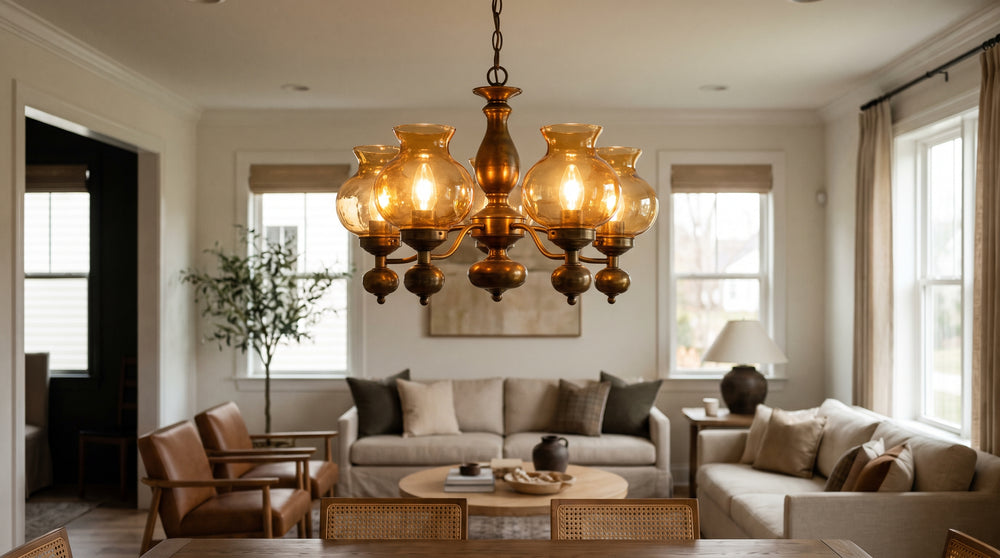
Wrought iron goes with patinated leather, old wood and matte fabrics, because its dark shade and irregular shape belong to the same register. Avoid adding chrome or glossy lacquer that clashes with the patina, and repeat the metal shade on another object.
Wrought iron, vintage leather and old wood: the combinations that hold
A vintage leather armchair and a patinated metal chandelier work together because they share a deep shade and visible wear. Old wood brings the same warmth without competing with the metal. The principle is to keep one dominant metal and one dominant wood, without multiplying shades. A wood and wrought iron bench in a hallway calls more for a ceiling fixture than a low chandelier.
Gold, silver or blackened metal: which harmony to choose
Blackened or patinated metal warms the light and goes with dark woods. The gold finish reflects more and suits light rooms; see the gold-finish metal chandeliers. Silver gives sharp reflections, closer to a contemporary interior, to compare in the silver finishes. Crystal remains separate: it diffracts the light and takes over from the metal, as in the crystal chandeliers for living rooms.
| Finish | Light rendering | Where it works | Care |
|---|---|---|---|
| Patinated wrought iron | Warm, contrasted, little-reflected light | Living room, dining room, hallway in an old style | Dry cloth, never abrasive |
| Gold-finish metal | Warmed light, visible reflections | Dining room, bedroom, light hallway | Soft cloth, avoid standing water |
| Silver-finish metal | Colder light, sharp reflections | Contemporary interior, kitchen | Microfibre cloth |
| Glass | Diffused light, less contrast | Small rooms, low ceiling | Soapy water on the glass only |
| Crystal | Sparkles and diffraction, strong decorative effect | Large living room, dining room | Clean piece by piece |
How to install and maintain a wrought iron chandelier?
Installation requires a solid fixing point, suited to the weight of the fixture, and a connection made with the power off. For maintenance, a dry cloth is enough: abrasive products remove the patina, which is precisely what gives wrought iron its original look.
Fixing and connection: what to prepare
Before drilling, identify the type of support: concrete slab, plasterboard or panelling do not call for the same anchor. A chandelier with arms is heavy and hangs; the anchoring point must be sized for this weight, and for a hollow ceiling, a crossbar taking two points is better than one. The connection is made after switching off the power at the circuit breaker, and the length of chain and cable is checked before hoisting the fixture.
Cleaning patinated metal without removing the patina
A dry or slightly damp cloth is enough on the metal. Abrasive sponges, alcohol and descalers attack the patinated layer and reveal the bare metal, lighter and impossible to re-tint evenly. Glass and crystal are cleaned separately, with soapy water, then dried to avoid marks. For the care of models lit differently, see the LED versions for living rooms, less frequently replaced.
What budget should you plan for a vintage wrought iron chandelier?
What makes the price vary? Size, number of arms and the work on the metal. The price grid shown on each page of the 9 models gives the exact price. Accessible models are often in thinner metal and with a uniform finish; exceptional pieces are recognisable by the casting, the hand-forged details and the worked patina.
What makes the price of a metal chandelier vary
Diameter and number of light points count first: more arms means more metal, more sockets and more assembly time. The manufacturing method weighs next: thick casting and hand-forged elements cost more than folded sheet metal. Finally, the addition of glass, crystal or a patinated finish worked in several passes moves the model towards the top of the catalogue.
Accessible model or exceptional piece: how to tell
An accessible model shows a continuous shade, regular arms and discreet welds. An exceptional piece shows the hand: irregular edges, added details, nuanced patina. Between the two, there are intermediate steps. The current price is shown directly on the collection grid, which avoids ranges that age badly. To place each level, browse the bohemian crystal models and the modern metal chandeliers.
| Room | Recommended type | What matters most | To avoid |
|---|---|---|---|
| Living room | Hanging chandelier with arms | The diameter in relation to the clearance of the armchairs | A model that hangs below the seated field of vision |
| Dining room | Chandelier at the centre of the table | The distance between the table and the bottom of the chandelier | A chandelier wider than the table |
| Hallway | Ceiling fixture or small chandelier | The clear height under the fixture | A model that interferes with a door opening |
| Open kitchen | Metal pendant or ceiling fixture | The distance from cooking and water areas | A chandelier with arms above the hob |
| Staircase | Long-chain chandelier | The total available height | A fixing not suited to the weight |
| Bedroom | Small chandelier or gold-finish ceiling fixture | A soft, non-directed light | Too direct a flow above the bed |
Once the room and the dimension are chosen, the remaining choice comes down to the finish: browse design chandeliers for dining rooms or, for a hallway, the hallway light fixtures, and keep in mind the metal shade already present in your home.
- Secure payment on the Designix shop.
- Tracked delivery, with a parcel to be received carefully, as a chandelier remains fragile.
- Returns possible if the model does not match the dimensions taken.
- Designix customer service to check a dimension before ordering.
Frequently asked questions about vintage wrought iron chandeliers
How to recognise an antique wrought iron chandelier?
An antique wrought iron chandelier shows irregular welds, slightly asymmetrical arms and an uneven patina, darker in the recesses. The finish is never perfectly uniform. A new model, on the other hand, shows regular assemblies and a continuous shade over the whole surface.
Can you buy an antique wrought iron chandelier second-hand?
Yes, provided you check three points: the condition of the welds and arms, the presence of the cable and the fixing system, and the compatibility of the sockets with common bulbs. An irregular patina is not a defect, pierced or cracked metal is one.
Does a wrought iron chandelier go with a vintage leather armchair?
Yes, both share a deep shade and a patinated look that work together. Simply avoid adding chrome metal or glossy lacquer nearby, which clashes with aged leather. Repeating the shade of the chandelier on a base or a frame is enough to tie the whole together.
How to pair a wrought iron chandelier with a wood and wrought iron bench?
A wood and wrought iron bench and a patinated metal chandelier answer each other through the metal and the wood, provided you do not multiply shades: keep one dominant metal and one dominant wood. An old wrought iron bench in a hallway calls more for a ceiling fixture than a low chandelier.
Feng shui open or closed kitchen: where to place the light?
Feng shui sets no standard for electrical installation. It recommends a soft, spread light rather than a single dazzling point. In practice, in an open or closed kitchen, avoid hanging a chandelier with arms right above the hob and prefer a ceiling fixture or a side pendant.




