
Vintage LED string lights
This selection is also available in our French store: Guirlandes LED vintage
No products in this selection.
- Tracked delivery to your country Tracked delivery
- Secure payment at checkout Multiple payment methods
- 14 days to change your mind 14-day returns
- Secure payment Secure payment
Not sure of your style? Find it in 30 seconds
A few questions, and we will show you the pieces made for you.
Frequently asked questions
How do I choose the right product?
What are the delivery times?
Can I return an item?
Can I pay in instalments?
An interior that reflects who you are
Carefully selected pieces, shipped from our warehouses. Our team advises you before you buy, so you choose with confidence.
- Tracked delivery
- Pay in instalments, where available
- 14 days to change your mind
- Advice & showroom in Lyon, France
A set of vintage LED string lights is a string light where the bulbs stay visible and give off a warm, golden light close to incandescent while using little power. The effect comes from the number of bulbs, their shape and the spacing of the cable, not from wattage alone: these are the three things to settle before choosing the power supply and the protection rating.
- What light do vintage LED string lights give
- Where to install them, from the tree to the terrace
- Which IP protection rating to choose
- Mains, 24V, solar or rechargeable
- Cable length and number of bulbs
- How to hang and connect them
- Care and storage
What are vintage LED string lights and what light do they give?
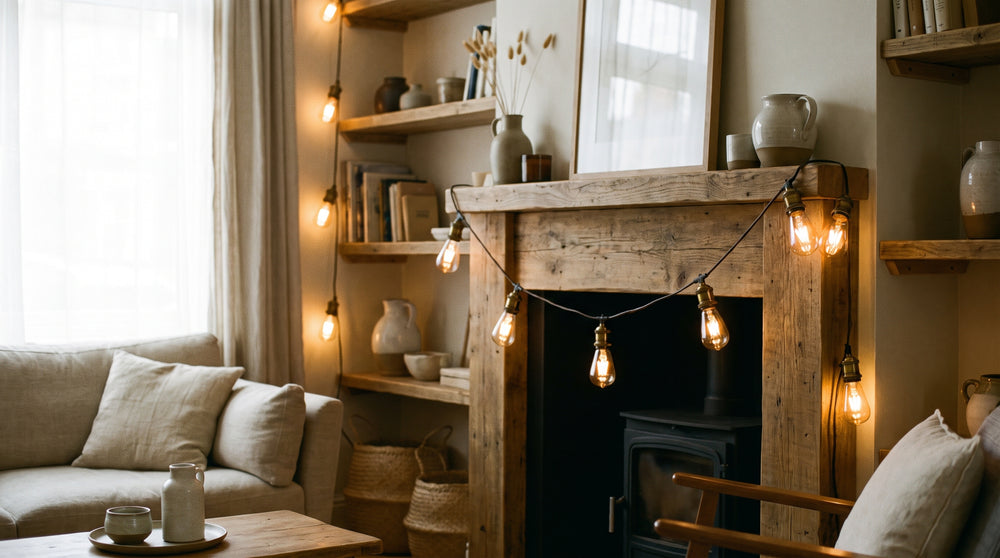
Vintage LED string lights are recognisable by their exposed bulbs: the filament stays visible through clear or amber glass, and the light comes out as a warm halo rather than a sharp point. That is what sets the bistro look apart from simple accent lighting.
Vintage string lights: visible bulbs and warm light
The filament draws a luminous line that the eye follows, and the slightly tinted glass warms the hue further. On this type of product, colour temperatures generally sit between 2700 and 3000 kelvins, a warm white range that leans golden. E27 socket models take larger bulbs, E14 ones slimmer bulbs, which changes the visual density of the arrangement. Cable spacing matters as much as the bulb: tight, it makes a curtain of light; wide, it leaves pools of shadow that create the terrace effect. To compare styles, browse the decorative string lights.
Retro LED string lights or classic LED string lights: what is the difference?
Retro relies on bulbs with a visible filament and often a textured cable, with an openly old-fashioned spirit. Classic stays more discreet: small points of light, a thin cable, a light presence on a wall. The deciding factor is not the technology but the effect: bulbs to look at, or accompanying light. Both families are gathered in the LED string lights collection.
Where to install vintage string lights?
They go anywhere the cable can follow a clean line: facade, pergola, balcony, stair rail, headboard, Christmas tree. Indoors, aim for a wall or a corner worth highlighting; outdoors, choose a model protected against damp and avoid hollows where water collects.
For a Christmas tree, start at the bottom and from the inside of the branches, working outwards: the string settles into the hollow of the branches, not on top of them. On a terrace, follow a roof edge, a beam or a pergola arch, keeping the same direction of unwinding to avoid crossings. A sheltered balcony corner easily takes IP44 LED string lights for covered terraces. To place these models within the rest of the range, take a look at our lighting catalogue.
| Use | Recommended power supply | Protection rating | What matters most |
|---|---|---|---|
| Living room, headboard, indoor wall | 220V mains or rechargeable | Unprotected or IP44 | Warm light and bulb spacing |
| Covered terrace, awning, sheltered balcony | 220V or solar | IP44 | Cable length and fixing points |
| Garden, facade, hedge exposed to rain | 220V or solar | IP65 | Watertightness of the connections |
| Indoor Christmas tree | 220V mains | Unprotected | Density and shape of the bulbs |
| Bistro and outdoor receptions | 220V or 24V with transformer | IP44 to IP65 | Consistency of the effect along the length |
Indoors or outdoors: which IP protection rating to choose?
The IP rating gives resistance to dust and water. Indoors, an unprotected model is enough. Under an awning or a covered terrace, IP44 protects against splashes. Outdoors in the rain, IP65 withstands water jets. A higher rating never removes the need to take care with the connections.
The weak point of an outdoor installation is the connection, not the bulb. A connector block left on the ground, a plug dangling under the gutter, a connector left uncovered: water gets in there even on a well-protected model. Raise the connection, shelter it under a cover or in a closed box, and check that the cable does not form a pocket at its lowest point. IP65 LED string lights are designed to stay outside in the rain, not to be submerged.
| Protection rating | Resists | Typical location | Avoid |
|---|---|---|---|
| Unprotected | Nothing in particular | Living room, bedroom, tree | Outdoors and damp |
| IP44 | Water splashes | Covered terrace, awning, sheltered balcony | Water jets and immersion |
| IP65 | Water jets | Facade, garden, hedge | Immersion |
Mains, solar or rechargeable: which power supply to choose?
220V string lights plug into a socket and suit long lengths. A 24V version goes through a transformer and is reserved for small spaces. Without a socket, solar works outdoors with enough sunlight, while rechargeable can be charged and then moved anywhere.
220V or 24V string lights: what it changes for installation
With 220V, you need a socket nearby and an extension lead if the run is long; it is the simplest solution for covering a facade or a pergola in one go. With 24V low voltage, the transformer becomes the central point: that is what you hide, not the string lights. The benefit of 24V shows on small set-ups, a window ledge, a shelf, a counter top. Compare 220V string lights and 24V low-voltage string lights according to the length to cover.
Solar or rechargeable string lights: lighting without a socket
Solar is installed where the panel gets daylight, otherwise it lights up little or not at all: a south-facing balcony, an open pergola, a low wall. Rechargeable does not depend on the sky: you charge it from the mains, then hang it where no socket exists, including indoors. Solar string lights without a socket suit sunny outdoor spots, rechargeable string lights suit portable uses and dark corners.
How many bulbs and what length for my tree or facade?
Start from the length to cover, not the number of bulbs. Measure the run to follow, add enough for the returns and curves, then take the nearest cable length. Tight spacing gives a dense effect, wide spacing a more airy bistro effect.
Diamond vintage string lights: what effect does the bulb shape give?
The so-called diamond bulb has facets that send the light back in small glints rather than a uniform halo. The effect looks more sparkling, especially on a tree or a facade where the eye catches the reliefs. It is a mood choice: the shape changes the way the light scatters, not the cable length needed.
Cable length or number of bulbs: what to look at first?
Length first, because it decides whether the set-up holds or stops halfway along a branch. The number of bulbs comes next and sets the density: on a tree, you want presence in the hollows; on a beam, a regular line is enough. If you hesitate between two lengths, take the longer one and keep the surplus in reserve at the end, never spread loosely in the middle. Details of the models with visible bulbs can be found in the string lights with visible bulbs.
How to hang and install vintage string lights?
Stretch the cable without pulling it taut, with regular fixing points and a slight slack between two fastenings to absorb the wind. Keep the plug out of reach of water, avoid stacking several connections in the same place and check the height above a table before fixing.
How to stretch string lights across a facade or a pergola?
Start with a fixed point at one end, unwind without pulling, then add the fastenings as you go, keeping a light touch: a cable that is too taut strains the solder joints at the first gust of wind. Above a garden table, the string lights should stay high enough not to get in the way and be visible without looking up. One hook roughly every metre is usually enough to hold a straight line.
Where to plug in string lights when the socket is far away?
Three options depending on the set-up: an outdoor extension lead placed away from run-off areas, a solar model with the panel facing full daylight, or a rechargeable model hung without a power cable. Solar models avoid any trench and any extension lead on a terrace. If the socket exists but stays indoors, run the cable through an opening already protected from the rain rather than under an open window. For a long, permanent installation, go for 220V mains string lights.
Designix reassurance: secure payment, tracked delivery, returns and Designix customer service to help you choose the length and power supply.
How to care for and store vintage string lights so they last?
Switch off the power before cleaning, dust the bulbs dry and wipe the cable with a barely damp cloth. When storing, coil without bending on a wide support, away from damp. IP65 string lights are made for outdoors, never for immersion.
Can vintage string lights be left outside all year round?
It all depends on the rating: an IP65 model withstands continuous outdoor exposure in the rain, an IP44 one is limited to a covered terrace. In both cases, protect the connections, check after heavy rain that water is not pooling in a pocket of cable, and bring the whole set in if a storm is forecast.
How to store bistro string lights without damaging the bulbs?
Coil them loosely around a wide board, a cut-out piece of cardboard or the original spool: wide loops avoid bending the wires right at the base of the socket, the place that breaks first. Store in a dry place, away from frost, and note the length on the packaging for the following season.
One last marker before ordering: define the location, then the protection rating, then the length. To compare the families and find the model that matches your facade or your tree, browse all Designix lighting and the classic LED string lights.
Frequently asked questions
Which vintage string lights for a Christmas tree?
Choose mains-powered string lights for indoors, with visible bulbs and a spacing suited to the density of the tree: tight for a dense effect, wider for a bistro effect. Choose the length by measuring around the branches, not at random.
What is the difference between retro LED string lights and classic LED string lights?
Retro plays on bulbs with a visible filament and warm light, in an old-fashioned spirit. Classic stays more discreet, with small points of light and a thin cable. The choice depends on the effect you want: bulbs to look at or accent light.
Can vintage string lights be left outside all year round?
It depends on their protection rating: an IP65 model withstands water jets and outdoor exposure, an IP44 one is limited to a covered terrace. In every case, protect the connections, avoid areas where water collects and never immerse the string lights.
How to install vintage string lights when there is no socket?
Turn to a solar model if the spot gets sunlight during the day, or to rechargeable string lights that you charge and then move. Both solutions avoid the power cable and suit balconies, pergolas and distant garden corners.
Diamond vintage string lights: what effect does this bulb shape give?
The so-called diamond bulb has facets that send the light back in small glints rather than a uniform halo. The effect looks more sparkling, especially on a tree or a facade. The bulb shape changes the mood, not the cable length to plan for.




