
Vintage brass wall sconces
This selection is also available in our French store: Appliques murales en laiton vintage
No products in this selection.
- Tracked delivery to your country Tracked delivery
- Secure payment at checkout Multiple payment methods
- 14 days to change your mind 14-day returns
- Secure payment Secure payment
Not sure of your style? Find it in 30 seconds
A few questions, and we will show you the pieces made for you.
Frequently asked questions
How do I choose the right product?
What are the delivery times?
Can I return an item?
Can I pay in instalments?
An interior that reflects who you are
Carefully selected pieces, shipped from our warehouses. Our team advises you before you buy, so you choose with confidence.
- Tracked delivery
- Pay in instalments, where available
- 14 days to change your mind
- Advice & showroom in Lyon, France
Place a vintage brass wall light wherever you want low, directed light: on either side of a sofa or a bed, along a staircase or in a hallway. Brushed brass gives a matte finish, polished brass throws bright highlights, and the socket base determines which bulb can fit.
- Where to place them
- In the living room
- In an adult bedroom
- Brushed, polished, gold
- 1930s art deco style
- On a staircase
- Matching a vintage decor
- Technical criteria
- Frequently asked questions
Where are vintage brass wall lights best suited?
A vintage brass wall light goes wherever you want low, directed light: on either side of a sofa or a bed, along a staircase, in a corridor or a hallway. It replaces a table lamp and frees up floor space. Brushed brass gives a matte finish, gold a brighter one.
Living room or adult bedroom wall lights: what is the difference in use?
In a living room, the light grazes the wall and highlights a frame, a bookcase or a wall covering. In an adult bedroom, it is mainly used for reading without lighting the whole room. A living space often needs two light points, a bedroom one on each side of the bed. For a tight space, see how to light a hallway or arrange a narrow corridor without cluttering the passage.
Can a brass wall light be installed in a damp room?
Yes, provided you choose a model whose ingress protection rating matches the zone. In a bathroom, the area around the sink and bathtub requires a high IP rating, while a standard model is enough elsewhere in the room. Brass holds up well there, its patina simply developing faster if the room is poorly ventilated. Our selection of brass for the bathroom specifies these ratings, and the IP44 collections cover locations exposed to splashes.
| Room | Role of the light | Model to favour | Point to watch |
|---|---|---|---|
| Living room | Warm accent light along the sofa or a bookcase | Adjustable model, standard socket | Do not replace the ceiling light, avoid glare on screens |
| Adult bedroom | Reading and atmosphere, on either side of the bed | Adjustable model, low output possible | Glare for the person sleeping next to you |
| Staircase | Lighting the steps and a night guide | Single or paired wall light, directed light | Keep the source out of the line of sight when climbing |
| Hallway and corridor | Welcome light, tight space | Compact format, light directed upwards | How far the model protrudes into a narrow passage |
| Bathroom | Lighting the mirror or the room | Model suited to damp conditions | Insufficient IP rating in splash zones |
| Kitchen | Worktop or dining area | Wall light fixed under the upper cabinets | Heat given off by the bulb near the cabinets |
In a kitchen, it is usually placed under the upper cabinets to light the worktop without casting shadows, as shown by the vintage wall lights for the kitchen. Outdoors, the reasoning changes: a sheltered facade is fine with a standard model, an exposed terrace calls for a waterproof outdoor model or a brass outdoor model.
Which wall lights should you choose for a living room?
In a living room, the wall light does not replace the ceiling light: it lights the wall rather than the room. Placed on either side of a sofa or a bookcase, it creates a warm accent light, brings out the texture of the brass and lets you light only the area where you read.
Living room wall lights: at what height should they be placed?
Think in relation to the seat and the eye line, not the tape measure alone: the source goes above the back of the sofa and below eye level when seated, so that it lights the book or the wall without shining straight into your eyes. Two wall lights framing the sofa should be placed at the same height, at equal distance. Many LED wall lights for the living room come in this paired format.
Do you need a dimmable model for a living room?
Useful but not essential. A dimmer lets you lower the light late in the evening without switching it off, which avoids the abrupt jump from a lit room to a dark one. You then need a dimmable bulb, otherwise dimming does not work. Dimmable models often have the control on the cable or on the backplate.
Which wall lights for an adult bedroom?
In an adult bedroom, the wall light replaces the bedside lamp and frees up the bedside tables. Placed on either side of the bed, it provides reading light and ambient light. An adjustable model and a low-output bulb prevent glare for the person sleeping next to you.
Can a bedside lamp be replaced by a wall light?
Yes, and you save space: no more trailing cable, no more lost space on the table. On the other hand, the position is fixed, so you have to decide it once and for all. Plan for installation at shoulder height when sitting up in bed, and angle the shade downwards or towards the book. Our LED bedroom lighting gathers the compact formats suited to this position.
How can you light without disturbing the other side of the bed?
By directing the light downwards and towards the wall, never towards the centre of the bed, and by choosing a low-output bulb. An adjustable source, or a shade that is opaque on top, keeps the light on your side. Warm light, around 2700 K, is less tiring for the eyes when reading, depending on individual habits.
What is a brushed brass light and what kind of light does it give?
Brushed brass is brass whose surface has been rubbed to obtain a matte look, without mirror reflections. It reflects a soft, warm light, less bright than polished or gold brass, and develops a patina slowly without changing colour. It suits rooms where you want to avoid reflections.
Brushed or polished brass: which should you choose?
| Finish | Appearance | Reflected light | Where it works best |
|---|---|---|---|
| Brushed brass | Matte, fine grain, few reflections | Soft, diffuse, without marked highlights | Living spaces where you want to avoid reflections |
| Polished brass | Shiny, almost mirror-like | Bright, with points of light | Hallways, corridors, dark rooms to brighten |
| Gold-coloured brass | Warm and luminous, strong shine | Warm, enhances light materials | Classic interiors and light decors |
| Antique bronze | Dark, patinated, matte | Very soft, absorbed | Vintage decors, dark wood, patinated leather |
Brushed brass blends in, polished brass draws the eye. A dark room or a corridor benefits from polished brass that wakes up the wall; a bright living room with a television screen will prefer brushed brass to limit reflections. See the gold finishes for a stronger shine, and all the vintage metal wall lights to compare materials.
Does brass develop a patina over time?
Yes, brass changes: it darkens slightly and develops a patina that gives it a deeper tone. This happens faster in a damp, poorly ventilated room and more slowly in a dry one. Solid brass develops a surface patina and can be repolished; plated brass may reveal the underlying metal if rubbed too hard, hence maintenance limited to a soft cloth.
How can you recognise a 1930s art deco wall light?
A 1930s art deco wall light is recognised by its geometric, symmetrical lines: fans, arcs, squares, repeated ridges, often in brass or bronze, with frosted or moulded glass. It lights upwards or downwards rather than to the sides, which creates marked cones of light.
1930s art deco wall lights: how can they be integrated into a modern interior?
Contrast does the work: a plain wall, a discreet wallpaper, or on the contrary a dark background that brings out the brass pattern. Pair them with contemporary furniture with straight lines, avoiding combining them with other highly ornate pieces. The vintage glass wall lights and the models combining brass and glass give an idea of the shapes available today.
Which bulb for an old art deco wall light?
A filament bulb, with an E27 or E14 base depending on the socket, respects the spirit of the period with its warm light. Above all, check the maximum power allowed by the original socket and do not exceed it: old sockets heat up. A low-power LED bulb, around 2700 K, remains a cautious option.
How do you install wall lights on a staircase?
On a staircase, the wall lights are placed out of the way, at hand height, one per landing or at regular intervals along the wall. Avoid placing the source in the line of sight when climbing, so as not to dazzle, and direct the light towards the steps rather than into the room.
Staircase wall lights: at what height should they be fixed?
First find the hand line, then place the source a little above it, out of children's reach and away from shoulders. One wall light per landing is often enough, rather than a tight alignment that slices the stairwell into strips. What matters is that each flight of steps is marked without shadow areas. See the design wall lights for staircases.
How can you coordinate the wall lights with the handrail?
Align the height of the wall lights with that of the handrail, or offset them clearly to avoid a staircase effect within the staircase. The same brass finish for the handrail and the wall lights holds the whole together; mixing two metals requires more precision. Also think about running the cables in a stairwell, which is often difficult to redo afterwards.
How can you match a brass wall light with a vintage decor?
Brass goes well with warm, patinated materials: leather, dark wood, smoked glass, patterned textiles. Choose a single family of metal per room and repeat it, or mix brass and bronze letting brass dominate as accents, never in equal parts between the two.
Brass and bronze: can the two be mixed?
Yes, provided you set a hierarchy: one metal leads, the other punctuates. A dominant light brass, with a dark bronze on a frame or a handle, works; two metals in equal parts create visual hesitation. Consistency from one room to another also matters, browse all our lights to check your finishes.
Brass wall light and vintage leather armchair: what is the right match?
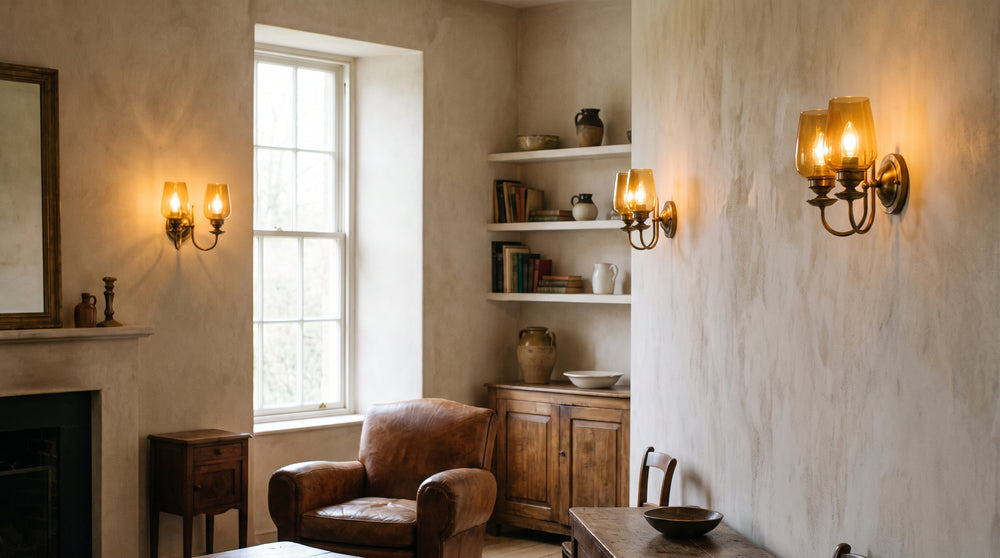
Warm brass and patinated leather share the same family of tones, so let them talk without adding cold metal. Place the wall light so that its grazing light caresses the leather: it reveals the nuances and marks of time. This is one of the rare cases where a very grazing light looks better than frontal lighting.
Which technical criteria should you check before buying a brass wall light?
Four points are enough: the socket and the maximum power allowed, the IP protection rating depending on whether the room is dry or damp, the material of the support (solid or plated brass) and the presence of a dimmer. These elements determine the bulb to plan for and the places where the wall light can actually be installed.
Which bulb should you choose according to the wall light socket?
An E27 socket takes large screw bulbs, common and available in many shapes and temperatures; an E14 socket only takes small screw bulbs, which are rarer, for compact wall lights. Some wall lights include a non-replaceable LED: the temperature is then set by the manufacturer. E27 wall lights remain the most flexible choice. Never exceed the maximum power indicated on the socket.
IP44, IP20: what is needed for a bathroom?
The IP rating describes resistance to dust and water. In a splash zone, around the sink, bathtub or shower, a high IP is required; elsewhere in the room, an ordinary model is fine. Compare the IP44 collections and the vintage bathroom models before making your choice.
Secure payment, tracked delivery, returns and Designix customer service: once you have noted your dimensions and socket, all that remains is to choose the format that fits the available wall space.
Frequently asked questions about brass wall lights
What is the value of a brass light?
It depends on the material, the age, the finish and the condition, not on the word brass alone. Solid brass that has kept its patina, intact glass and a complete support count for more than repolished plated brass. For a wall light, the same criteria apply.
How can you recognise a high-end design wall light?
It is judged on the material and the details: solid rather than plated brass, clean welds, thick glass, fixings supplied, even finish right into the corners. A high-end model also gives controlled light, without direct glare, and ages without deteriorating.
How do you care for a brushed brass wall light?
A soft cloth is enough for dust. Avoid abrasive products and polishing pastes, which erase the brushed grain and reveal irregular shiny areas. To revive polished brass, a specific product is used occasionally, on a small area tested beforehand.
Can a new wall light be combined with a second-hand vintage leather armchair?
Yes, and it is often the difference in finish that makes the whole readable. Above all, check the shade of the brass, brushed or polished, and the bulb temperature: light that is too cold makes leather look dull, warm light warms it further. The condition of second-hand furniture is no obstacle.
Which socket and which type of bulb for a brass wall light?
It all depends on the model: E27 wall lights take large screw bulbs, E14 models take small screw sockets, and some wall lights include a non-replaceable LED. The product sheet indicates the socket and the maximum power allowed, which must not be exceeded.




