
Solar stair lamps
This selection is also available in our French store: Lampes à poser solaires pour escalier
No products in this selection.
- Tracked delivery to your country Tracked delivery
- Secure payment at checkout Multiple payment methods
- 14 days to change your mind 14-day returns
- Secure payment Secure payment
Not sure of your style? Find it in 30 seconds
A few questions, and we will show you the pieces made for you.
Frequently asked questions
How do I choose the right product?
What are the delivery times?
Can I return an item?
Can I pay in instalments?
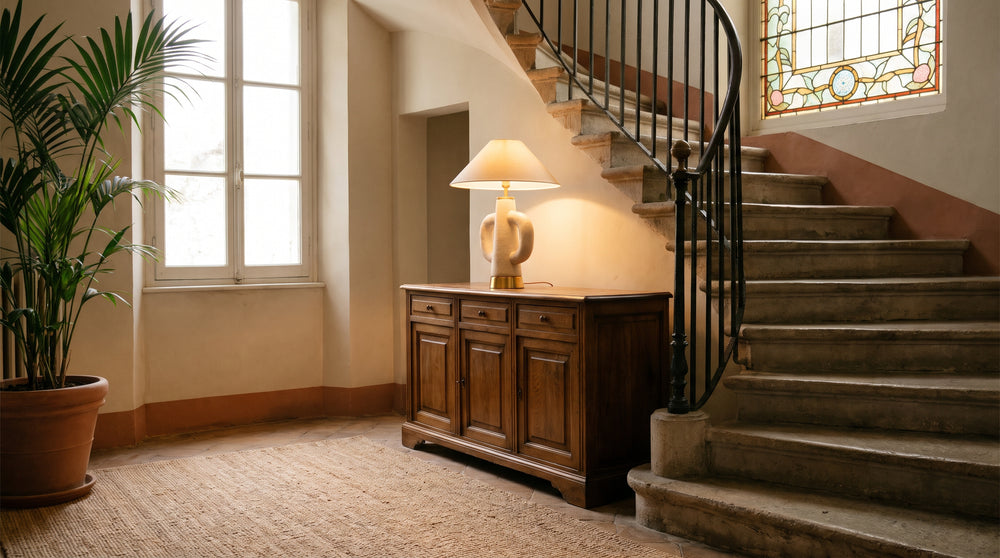
An interior that reflects who you are
Carefully selected pieces, shipped from our warehouses. Our team advises you before you buy, so you choose with confidence.
- Tracked delivery
- Pay in instalments, where available
- 14 days to change your mind
- Advice & showroom in Lyon, France
Plan for one light point per step, on the tread nose, the riser or the low wall, with the solar panel facing the sky and clear of the handrail. A solar step light needs no wiring: it marks the stairs on its own, provided daylight recharges its battery every day.
What light does a solar step light give on a staircase?
On a staircase, a solar step light mainly acts as a marker: it outlines the steps so they can be seen without switching on the whole stairwell. The light comes from LEDs, in warm white or cooler white depending on the model, and switches on as daylight fades or when someone passes.
Warm white or cool white: which for a staircase?
Warm white (around 2,700 to 3,000 K) recalls a classic bulb and suits a house staircase in wood or stone, especially if it opens onto the living room. Neutral or cool white makes edges sharper and reads better outdoors, on concrete or metal. A useful general rule: the cooler the tint, the more clearly the step reads, the less warm the whole effect. Adjustable models also let you aim at the step nose rather than the wall.
Should every step be lit or only the landings?
One light per step is a lot for a daytime staircase; one light every two or three steps is enough to read the rhythm of the flight in the dark. Reserve the landing and the last step for a dedicated point, as these are where people stop and where the eye looks for the floor. On a narrow flight, two lights facing each other draw a discreet corridor of light.
| Tint | Perceived effect | Where to use it |
|---|---|---|
| Warm white | Soft light, close to a classic bulb | House staircase, wood, stone |
| Neutral white | Clear reading of the steps | Outdoor staircase, concrete, metal |
| Cool white | Strong contrast | Garden path, terrace edge |
Where to install solar step lights on an outdoor staircase?
On an outdoor staircase, the light sits on the step, the riser or the low wall bordering the flight, in a spot that receives sun during the day. The solar panel must stay clear, otherwise the energy reserve will not recharge enough for the night.
Solar step lights for outdoor stairs: tread, riser or low wall?
The riser is the most discreet place: the light does not protrude into the passage and the light goes downwards. The tread is more exposed to feet and brooms, but is easier to spot from the terrace. The low wall offers the best clearance for the panel and keeps the light out of the rubbing zone. In any case, check that the handrail does not cast its shadow on the panel during useful hours.
How to keep the panel in the sun?
Track the sun's path over the flight before sticking or screwing: a panel placed on the north side, or under a canopy, recharges poorly. Keep the light away from a high wall, a bush or a planter that grows, and trim whatever masks the panel. Design LED models with a tilted panel often adjust better than a flat surface.
Can a solar step light be installed on an indoor staircase?
On an indoor staircase, solar only works if daylight reaches the panel, through a skylight, a window or a light well. Without direct input, the battery does not recharge: a wall light or a mains-powered step light is then the better choice.
Indoor staircase wall light or a light placed on the step?
A wall light requires drilling and an electrical supply, but it reliably lights all year round. A light placed on the step requires nothing and can be moved; it remains the right answer under a skylight or in an open stairwell onto a bright living room. For a windowless stairwell, compare with design table lamps for the living room and their plug-in versions.
Does a metal cage let light through?
An openwork cage, in metal or wire, lets the beam filter through and suits a staircase where you want light without a too-marked point. A closed cage, or an opaque shade, concentrates light downwards and suits a landing better. The right rule is simple: whatever hides the bulb must let the beam through towards the step, not towards the eye.
| Situation | What matters | Suitable solution | What to check on the spec sheet |
|---|---|---|---|
| Garden staircase very exposed to sun | Recharging and moisture resistance | Solar light placed on step or low wall | Protection rating and intended fixing |
| Indoor staircase under a skylight | Daylight on the panel | Solar light if the panel is lit, otherwise a mains model | Stated runtime and switch-on mode |
| Dark stairwell | No possible recharging | Wall light or plug-in table lamp | Power and socket type |
| Old wooden staircase | Do not damage the step | Adhesive fixing or clamp | Type of mount supplied |
How to connect several lights to a single power supply?
Solar lights are not wired: each carries its own panel and battery, so no cabling needs to be run between the steps. If you choose plug-in models, several points can run from the same supply, within the circuit's power limit and with an electrician's advice.
What if the staircase already has a power supply?
An existing supply can be reused for a plug-in model, but the number of points depends on the cable cross-section and the circuit protection: that is an electrician's job, not a counter calculation. If no supply exists, the solar version remains the simplest, with no chasing or conduit. Also see the white finishes for a light-coloured painted wall.
Motion sensor or dusk switch-on: what does the trigger mode change?
A dusk sensor switches on all night as soon as daylight fades: handy for a path, more demanding on the reserve. A motion sensor only switches on when someone passes: the battery lasts longer, but the step stays dark until you move. On a short flight, the sensor is enough; on a long flight, prefer continuous marking.
How to fix a solar light on a step without damaging the staircase?
The fixing depends on the surface: adhesive or magnetic strip for a smooth, clear step, screws and plugs for a porous surface or one exposed to wind. Mark the fixing point before drilling, at step height on the wall side, to light the step nose without glare.
Adhesive, screws or clamp: which fixing for a wooden or stone step?
On varnished wood or polished stone, a quality adhesive holds if the surface is degreased and dry; on porous stone or bare wood, screws and plugs are safer against wind and frost. Painted metal often accepts a magnetic mount, which can be moved without trace. Allow ten minutes per light, degreasing included.
At what height should the light be placed to illuminate the step without glare?
Aim at the bottom of the riser or the step nose, never at eye level: a source at eye height as you climb causes direct glare. On a low wall, place the light under the handrail and tilt the hood towards the ground. A metal model with an adjustable hood can be set more precisely than a fixed block.
How to match solar lights with the staircase decor?
Choose the same family of materials and tints as the handrail and the wall: black metal with a steel handrail, light wood with an oak rail, matte white on a painted wall. The light should read as a detail of the decor, not as an added object.
Which style of step light for a wooden or metal staircase?
An oak staircase takes turned wood, matte ceramic or a light fabric shade; a steel staircase calls for simple shapes, a cylinder, a cube, a matte black finish. Mixing two light tints on the same flight is more noticeable than mixing two shapes. Wood and black combinations handle this double constraint well.
How to extend the same mood to the living room, study or kitchen?
Carry the tint and material of the step marking over to the accent lights in the next room: a ceramic model on a hallway unit, a linen shade near the sofa. A modern kitchen decor works on the same principle: one family of tints, declined. Kitchen decor, like that of the staircase, benefits from keeping the light sources understated.
How to maintain a solar staircase light so it lasts through winter?
A clean panel captures better: wipe it regularly with a soft cloth, without abrasive products. In winter, weak light and short days reduce recharging, and therefore runtime; bring the light in if it allows, or accept a shorter switch-on. Also check the fixings after frost.
Why does the light stay on for less time in winter?
The battery recharges more slowly and for less time, while the night lasts longer: the same model therefore lasts fewer hours in December than in June. A light that flickers or switches off early often signals a dirty panel or a shaded hood, before signalling a tired battery. Clean, clear, observe for two or three days.
How to clean the panel without scratching the hood?
A damp microfibre cloth is enough for dust and rain marks; avoid abrasive sponges and concentrated detergents that dull the plastic. Remove leaves and twigs resting on the hood, they do more damage than dirt. A nearby wooden handrail is prepared like a piece of furniture, by dusting and degreasing before any stain.
Which mistakes to avoid before buying a solar staircase light?
The most common mistakes: neglecting the protection rating when the light stays outdoors, placing the panel in the handrail's shadow, mixing two light tints on the same flight, and expecting a simple marker to light the whole stairwell.
- Choosing without checking the IP rating on the spec sheet: outdoor use requires a value suited to rain.
- Placing the panel under a canopy or on the shady side, then concluding that solar does not work.
- Mixing warm white and cool white on the same flight.
- Expecting the brightness of a ceiling light from a low-level marker: these are two different uses.
- Sticking on a damp or dusty step, then being surprised when the light falls off.
Also compare a modern choice for the living room if the staircase opens onto a living space, and browse our lighting catalogue for all the families.
Frequently asked questions
Can a solar light be placed in a toilet?
No: a toilet does not have enough daylight to recharge a panel. Prefer a table lamp or a mains-powered wall light, in warm white and low intensity, to avoid glare in a small room without a window.
Is a living room chandelier enough when the staircase opens onto it?
It lights the volume but leaves shadow areas on the steps. On a staircase open onto a large living room, add low-level marking, solar outside or mains inside, so the step nose stays readable when the chandelier is off. The tint of the chandelier and that of the marking should stay close.
Italian design table lamp: what sets it apart?
Simple shapes, worked materials and careful detail on the joints. On a staircase, this restraint avoids overloading the flight. Above all, check the socket, the light tint and the switch-on mode: these determine the real use.
Does an outdoor wall light avoid drilling?
No, it is generally screwed to the surface and requires a power supply. A solar step light avoids both: it fixes to the step or low wall and depends on no circuit. The choice is yours, based on the actual exposure of the flight and the work you accept.
How to match the living room light colour to the staircase marking?
Stay in the same family of tints: a warm white in the living room calls for a warm white on the steps. Too sharp a difference is noticeable as soon as you move from one space to the other. The tint is read on the product spec sheet, not on the photo, which always flatters the colour.
Ordering from Designix
The choice comes down to three lines on the spec sheet: protection rating, switch-on mode, type of fixing. Once these three points are settled, the rest is decor. If the staircase opens onto a living space, complete the marking with a design lamp for the bedroom or the LED bedside models to keep a consistent tint from one floor to the next. You can also compare a matte black finish with a study's lighting before deciding.
- Secure payment
- Tracked delivery
- Returns
- Designix customer service




