
Solar floor lamps
This selection is also available in our French store: Lampes à poser solaires sur pied
No products in this selection.
- Tracked delivery to your country Tracked delivery
- Secure payment at checkout Multiple payment methods
- 14 days to change your mind 14-day returns
- Secure payment Secure payment
Not sure of your style? Find it in 30 seconds
A few questions, and we will show you the pieces made for you.
Frequently asked questions
How do I choose the right product?
What are the delivery times?
Can I return an item?
Can I pay in instalments?
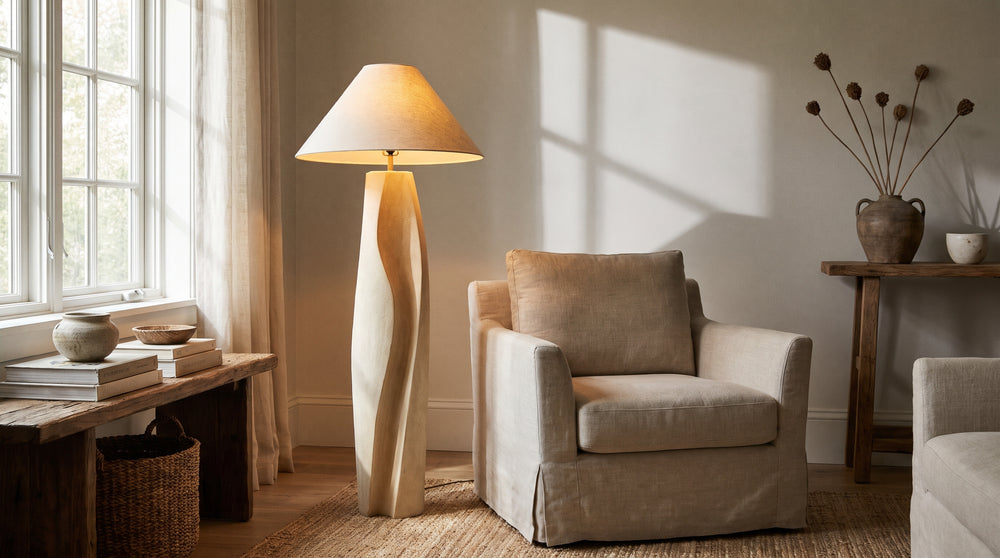
An interior that reflects who you are
Carefully selected pieces, shipped from our warehouses. Our team advises you before you buy, so you choose with confidence.
- Tracked delivery
- Pay in instalments, where available
- 14 days to change your mind
- Advice & showroom in Lyon, France
Plan on one solar floor lamp per area to mark out: near the sofa in a bright living room, at the edge of the terrace, along a path. No socket or cable needed: the panel recharges the battery during the day, and the LED takes over in the evening as accent lighting.
What is a solar floor lamp and what kind of light does it give?
A solar floor lamp works without a cable: a photovoltaic panel recharges a battery during the day, and the LED comes on in the evening. Its light is that of accent lighting, soft and localised, designed for a terrace, a balcony or a corner of the garden rather than for lighting a whole room.
Accent lighting, not a ceiling light: what to expect
Expect a halo that picks out an armchair, a step or a table top, not a room bathed in white. As a rule, ambient models sit around 2700 to 3000 kelvin, a warm tone that flatters wood and fabric. For reading for a long time or working, that is not enough: this is presence and mood lighting.
Panel, battery, sensor: how a solar floor lamp works
The panel captures daylight and charges the battery, which releases the energy at nightfall. A motion sensor, where there is one, raises the brightness for a few seconds and then returns to the low level. To place these mechanisms among other light sources, browse all our lighting and the designer LED floor lamps.
Living room floor lamp: how to choose it and where to place it?
In a living room, a floor lamp goes near the sofa, in the dark corner or behind an armchair, at shoulder height when seated to avoid glare. You first choose the diffusion you want, soft or directed, then the stand and finish that match the rest of the room.
The living room floor lamp, next to the sofa or in the corner
Next to the sofa, it is used for reading or holding a glass without switching on the ceiling light. In the corner, it dresses an empty space and lifts the light up the wall. Check that the base fits behind the furniture and that the stand does not get in the way: our designer floor lamps for the living room are chosen on this footprint criterion as much as on shape.
The most beautiful living room lamps: what makes the difference
They are judged on the light they give in the evening, on how well their height matches the seating and on what they show once switched off. A matt finish holds the room better than a gloss that reflects the slightest glare. Compare the modern models for the living room with the Scandinavian style, which is lighter.
Solar floor lamp: how to light a terrace or garden without a connection?
A solar floor lamp is installed where the panel gets several hours of sun a day: an open terrace, the edge of a garden, an entrance with no socket. Avoid the shade of a wall or a tree, angle the panel towards the south and accept a more discreet light on overcast days.
Where to place the panel so it captures enough light
Keep the top of the lamp clear: a branch, an awning or a high wall is enough to halve the charge. Models in wooden floor lamps find their place on a covered terrace, provided you bring the panel out or move the stand. A heavy stand or a weighted base holds up in the wind, and an adjustable model lets you aim at the path rather than the wall.
| Location | Expected light | Decisive criterion | To avoid |
|---|---|---|---|
| Bright living room | Soft mood light in the evening | Upward diffusion, stable stand | Panel in shade all day |
| Terrace | Accent lighting for meals | Panel facing due south, weighted stand | Placing the lamp against a high wall |
| Garden, edge of a path | Discreet light markers | Stand height, resistance to damp | Under a tree or a pergola |
| Balcony | Low light without glare | Footprint and weight of the stand | Exposure to wind without weighting |
| Entrance with no socket | Automatic welcome in the evening | Clear panel, motion detection | Relying on it as main lighting |
What limits an outdoor solar lamp: shade, season, orientation
In winter, the low sun and short days reduce recharging: the lamp will last less long, and that is normal. A badly oriented panel has the same effect as a grey sky. Nothing corrects the shade of a building; moving the stand a few dozen centimetres does.
What are the drawbacks of solar lamps?
The limits are well known: less light than a mains-powered model, a runtime that depends on sunshine and a battery that ages. You manage them by choosing a well-exposed panel, a model with a replaceable battery and use as mood lighting rather than main lighting.
Runtime, grey days and softer light
After several overcast days, the reserve drops and the time switched on gets shorter. The light stays soft, without glare, which suits a meal or walking along a path, less so a precise task. A linen shade softens the effect further, and a black for the living room colour makes it more graphic.
What a well-chosen model fixes, and what it does not
It fixes poor exposure (adjustable panel, movable stand), the sealed battery you cannot change and the stand that is too light. It does not fix a shaded location, nor the lack of sun in winter, nor the need for a real level of illumination for working.
| Criterion | Solar floor lamp | Plug-in floor lamp |
|---|---|---|
| Connection | No cable, no socket | Socket or power supply nearby |
| Light source | LED powered by battery | Depending on the bulb or LED provided |
| Runtime | Depends on sunshine and the battery | Continuous as long as the lamp is powered |
| Ideal location | Terrace, garden, balcony, entrance with no socket | Living room, office, bedroom |
| Maintenance | Clean the panel, monitor the battery | Dust the shade |
How do you connect several lamps to a single power supply?
With solar floor lamps, the question does not arise: each one is self-contained, with no cable or socket. For plug-in lamps, you spread the devices over a power strip suited to the stated wattage, avoid stacking extension leads and check that the socket is suitable for outdoor use.
When solar avoids the connection
An entrance, a rented balcony or a terrace at the end of a garden often have no power supply available, and having a light point installed costs more than the lamp. That is where solar makes full sense: each stand is independent, and you move it without an electrician. For a fixed indoor position, look instead at the designer floor lamps for the office.
Power strip and extension lead: the rules to follow
Add up the wattages stated on the lamps and compare them with what the power strip accepts. One power strip per wall socket, never an extension lead plugged into another extension lead, and an outdoor-rated block if the cable goes outside. Models in metal for the office often have a plug and switch that are easy to group together.
What are the trends for floor lamps in 2026?
The visible directions are towards arched or tapered stands, natural materials such as wood, rattan and linen, matt black or gold finishes, and integrated LED sources. Solar follows the movement: the panel fades into the design instead of showing off as a technical accessory.
More sculpted stands, more discreet sources
The stand is becoming an object again: a slender stem that curves, a round base that tapers, an assembly of two materials. The source disappears into the shade or into a luminous slot. The ceramic floor lamps and the black wooden lamps show this blend of raw material and clean line well.
Solar that fades into the decor
The panel slips into the top of the shade, onto the top of the stand or into a collar. The result: the lamp looks like an indoor light, which makes it acceptable in a bright living room. The gold and black finishes accompany this shift.
Which original floor lamp to stand out from the classic?
An original floor lamp is recognisable by a silhouette that stands up on its own, a sculptural stand, a textured shade or an unexpected tilt. Italian design often serves as a reference: simple lines, noble material, right proportion, with no detail added to look rich.
A stand that becomes a sculpture
Look for a shape that reads clearly even switched off: a continuous curve, an off-centre stem, a wide low base. That is what distinguishes a character piece from a straight stand dressed with a shade. The crystal pieces play on transparency, the designer white finishes play on mass and shadow.
Italian design as a style reference
It is not a brand but a school of proportion: nothing too much, a material owned, a metal that shines no more than necessary. This reference helps you decide between two similar models, the one that will still be right in five years and the one you will tire of. An original floor lamp is judged on that restraint.
How do you maintain and winterise a solar floor lamp?
A solar panel is cleaned with a soft cloth and clear water to keep its performance. In winter, you bring the lamp in or remove the battery if it is removable, to avoid prolonged cold and stagnant damp. The shade is dusted without abrasive products.
Cleaning the panel and the shade
A dusty panel or one covered in fingerprints charges less well: a wipe with clear water, without glass cleaner or abrasive sponge, is enough. For fabric, vacuum gently or brush dry, as on the floor lamps for the bedroom in fabric.
Winterising the battery and the stand
If the battery is accessible, take it out before the hard frosts and store it dry, at a moderate temperature. If not, bring the lamp into the garage or under shelter. Take the opportunity to tighten the stand and check the base. The rest of the selection is in the Designix catalogue.
Secure payment, tracked delivery, returns and Designix customer service: you order with no risk, and the team answers if any doubt remains about the stand height or the panel exposure. Take the time to measure your living room corner or your terrace before confirming your choice.
Frequently asked questions about solar floor lamps
What should you check before buying solar floor lamps?
First look at the planned exposure: without direct sun for several hours a day, the lamp will stay discreet. Then the stability of the stand, the direction of diffusion, the material facing damp and the fact that the battery is accessible or replaceable. Style only comes after these checks.
Can a solar floor lamp be used as a reading lamp?
It is designed as accent lighting: soft, localised, self-contained light. For reading for a long time, a plug-in living room floor lamp, adjustable and stable, remains more suitable. The solar lamp takes its place as mood lighting, on a terrace or in a corner of a living room that is bright during the day.
How should ceiling spotlights be arranged?
Start from the uses rather than the ceiling: identify the areas to light (table, passage, worktop), avoid placing a spotlight in your line of sight when seated, and favour adjustable light for areas that change. A solar floor lamp completes this plan with no work or wiring.
How do you light a wooden table when eating without a tablecloth?
Without a tablecloth, grazing light reveals scratches and marks: better a source placed above or to the side, aimed at the table top, rather than a halo that strikes the wood at an angle. Soft, stable light makes the meal more comfortable and avoids glare for the guests.
The most beautiful living room lamps: on what criteria should they be judged?
A living room lamp is judged on three points: the quality of the light it gives in the evening, how well its height matches the seating and its ability to hold the room when switched off. Finish and material come after, even if they make the difference day to day.




