
Solar outdoor LED string lights
This selection is also available in our French store: Guirlandes LED d exterieur solaires
No products in this selection.
- Tracked delivery to your country Tracked delivery
- Secure payment at checkout Multiple payment methods
- 14 days to change your mind 14-day returns
- Secure payment Secure payment
Not sure of your style? Find it in 30 seconds
A few questions, and we will show you the pieces made for you.
Frequently asked questions
How do I choose the right product?
What are the delivery times?
Can I return an item?
Can I pay in instalments?
An interior that reflects who you are
Carefully selected pieces, shipped from our warehouses. Our team advises you before you buy, so you choose with confidence.
- Tracked delivery
- Pay in instalments, where available
- 14 days to change your mind
- Advice & showroom in Lyon, France
Solar powered string lights for outdoors illuminate a patio, balcony or garden without a plug or cable: a panel recharges a battery, which powers the LEDs after dark. Bistro style, fairy lights or curtain lights, each model is chosen according to the area to cover and its protection rating.
Which solar outdoor string light should you choose for your patio or balcony?
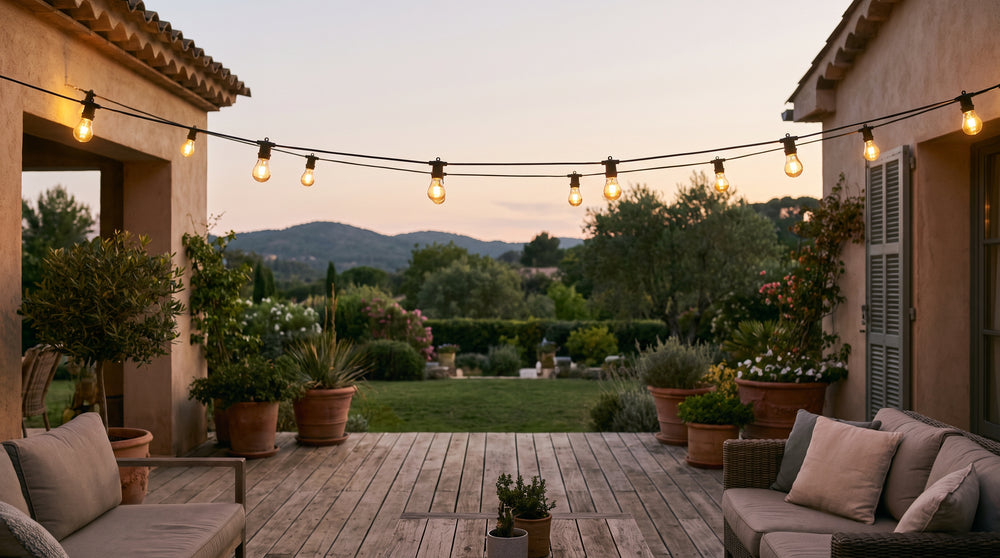
For a patio or balcony, a solar string light with round bistro style bulbs gives a warm, readable light at seating height. On a garden or hedge, a thin fairy light is less noticeable during the day and outlines the shapes. The choice depends on the area to cover and the hanging point available.
Solar outdoor string lights: patio, balcony or garden
From one space to another, three parameters change. Hanging height first: above a balcony table, the string light is seen up close, so bulb quality matters more than length. Setback next: on a large patio, a line stretched between two posts is enough to define the space, whereas a garden needs several runs to follow a path. Background, finally: on a light wall, a thin wire reads clearly; against dark foliage, round bulbs placed close together stand out better. A look through our outdoor string lights helps visualise the formats before deciding.
Solar bistro string light: what effect does it give?
The solar bistro string light shows its bulbs: round and evenly spaced, it evokes cafe terraces and stands out even when switched off. Fairy lights, by contrast, work as a line of light: more discreet by day, they structure a railing or hedge without overpowering the planting. Within the same family, the selection of solar string lights lets you compare effects without mixing styles on the same facade.
| String light style | Light effect | Where to install it | Hanging point |
|---|---|---|---|
| Bistro with round bulbs | Warm, visible light, cafe feel | Patio, arbour, awning | Wire stretched between two supports |
| Thin fairy lights | Discreet lines of light | Hedge, railing, shrub | Flexible wrapping |
| Elongated bulbs | Spaced points, more graphic | Pergola, facade, large garden | Hooks or regular clips |
| Curtain or light veil | Vertical sheet of light | Wall, closed arbour | High fixing on a rod |
| Solar ball or lantern | Single light placed on the ground | Path, flowerbed, low table | Placed directly, no fixing |
How does a solar outdoor string light work and does it really light up?
A solar outdoor string light works with a small photovoltaic panel that recharges a battery during the day; the battery powers the LEDs in the evening, often via a dusk sensor. The amount of light depends on the sunlight received and the charge, not on the number of bulbs printed on the packaging.
The panel, the battery and the dusk sensor
The panel converts daylight into current, the battery stores that energy, and the dusk sensor switches the circuit on when light levels drop. Three practical consequences: a grey day gives a shorter evening, a partly shaded panel recharges poorly even if the string light is new, and a cold battery loses autonomy. No lighting duration applies to all models; the product sheet gives the battery capacity. This is why solar LED string lights are sold as ambient lighting rather than safety lighting.
Warm white or cool white: what effect in the evening?
A warm white, around 2700 to 3000 K, leans towards amber and suits patios, arbours and wooden or stone facades: the light warms the material instead of bleaching it. A more neutral white, around 4000 K, lights more sharply and pairs better with grey render, metal cladding or a contemporary patio. The general rule: stay within a single white family in the same space, otherwise the eye immediately spots the string light that clashes.
Which IP protection rating for a solar string light outdoors?
The IP rating indicates resistance to water and dust. IP44 corresponds to protection against water splashes, suitable for sheltered outdoor use; IP65 withstands water jets and is suitable for direct exposure to rain. Choose the rating according to the actual location, not according to aesthetics.
IP44 and IP65: what changes in the rain
IP44 holds up against splashes and light rain, provided the string light stays under an awning, a covered pergola or a balcony with an overhanging roof. IP65 withstands driving rain and gentle jet cleaning, so a hedge, a facade or an open garden. IP65 models are the default choice when the hanging point is truly outside; IP44 string lights are enough for a covered area. Neither goes underwater: no immersion, no high-pressure jet.
Can a solar string light be left outside all year round?
A correctly protected string light withstands the year outside, but three things wear it down: repeated moisture on the connections, frost weighing on the battery, and a dirty panel that cuts the recharge. If the rating is modest, taking it down for winter remains safer. Checking the rating on the product sheet, keeping the connector sheltered and inspecting the panel from time to time is enough to avoid the silent spring failure.
How many light points and what length of string light for a garden?
Length is measured before buying: you need to cover the distance between the hanging point and the last area to light, keeping enough to make a detour or a loop. Better a slightly longer string light than one stretched to the maximum, especially on a railing or pergola.
Measure before fixing
Lay a rope on the ground following the intended route, from the first hook to the last, counting every corner and every drop. Measure the rope, add a margin of about a tenth for the loop and the connection to the panel. This method avoids the line being too taut, which breaks the clips at the first gust of wind, and the surplus piling up at the foot of the wall.
Short string light on a balcony, long on a hedge
Perceived density matters more than raw length. On a balcony, a short string light with closely spaced bulbs gives a clear line, readable from inside. On a hedge or flowerbed, a thin wire wrapped without tension over the branches creates a scattering of points that gets lost in the foliage: more metres are then needed for an equivalent effect. Bistro string lights and light curtains suit both approaches well.
| Location | Recommended format | What to check |
|---|---|---|
| Balcony | Short string light with round bulbs | Solid railing and clear panel |
| Patio | One or two bistro lines | Distance between posts, height above the table |
| Pergola | Spaced points or curtain | Regular hooks, panel moved out into the sun |
| Hedge and flowerbed | Thin fairy lights | Wrapping without tension on the branches |
| Arbour | Curtain or bistro | High fixing and cable routing |
Where to hang a solar string light and how to orient the panel?
The solar panel must receive direct sunlight for several hours a day: facing south, clear of foliage and walls. The string light is then hung on a pergola, a railing or an arbour, at a height that avoids knocks and allows it to be taken down easily.
Pergola, railing, arbour: the fixing points
On a railing, plastic clips or small screw-in hooks hold a light wire without drilling wide holes. On a pergola, the beams offer a natural support: aim for a height above head level, out of walkways, so the string light is not pulled down in passing. On an arbour, the high fixing must be backed by a solid point, as fabric does not carry load. The idea stays the same everywhere: at least one anchor point per metre, and the ability to take it down without tools.
The mistake that prevents recharging: a panel in the shade
A new string light that glows faintly almost always has a badly placed panel, not a dead battery. A roof overhang, a growing branch or a string light wound over the panel are enough to halve the recharge. Move the panel onto a clear support, tilt it towards the sky and clear it of foliage. String lights with a separate panel are easier to place freely for this reason.
Solar, rechargeable or 220 V string light: which power source to choose?
Solar suits sunny locations without a socket; a USB-rechargeable string light is prepared before installation and works even in the shade; 220 V remains the solution when the light must be strong and steady. These three families do not serve the same use or the same location.
Without a socket, with a socket: when solar is not enough
A courtyard shaded by a building, a north-facing awning or a need for guaranteed lighting all evening are outside the scope of solar. The USB-rechargeable string light then takes over: it is charged on an indoor socket, put in place, and its autonomy is known in advance. If a protected outdoor socket exists, mains 220 V string lights give constant intensity and duration without question.
Low voltage and 24 V: reserved for which uses?
24 V low voltage requires a transformer and a fixed installation: it is justified over long lengths, on a facade or in a structured garden where the string light no longer moves. It is not a portable solution; installation must be prepared. 24 V low-voltage string lights therefore require a location decided in advance, unlike a solar one that can be moved from one post to another.
| Power source | What to plan for | Best-suited use | Limitation to know |
|---|---|---|---|
| Solar with panel | A sunny location, clear panel | Garden, patio, pergola without a socket | Lower recharge in overcast weather |
| USB rechargeable | A charge before installation | Covered balcony, shaded location | Requires taking it down to recharge |
| 220 V mains | A protected outdoor socket | Facade, large plot, regular lighting | Cable to be routed neatly |
| 24 V low voltage | A suitable transformer | Fixed installation over a long length | Installation to prepare, less portable |
How to match several string lights in the same garden?
To match several string lights, keep the same colour temperature from one point to another and vary the formats rather than the shades. Two or three lines are enough to structure a garden; beyond that, the eye no longer distinguishes the areas and the whole loses readability.
Same colour temperature, several formats
A bistro string light on the arbour, a thin wire in the hedge and a solar lantern on the ground can coexist if the white stays the same. Mixing a warm white and a cool white on two neighbouring lines, however, creates a clear break. The rule: choose one shade, then play with bulb size and density. The lighting catalogue gives shade references from one family to another.
String lights and fixed fixtures: avoid visual overload
Two or three structuring lines are enough: one for the path, one for the facade, one for the table area. Leaving dark areas makes the others stand out. Before adding one more string light, check that it lights a spot still absent from the composition. A well-placed fixed fixture often replaces two string lights, and our whole lighting range lets you combine both approaches.
How to care for and store a solar string light in winter?
A dusty panel or one covered in leaves recharges less: cleaning with clear water is enough to bring the light back. In winter, taking the string light down, storing it dry and keeping the battery away from frost extend its service life, especially if the protection rating is modest.
Clean the panel to bring the light back
A soft cloth and a little clear water are enough, without abrasive products that scratch the surface and reduce efficiency. Wipe it once per season, more often under a tree that sheds its leaves. If the string light is dimmer than when bought, start there before suspecting the battery.
Store the battery away from frost
Cold reduces capacity and can damage a battery left outside unused. Take the string light down, store it dry in a bag, and if the protection rating is modest, do not leave it in place. Models with reinforced sealing can stay outside, with a check of the panel in spring. The rest of the time, leaving the string light in place untouched is risk-free if the fixing holds.
To go further, the selection of solar outdoor string lights can be browsed by style and by protection rating. Secure payment, tracked delivery, returns and Designix customer service accompany every order.
Frequently asked questions
Which solar outdoor string light should you choose?
For a patio or balcony, prefer a string light with round bulbs, warm and readable at seating height. For a garden, a hedge or a pergola, a discreet fairy light is less noticeable during the day and outlines the shapes in the evening. Length and hanging point decide before style.
Do solar outdoor string lights give enough light?
A solar string light gives ambient light, not safety lighting: it highlights a facade, a table or a hedge. Its brightness depends on the day's sunshine and the state of the battery. To light a path, a fixed fixture remains more suitable.
Does a solar string light withstand rain?
It depends on the protection rating indicated on the string light. IP44 protects against water splashes and suits under an awning; IP65 withstands water jets and direct exposure to rain. A string light with no IP rating is intended for indoor use.
How long does a solar string light stay on?
Autonomy depends on the charge stored during the day, the temperature and the lighting mode chosen. After an overcast day or in winter, the reserve is lower and it switches off earlier. No duration applies to all models: the product sheet gives the battery capacity.
Solar or rechargeable string light: which to choose?
The solar one is placed where the sun shines and needs no socket; the rechargeable one is charged via USB before installation and works even under an awning or a covered pergola. If the location stays shaded for much of the day, rechargeable battery models are more predictable.
One last reference before ordering: measure the route, check the panel's sun exposure, then choose the protection rating. The Designix catalogue groups the families so you can compare with confidence.




