
Smart outdoor lighting
This selection is also available in our French store: Éclairage extérieur connecté
No products in this selection.
- Tracked delivery to your country Tracked delivery
- Secure payment at checkout Multiple payment methods
- 14 days to change your mind 14-day returns
- Secure payment Secure payment
Not sure of your style? Find it in 30 seconds
A few questions, and we will show you the pieces made for you.
Frequently asked questions
How do I choose the right product?
What are the delivery times?
Can I return an item?
Can I pay in instalments?
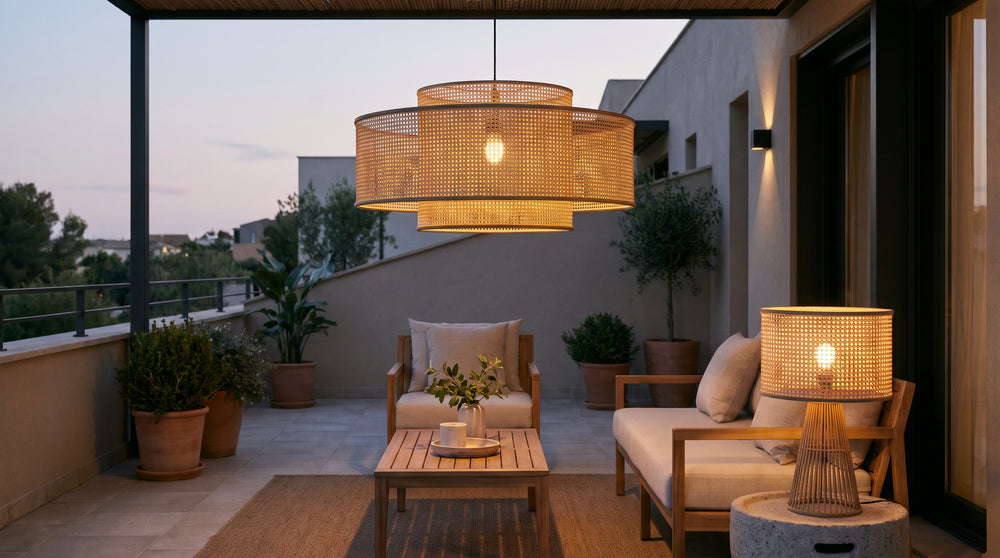
An interior that reflects who you are
Carefully selected pieces, shipped from our warehouses. Our team advises you before you buy, so you choose with confidence.
- Tracked delivery
- Pay in instalments, where available
- 14 days to change your mind
- Advice & showroom in Lyon, France
Smart outdoor lighting is controlled from an app, a remote control or a connected switch, and is installed on a terrace, along a path or on a facade just like a conventional light fixture. The connection changes the control, not the function: it is used to adjust brightness, colour and switch-on times.
What is smart outdoor lighting and what is it for?
Smart outdoor lighting is a terrace, garden or facade light fixture whose switching, brightness or colour is controlled remotely. It differs from a conventional fixture through its control, not its function: it lights a path or a wall like any outdoor fixture.
Wireless or wifi smart outdoor lighting: what is the difference?
Wireless Bluetooth pairs directly with the phone, with no hub or account, but stays within short range. Wifi goes through the hub and allows control from indoors or remotely. Some proprietary remote controls work on their own, without a network. You check the mode stated on the product page, without assuming universal compatibility with an existing installation.
What the connection changes day to day
A schedule turns the entrance on at sunset without a thought, dimming lowers the light late in the evening. Several grouped points replace a two-way switch and its cables. You set it once, then the light repeats. To see the available families, browse the outdoor lighting range.
Smart outdoor spot, floodlight or smart outdoor lamp: which to choose?
You choose according to the surface to cover and the need to direct the beam: a spot lights a precise area and can be aimed, a floodlight covers a large volume or a gate, a lamp is placed without work and can be moved. The size of the device says nothing about its real use.
Smart outdoor spot: for which facade and which angle?
Mounted on a facade or under a roof overhang, it washes a wall or marks a door. A narrow beam highlights a material, a wide beam lights a passage. You aim it downwards or towards the wall, never towards the eye of the person arriving. Track solutions offer an indoor equivalent, for the same logic of adjustable points.
Smart outdoor floodlight: when to prefer it?
For a courtyard, a large garden or a gate, when you need reach from a high point. The quality of the mounting and the angle setting then matter more than the shape of the housing. Poorly aimed, a floodlight dazzles and spoils the rest of the installation.
Smart outdoor lamp: the no-work format
Battery or solar powered, it sits on a table or a low wall and moves with the seasons. Battery life limits daily use in winter. For switching on every evening, a wired model remains more consistent: see outdoor lighting kits.
Smart outdoor post light or lighting bollard: how to light a path?
The post light shines from above and guides the eye towards the entrance, the bollard stays low and draws the path without dazzling. You combine the two: bollard for the passage, post light for the threshold. The connection is mainly used to lower the brightness after a certain time.
Smart outdoor post light: height and placement
It is placed at the edge of the path, on the wall or border side, so that the head sits above eye level and lights the ground rather than faces. One well-placed post light does more than a series of tightly spaced points. The light flows downwards, the shadow stays soft.
Lighting bollard: drawing a path without dazzling
Spaced regularly, they trace a readable line without turning the path into a runway. A bollard that is too tall or too powerful dazzles from the window. A ready-to-install set for a path avoids mixing heights and shades.
| Use | Type of fixture | Where to place it | What to check |
|---|---|---|---|
| Lighting a path | Bollard or low post light | Edge of the path, on the wall or border side | Height of the head and direction of the beam |
| Marking a facade | Outdoor wall light | Above a door, on a low wall | Stated protection rating and material |
| Lighting a terrace | Spot or adjustable wall light | Under a roof overhang, on the facade | Beam angle and risk of glare |
| Covering a large volume | Smart outdoor floodlight | High point, aimed at the ground | Stated power and quality of mounting |
| Creating an atmosphere | Low lamp or string lights | Border, trellis, pergola | Power supply and control mode |
Smart garden lighting: how to harmonise it without overloading?
Smart garden lighting is built in three layers: the passage with bollards, the facade with wall lights or spots, the borders with string lights or low lamps. You keep a single family of light and two or three scenarios. Better to light three clear zones than to scatter points everywhere.
The three layers to plan
The passage layer is for moving around without a thought, the facade layer gives depth, the low layer dresses the borders and the foot of the trees. Each has its own brightness. A readable garden reads like a house seen from afar: a clear entrance, volumes, nothing flashing.
Outdoor string lights: where to place them and how to connect them
On a pergola, a trellis or a railing, they bring a low, continuous light that is not meant for seeing clearly. They are connected to a protected socket or to a low-voltage supply intended for outdoor use. A single shade of white along the whole length works better than a mix.
Outdoor terrace wall light: how to choose and install it?
An outdoor terrace wall light is chosen on three points: the stated protection rating according to exposure, the material facing spray and the direction of the beam, upwards, downwards or diffused. It is placed above a door, on a low wall or along a wall, at a height that avoids direct glare.
Protection rating and material
A facade exposed to driving rain and sea wind calls for different care than a wall under an awning. Treated aluminium and stainless steel age better than certain resins in full sun; glass cleans without scratching. The product page states the sealing level and the material: that is what decides, not the photo.
How to install a wall light on a facade wall
Switch off the power, locate the cable entry, fix to a solid support, then check the sealing of the cable passage before switching the power back on. A beam directed downwards lights the step without dazzling. To vary the points on the same facade, compare with wall lights and bollards for the garden.
Outdoor E27 bulb: which one to screw into a smart fixture?
The outdoor E27 bulb is chosen according to colour temperature and use: warm white around 2700 to 3000 K for a terrace, neutral white around 4000 K for moving around without harsh shadows. You check that the fixture accepts a replaceable bulb and that the bulb withstands humidity, then you respect the maximum power stated on the fixture.
Colour temperature and use
A warm white relaxes a terrace in the evening, a more neutral white makes steps and gravel readable. Mixing two temperatures on the same facade shows immediately. The E14 base fits small wall lights, with a more limited choice of sources.
Conventional bulb in a smart fixture: is it possible?
Yes: the connection can come from the fixture, the bulb or the switch, not necessarily all three. An ordinary bulb in a controllable fixture remains controlled by it. A smart bulb in a conventional fixture also works, provided it is powered continuously. See the full lighting catalogue to identify both cases.
Wifi smart outdoor lighting: what compatibility to check before buying?
Before buying, you check the stated control mode, compatibility with the existing installation and the number of devices that can be controlled together. Wifi goes through the hub and is controlled from the app or a voice assistant; Bluetooth works without a network but at short range; some remote controls remain standalone.
Wifi, Bluetooth or proprietary wireless: what it changes
Wifi requires a decent signal outside, which is not guaranteed at the bottom of a garden. Bluetooth is set on site, handy for a nearby terrace. The proprietary remote control helps out when no network reaches. You never promise interoperability of all devices with each other: the product page states what is planned.
Connected switch and outdoor motion sensor: should you plan for them?
A connected switch controls an existing wired circuit, provided you know the type of circuit and whether a neutral is present. The outdoor motion sensor lights on passage, on an entrance or a poorly visible corner, and is set with a delay. For a renovation without changing the fixtures, it is often the simplest solution; see the ready-made lighting kits.
| Control mode | What it allows | When to choose it | What to check |
|---|---|---|---|
| Wifi | Remote control, app or voice assistant | Garden around the house, several zones | Stated compatibility and signal outside |
| Bluetooth | On-site setting, no hub or account | Nearby terrace, occasional use | Real range from the phone |
| Remote control | Switching and dimming without a network | Simple installation, a single zone | Number of devices paired together |
| Motion sensor | Switching on passage | Entrance, gate, poorly visible corner | Delay and sensitivity settings |
| Connected switch | Controlling an existing wired circuit | Renovation without changing the fixtures | Type of circuit and presence of a neutral |
Connecting an LED strip without a connector: how to do it properly?
An LED strip is connected without an original connector using terminal blocks or crimp connectors suited to the cable cross-section, then by carefully insulating the junction. Outdoors, this connection must be placed in a waterproof box. You always switch off the power before working and respect the polarity indicated on the strip.
Outdoor LED strip: sealing before connection
The weak point is not the solder but the place where water stagnates. You identify positive and negative, crimp, insulate, then enclose the junction high up rather than on the ground. A strip rated for outdoor use is installed under a support that shelters it.
LED ceiling light: the same reflexes indoors
Switch off the power, respect the cable cross-section, check the polarity: the method does not change. A closed LED ceiling light is cleaned with a wipe, which matters in a damp room. To equip a small space, see what you need to equip a small space.
WC lighting, toilet lighting: what light in a small space?
WC lighting comes down to a few points: a main light on the ceiling, preferably warm and non-dazzling, and sometimes a low-level accent. The space is small and often damp, so you favour a closed fixture, easy to clean, with simple switching by switch, sensor or timer.
WC lighting: ceiling light or wall light?
The ceiling light gives even light and avoids cast shadows. A wall light above the mirror only makes sense if the washbasin is in the room. You avoid a source right above the head, which dazzles as soon as you look up.
Toilet lighting: sensor, switch or timer?
The sensor suits a place of short passage, provided the delay is set. In a home, the switch remains simpler. The timer prevents forgetting the light. These reflexes also apply outdoors, where automatic switching on an entrance is useful: compare terrace and facade lighting and track solutions for circulation areas.
How to buy an outdoor fixture without getting it wrong
Three checks before confirming: the stated control mode matches what you want to do, the material and protection rating match the real exposure of the wall, the source is replaceable or not depending on whether you want to change the shade later. The rest (shape, finish) is chosen afterwards, once the use is settled.
You can thus equip a path with comparing outdoor kits, then complete with the whole catalogue for the entrance, and pick from the outdoor selection for the finishes. Lighting kits cover small indoor spaces. To change lighting family, see the other lighting families and a lighting track to vary the points.
Order on Designix: secure payment, tracked delivery, returns and customer service for any question about a model before confirming the basket. This is the moment to check the control mode on the product page of the fixture you have chosen.
Frequently asked questions
WC lighting: how to choose the right light?
You look for even light, preferably warm white, without a dazzling point right above the head. A closed ceiling light that is easy to clean is enough in a small space; an accent above the mirror is only useful if the washbasin calls for it. Switching is by switch, sensor or timer depending on how often the room is used.
Outdoor E27 bulb: how to choose it?
You start from the use: warm white for a terrace in the evening, neutral white for a path you walk through. You check that the fixture accepts a replaceable bulb of this base and that the bulb is intended for humidity. The maximum accepted power is stated on the fixture, not on the bulb.
LED ceiling light: which criteria to look at?
You judge the colour temperature, the diffusion of light, the ease of cleaning and the switching mode. In a small damp space, a closed fixture without roughness holds up better. The integrated LED avoids handling a bulb but cannot be replaced: the stated lifespan and after-sales service therefore count more.
WC lighting: do you need a presence sensor?
It is relevant in a WC accessible to several people or for short passage: the light switches on and off by itself. You must be able to set the delay, otherwise you end up in the dark at the wrong moment. In a home WC, a simple switch often remains more practical and less restrictive.
Can you have wireless smart outdoor lighting without work?
Yes, when the fixture runs on battery, rechargeable battery or solar panel and is controlled remotely: it is installed without running a cable. The limit is battery life and control range, shorter in winter or behind a thick wall. A wired model remains more consistent for lighting a path every evening.




