
Wicker floor lamps
This selection is also available in our French store: Lampes à poser sur pied en osier
No products in this selection.
- Tracked delivery to your country Tracked delivery
- Secure payment at checkout Multiple payment methods
- 14 days to change your mind 14-day returns
- Secure payment Secure payment
Not sure of your style? Find it in 30 seconds
A few questions, and we will show you the pieces made for you.
Frequently asked questions
How do I choose the right product?
What are the delivery times?
Can I return an item?
Can I pay in instalments?
An interior that reflects who you are
Carefully selected pieces, shipped from our warehouses. Our team advises you before you buy, so you choose with confidence.
- Tracked delivery
- Pay in instalments, where available
- 14 days to change your mind
- Advice & showroom in Lyon, France
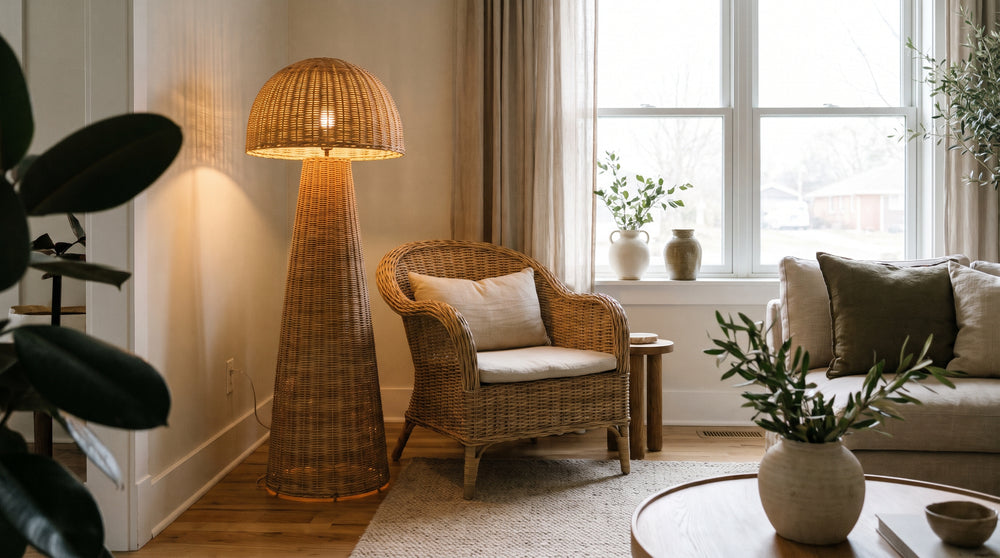
All it takes is a stable base and a woven shade that blocks part of the light: that is the principle of the rattan floor lamp. Place it in the corner of a sofa or near a bed, within reach of a socket, and it is enough to create a corner without lighting the whole room.
What is a rattan floor lamp?
It is a lamp that stands on the floor on a base, a stem or a tripod, and carries a woven rattan shade or basket at the top. The base places it at seating height, the weave filters the light. It lights a corner, not a whole room. Rattan is not a style: it is a plant material, most often willow, woven by hand. You choose it for what it does to the light as much as for its natural tone.
Floor lamp or standing lamp: what is the difference?
Both stand on the floor, but their height does not destine them for the same use. A standing lamp rises above the seat and lights a wide area, often from above. A floor lamp stays lower, close to the floor, and moves from one room to another without effort. One structures, the other accompanies. If you are looking for a table light instead, compare with design table lamps for the living room.
Rattan, wicker: how to recognise a weave
Rattan is woven in tight meshes, with supple strands and a pale blond tone that darkens slightly over time. Wicker, stiffer, offers more regular meshes and a sober artisanal look. Look at the fineness of the weave: the wider the meshes, the more frankly the light passes through and draws patterns. The tighter they are, the more the light comes out subdued. For a warm look close to rattan, more Nordic lines often play the same card with different materials.
What light does a rattan floor lamp give in a living room?
The weave blocks part of the flow and lets the rest through the meshes: the light comes out subdued, warm, without glare, and draws patterns on the wall. Placed in a corner, it creates a rest area. To read, you need a more generous bulb or a second light source, because a woven basket does not go low enough in intensity for a book.
The subdued light of the weave, and its shadows
The interest of the woven basket lies in what it does not do: it does not project a hard beam towards the eyes. The light passes through the meshes in irregular sheets, which gives the wall a living pattern, never identical depending on the distance of the wall. That is what makes the rattan floor lamp so effective as ambient lighting, and so poorly suited to a precise task. A light wall thirty or forty centimetres behind the shade makes these patterns more readable; a dark wall absorbs them.
Which bulb to read next to a rattan lamp?
A colour temperature around 2700 K gives a warm white, consistent with the tone of the rattan. To read, the weave alone is not enough: either you add an adjustable lamp near the armchair, or you accept that the reading corner stays a little further away. Light that is too cold, beyond 4000 K, hardens the shadows of the basket and breaks the warm effect. Above all, check the socket indicated on the product sheet, it alone decides the bulb you can buy.
Where to install a rattan floor lamp in the home?
In a living room, near the corner of the sofa or an armchair; in a bedroom, next to the bed for low light; in a hallway, as a night light. It needs a socket nearby and a clear passage around the base, because it is often moved. A cable crossing a walking area gets pinched or makes people trip.
In the bedroom, next to the bed
The woven shade casts low light on the floor and the wall, without sending a beam towards the pillow. A switch accessible from the bed changes all the comfort of the evening. If space is lacking between the bed and the wall, a bedside lamp placed on the nightstand remains safer: see the models designed for the bedroom and the black metal for the bedside.
In the living room and hallway, as additional light
In the living room, the rattan floor lamp is placed at the end of the sofa, next to a bookcase or a plant. In the hallway, a slim base and a small basket are enough to light a console without turning on the whole corridor. The night-light use works well: you keep a low light in the evening, without a ceiling light. For a hallway without a floor socket, a table lamp on furniture is better.
| Room | Suitable format | Type of light | Location |
|---|---|---|---|
| Living room | Tall base, wide shade | Subdued ambience | Corner of the sofa, near the bookcase |
| Bedroom | Medium base, closed shade | Low and warm light | Next to the bed or the armchair |
| Hallway | Slim base, small basket | Night light or additional | Near the console |
| Desk corner | Compact base | Light close to the worktop | At the corner of the desk |
Standing lamp or rattan floor lamp: how to choose?
The height of the shade relative to the seat and the wiring matter as much as the style: a low shade lights the floor, visible wiring is planned from the installation. An Italian design table lamp is recognised by its simple lines, the balance of the base and a strong detail on the shade. It is up to you to see whether the corner should see clearly or breathe.
Height changes the use
The higher the shade, the further and higher the light spreads, and the wider it lights. The lower it is, the more local it stays, at knee or seat height. A low lamp lights an armchair and the floor around it; a high lamp lights the sofa and the wall behind. In a small living room, a lamp that is too high crushes the space and gets in the way of the eye. Check the floor measurements before placing the lamp, not just the height.
Weight, base and stability on the floor
A wide base or a heavy base at the bottom prevents a lamp from tipping over near a sofa or a bed. A tripod distributes the load over three points and stays stable on a flat floor, less so on a thick carpet. Near a busy passage, a solid base is better. For more contemporary rooms, more contemporary pieces and desk lighting offer more compact bases.
How to match a rattan floor lamp with a wooden living room?
Rattan and wood share the same family of warm tones: a rattan lamp near a wooden table or shelf blends without effort. To avoid the all-fibres look, keep one woven piece per area and surround it with smooth materials, metal, glass or linen.
What look for the wooden table, and how to protect it
Without a tablecloth, the top remains visible and the neighbouring weaves must stay discreet. Use placemats or trivets, wipe liquid marks straight away, and move the lamp so it does not light the backs of the guests. A wooden top is fed with a suitable product, not with a damp cloth. As for materials, the wood versions and the wood for living room extend the match without repeating it.
A rattan ceiling light above the table
A rattan ceiling light takes up the weave without copying it: wider meshes to let the light down onto the top, a diameter proportionate to the table. The pendant is set high enough not to obstruct the guests' gaze, and two different weaves in the same area are avoided. A ceramic table lamp on a sideboard balances the whole by contrast.
| Material | Light rendering | Style | Maintenance | Room to favour |
|---|---|---|---|---|
| Woven rattan | Subdued, patterns on the wall | Natural, warm | Dry cloth or feather duster | Living room, bedroom |
| Wicker | Subdued, more regular meshes | Artisanal, sober | Soft cloth, avoid humidity | Living room, hallway |
| Wood | Light contained by the shade | Nordic, clean | Dry cloth | Bedroom, desk |
| Ceramic | Opaque light upwards and downwards | Classic or contemporary | Damp cloth | Bedside, console |
| Metal | Sharp light, without filter | Industrial or minimal | Microfibre cloth | Desk, reading |
Which bulb to put in a rattan floor lamp?
Follow the socket indicated on the product sheet: E27, E14 or integrated LED module. Since the weave already filters the light, a warm white bulb is enough; light that is too cold or too powerful hardens the shadows of the basket. The maximum power is written on the socket or the label.
Read the socket before buying the bulb
The socket decides everything: an E14 base does not accept an E27 bulb, and an integrated LED module cannot be replaced. Note the type, then the maximum power tolerated, indicated on the bulb holder or the instructions. A bulb with a visible filament behind a tight weave gives an unpleasant hot spot; prefer a diffuse bulb. Design LED lamps avoid this question when the module is integrated.
And if the ceiling already has spotlights?
Two sources that contradict each other tire the eye. Aim the spotlights towards the walls or a piece of furniture rather than towards the eyes, and keep the rattan lamp as an accompaniment rather than the main source. A corner already lit by a weave does not need a spotlight aimed at it, which would project hard shadows. For task lighting nearby, look at the LED desk lamps.
How to connect several lamps to a single power supply?
Add up the power of the lamps and compare it with what the extension lead or the socket supports: the value is written on it. Avoid stacking extension leads on top of each other and running a cable under a carpet. For an additional fixed line, an electrician is needed.
Extension lead, extension cable, switched socket
An extension lead indicates the power it accepts, and this value drops if you plug several demanding devices into it. A socket controlled by a switch saves you from bending down behind the base of the lamp. Choose a model with protection and keep the plug accessible. The cable must remain visible along its whole length, without being pinched by furniture.
Connections not to stack
Extension lead on extension lead, multiple socket on multiple socket, cable under carpet or behind a radiator: these setups heat up without being seen. A rattan lamp near a sofa needs a nearby socket, not a string of extension leads. For technical rooms, the black colour for desk and the modern desk often offer shorter cables.
How to care for a rattan floor lamp?
A dry cloth or a feather duster is enough: woven rattan holds dust in its meshes and water can deform it. Avoid damp rooms and direct sunlight that dull the tone. From time to time, check that the base remains stable and that the cable is not pinched.
Dusting a weave without damaging it
Run the feather duster between the meshes, then a dry microfibre cloth over the strands. A vacuum cleaner with a soft brush nozzle also works, provided you do not press. No damp sponge, no cleaning product: water swells the fibres and the weave deforms as it dries. For fabric shades, a linen shade is dusted dry in the same way.
What rattan does not like: humidity, sun, water
A bathroom or an unheated conservatory damages the weave. Direct sunlight, behind a bay window, dulls the natural tone within a few seasons. Finally, check the stability of the base and the condition of the cable: a cable pinched under a base gets damaged without any visible sign. An IP2X protection rating corresponds to dry indoor use; an indoor lamp has no place outside.
| Criterion | What to look at | Why it matters |
|---|---|---|
| Socket | Type indicated on the product sheet | Determines the bulb you will be able to buy |
| Height and diameter | Floor measurements and total height | A lamp that is too high crushes a small living room |
| Stability of the base | Wide base, weight at the bottom | Prevents tipping near a sofa or a bed |
| Switch and cable | Cable length, control on the cable or on the base | You know where the socket will go and how to switch on |
| Protection rating | IP indicated on the sheet | An indoor lamp has no place outside |
To widen the comparison to other materials, browse all the lighting in the home, the design table lamps for the living room and the white ceramic. On the order side, Designix provides secure payment, tracked delivery, returns and a reachable customer service: enough to check the socket and the height calmly once the lamp has arrived.
Frequently asked questions
How to connect several lamps to a single power supply?
Add up the power of the lamps and compare it with what the extension lead or the socket supports: the information is printed on it. Avoid stacking extension leads on top of each other, running a cable under a carpet or behind a base. To add a fixed line, call in an electrician.
How to arrange ceiling spotlights?
Aim the spotlights towards the walls or a piece of furniture rather than towards the eyes, and avoid aiming them at a weave that would project hard shadows. If a corner is already lit by a rattan floor lamp, keep the spotlights as passage lighting rather than the main source.
What are the most beautiful living room lamps?
A beautiful living room lamp is one whose light suits the corner: subdued near the sofa, sharper near the reading armchair. The shape of the base, the tone of the weave and the place on the floor matter as much as the style. The choice is made on use, not on the photo alone.
Which rattan ceiling light to choose above a table?
A rattan ceiling light takes up the weave of the floor lamp without repeating it identically: wider meshes to let the light down onto the top, a diameter proportionate to the table. The pendant is adjusted so as not to obstruct the guests' gaze and two different weaves in the same area are avoided.
How to eat at a wooden table without a tablecloth without damaging it?
Use placemats or trivets rather than a tablecloth, wipe liquid marks immediately and feed the top with a product suitable for wood. On the light side, move the lamp so it does not light the backs of the guests and keep the weave out of reach of hands.




