
Purple LED neon lights
This selection is also available in our French store: Néons LED coloris violet
No products in this selection.
- Tracked delivery to your country Tracked delivery
- Secure payment at checkout Multiple payment methods
- 14 days to change your mind 14-day returns
- Secure payment Secure payment
Not sure of your style? Find it in 30 seconds
A few questions, and we will show you the pieces made for you.
Frequently asked questions
How do I choose the right product?
What are the delivery times?
Can I return an item?
Can I pay in instalments?
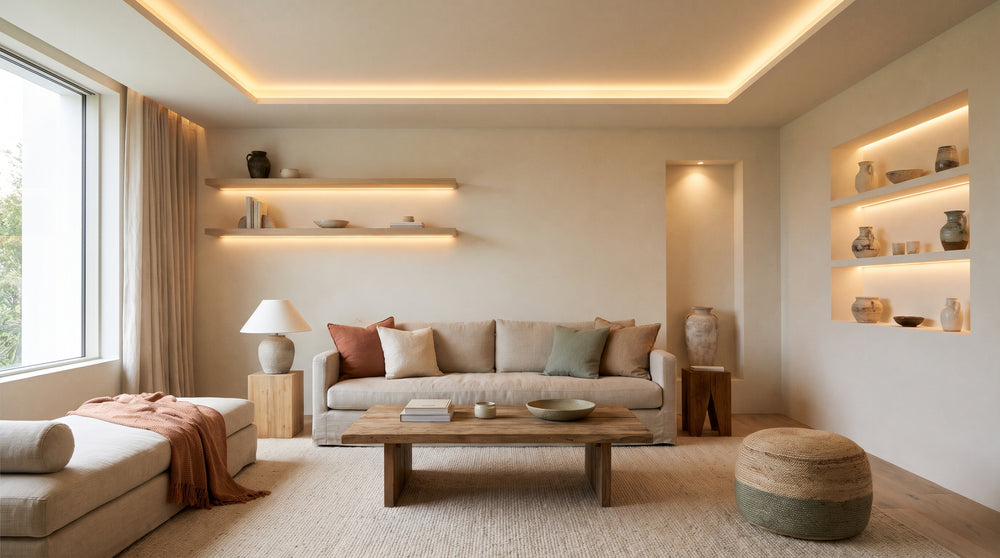
An interior that reflects who you are
Carefully selected pieces, shipped from our warehouses. Our team advises you before you buy, so you choose with confidence.
- Tracked delivery
- Pay in instalments, where available
- 14 days to change your mind
- Advice & showroom in Lyon, France
A purple LED neon light draws a continuous coloured line of light, with no visible bulb or hot spot: it works as an accent behind a sofa, in a niche or along a hallway, not as main lighting. Before choosing, measure the length of the run and locate the nearest socket, then decide on the format and the IP rating.
- The light from a purple neon
- Where to install it in the home
- Neon, ceiling light or chandelier
- Replacing a wall light
- Length, power supply, IP rating
- Outdoors and damp rooms
- Cuttable strip
- Installation and care
What is a purple LED neon light and what light does it give?
A purple LED neon light is a flexible or rigid light module that diffuses a continuous purple light along its whole length, with no visible bulb or hot spot. It comes as a flexible cord, a cuttable strip or a wall shape ready to install, and runs on 12 V, 24 V or directly on 230 V depending on the model.
Flexible LED neon or wall neon: what is the difference in light?
The flexible cord follows a curve, a piece of furniture's outline, an arch: it takes the shape you give it and keeps a regular line. The wall module arrives with its shape already drawn, circle, wave or segment, and is fixed as it is, which gives a more graphic result and a faster installation, but imposes the curve. In both cases the light is even. These two families are among all our light fittings.
Purple light: atmosphere or main lighting?
Purple colours the room, it does not replace a white light: it distorts the perception of shades and tires the eyes when reading. Keep a ceiling light or wall lights to see clearly, and reserve the neon for atmosphere. A room already fitted with lighting suited to each room easily takes one more coloured line.
Where to install a purple LED neon in the home?
A purple LED neon is used as accent lighting: behind a sofa or a headboard, in a niche, along a hallway or a stair rail, under a shelf. It underlines an architectural line rather than lighting a room. In a bathroom or outdoors, check the IP rating before choosing.
Wall LED neon in a living room or bedroom
Behind a sofa or a headboard, the halo detaches the furniture from the wall without dazzling, and the socket is often within reach. In a niche or under a shelf, the indirect line lights without showing the source. To gauge formats according to the surface, choosing a light fitting room by room gives useful reference points.
Purple LED neon in a hallway, entrance or staircase
Along a handrail or a skirting board, the line guides the step without switching on harshly. Without a false ceiling, forget recessed: place the strip on a cornice or along a beam, the light bounces off the ceiling and lights it indirectly. The rest of the circulation benefits from being completed with the other light fittings in the home.
Purple LED neon, LED ceiling light or LED chandelier: which light fitting for which room?
An LED ceiling light or an LED chandelier lights the whole room from the ceiling, in white light, and serves as main lighting. A purple LED neon brings a coloured line and an atmosphere: it complements the ceiling light rather than replacing it. Keep the ceiling light to see clearly, add the neon for the mood.
| Light fitting | Type of light | Room | Strength | Limitation |
|---|---|---|---|---|
| Purple LED neon | Coloured, continuous | Living room, bedroom, hallway | Atmosphere and graphic line | Does not replace white light |
| LED ceiling light | White, diffused | Living room, kitchen, bedroom | Lights the whole room | Little coloured relief |
| LED chandelier | White, staged | Living room, dining room | Decorative effect above a table | Requires ceiling height |
| LED wall light | White, directed | Living room, hallway, bedroom | Reading and additional lighting | Lights a point, not a line |
A modern LED ceiling light with a diameter in proportion to the room plays the main role, and the neon comes in second. To decide between pendant and fixed models, comparing with ceiling lights and pendants helps to visualise the result.
Can an LED wall light be replaced by an LED neon?
An LED wall light shines upwards or downwards from a fixed point and is easily replaced. An LED neon can take its place if you want a continuous line of light rather than a point of light, provided you plan a power supply nearby. For reading in a living room, the wall light remains the right choice.
LED living room wall light or neon: what effect on the wall?
A powerful LED living room wall light sends a directed beam, ideal at shoulder height for reading or for marking out a hallway. The neon, for its part, underlines an entire wall with a regular stroke: the wall becomes the source. The two coexist very well in living room and bedroom lighting.
LED neon and recessed spotlight: two different logics
A recessed LED spotlight sits in a ceiling cut-out and is replaced identically: switch off the power, unclip the ring, disconnect the connector and fit a model with the same cut-out diameter. A neon is surface-mounted, it does not replace a spotlight. To fit the home with LED lighting, treat the two separately.
How to choose a purple LED neon: length, power supply and IP rating?
First choose the usable length and the type of power supply: 12 V or 24 V require a transformer to be housed, 230 V connects directly. Then check the IP rating according to the room, the LED density for the perceived intensity and the exact purple shade, which varies from one model to another. See the full light fitting range lets you compare formats side by side.
12 V, 24 V or 230 V: which power supply for an LED neon?
12 V and 24 V require an LED transformer housed in an accessible place, often behind a piece of furniture or in a profile. 24 V holds the length better, 12 V is enough on a short run. 230 V avoids the transformer but requires a mains connection. Enough to browse the Designix light fittings with full knowledge of the facts.
IP20, IP44, IP65, IP68: which rating for which room?
| Rating | Protection | Room or use |
|---|---|---|
| IP20 | No protection against water | Living room, bedroom, dry furniture |
| IP44 | Resists splashes | Bathroom, kitchen splashback |
| IP65 | Resists water jets | Sheltered terrace, outdoors under a canopy |
| IP68 | Resists temporary immersion | Exposed outdoor use, according to the manufacturer's instructions |
The highest rating is useless in a dry living room, and the lowest does not forgive a wet room. To find the right light fitting, start from the room, not the data sheet.
Purple LED neon for outdoors or a damp room: which waterproof model to choose?
For outdoors, take an LED neon advertised as waterproof with an IP65 or IP68 rating, a cord or a closed profile, and a power supply protected from the rain. An indoor IP20 model will burn out at the first shower. Also check that the connectors are designed for humidity.
The weak point is almost never the strip: it is the connectors and the transformer. Place the latter under a canopy, in an enclosure, and leave it accessible for replacement. By the sea, rinse with clean water from time to time and accept that a model exposed to full sun will tarnish faster. A light fitting suited to outdoors is chosen on the instructions, not on the photo.
Cuttable LED strip: how does it work?
A cuttable LED strip has regular cut marks: cut only at these marks, never between two. Each section becomes a self-contained strip that is connected with a connector or a soldered cable. Cutting elsewhere breaks the circuit and leaves a portion unlit.
Cutting an LED strip without damaging it
Locate the mark, count the LEDs on either side, cut straight with clean scissors or a craft knife, without crushing the sheath. A purple LED strip placed in a niche is measured before being cut: a one-centimetre mistake cannot be fixed. The Designix light fitting catalogue indicates the formats available by type of installation.
Connecting two sections after cutting
A clip-on LED strip connector is enough for a dry, indoor installation. In a damp environment, prefer a soldered and then insulated connection, or a closed aluminium profile. Test the whole thing dry before final fixing. To complete with other light sources, keep the same voltage on the same circuit.
How to install and care for a purple LED neon?
Place the neon on a clean, dry surface, with the fixings or the profile provided by the manufacturer, and leave the power supply accessible. Avoid bending a rigid cord at a right angle and burying the connectors. For care, a dry cloth is enough: solvents tarnish the silicone.
Fixing an LED neon to the wall without drilling everything
Degrease, draw a template in pencil, present the module before screwing or gluing. Avoid a freshly painted wall, the adhesive does not hold there. An aluminium profile is screwed at the ends and distributes the weight. Light fittings to mount on the wall follow the same preparation logic.
Cleaning a purple LED neon without tarnishing it
Dry or slightly damp cloth, never alcohol or acetone on the sheath. Dust rather than rub: accumulated dust shows more on a deep purple than on a white. Check once a year that the fixings are holding, especially above a passageway.
One last reference point before ordering: the length of the run and the location of the socket matter more than the colour. Secure payment, tracked delivery, returns and Designix customer service are there for you if the format does not suit. All that remains is to browse the Designix light fittings and pick the line that will structure the room.
Frequently asked questions about the purple LED neon
Purple LED neon: what is the difference from a classic LED strip?
A classic LED strip is cut and stuck to create a discreet line, often hidden behind a piece of furniture. An LED neon is visible: thicker sheath, even light along the whole length, a shape that is meant to be seen on the wall. The purple colour remains the same principle, only the finish changes.
How to change a recessed LED spotlight in the ceiling?
Switch off the power at the circuit breaker, remove the spotlight ring with a suction cup tool or by unclipping it, disconnect the connector and then fit a model with the same cut-out diameter and the same voltage. A ceiling spotlight cannot be replaced by a neon: the neon is surface-mounted.
Which modern LED ceiling light to choose for a living room?
Take an LED ceiling light whose diameter is in proportion to the room and whose white light covers the whole living room, then add a purple neon as an accent if you want relief. The ceiling light remains the main lighting: it is the one that must be comfortable every day.
What is the difference between an LED chandelier and an LED ceiling light?
The LED chandelier hangs from the ceiling and stands out: it dresses a living room or a dining room above a table. The LED ceiling light stays flat against the ceiling and lights more widely. A purple neon goes well with both, provided you do not combine three coloured sources.
How to light a ceiling with LEDs without a false ceiling?
Without a false ceiling, forget recessed: place a neon or a strip as a surface fitting on a cornice, behind a trim or along a beam. The light bounces off the ceiling and lights it indirectly. Check the fixing of the support and the proximity of a socket.




