
Paper garland
This selection is also available in our French store: Guirlande en papier
No products in this selection.
- Tracked delivery to your country Tracked delivery
- Secure payment at checkout Multiple payment methods
- 14 days to change your mind 14-day returns
- Secure payment Secure payment
Not sure of your style? Find it in 30 seconds
A few questions, and we will show you the pieces made for you.
Frequently asked questions
How do I choose the right product?
What are the delivery times?
Can I return an item?
Can I pay in instalments?
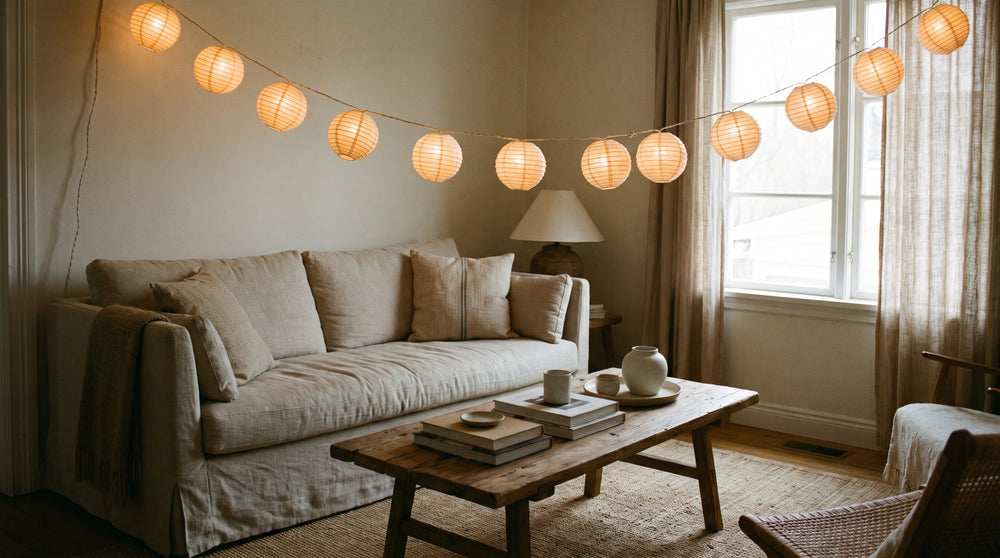
An interior that reflects who you are
Carefully selected pieces, shipped from our warehouses. Our team advises you before you buy, so you choose with confidence.
- Tracked delivery
- Pay in instalments, where available
- 14 days to change your mind
- Advice & showroom in Lyon, France
A paper garland comes down to three things: the material (crepe, tissue or card), the volume it should take up in the room and the surface it will hang on. It decorates and does not light up: for light, add a string of lights on the same line. Here are the practical criteria, the basic fold and the fixings that do not damage walls.
- What a paper garland is for
- Which paper to choose
- How to make one
- Where to hang it
- Fixing without damage
- Christmas and Halloween
- Outdoors, long lengths
- Paper and light
What is a paper garland and what is it for?
A paper garland is a decorative, non-luminous strip made of bunting, pom-poms or cut-out shapes joined by string. It marks an occasion (birthday, wedding, Christmas) or dresses a wall, a curtain rod or a party table, with no electricity and no heavy fixing.
Crepe paper garland or folded paper garland: what changes
Crepe paper crumples and puffs up: it gives volume and softens the light, which forgives rough cutting. Folding, on the other hand, aims for a clean shape: fans, hearts, symmetrical bunting. The same roll of crepe paper will therefore give a completely different wall depending on whether you crumple it or fold it.
What a paper garland does not replace
It does not light anything, even placed in front of a window. For accent lighting, head to the string lights section, which comes in wall, staircase and garden versions. And to properly light a room, compare in our full lighting range.
Which paper to choose for a paper garland?
Crepe paper gives a matte, crumpled finish, tissue paper a translucent, light effect, card a shape that holds on its own. Choose crepe for volume, tissue for lightness, card for bunting or crisp letters.
| Paper | Finish | Possible shapes | Where to use it |
|---|---|---|---|
| Crepe paper | Matte, textured, bulky | Flowers, pom-poms, crumpled strips | Wall, party table, bedroom |
| Tissue paper | Translucent and light | Pom-poms, petals, soft bunting | Window, hanging above a table |
| Card | Rigid, clean edges | Bunting, letters, hearts | Wall, taut line, frame |
| Printed paper | Graphic, irregular | Bunting, hearts, folds | Study, bedroom, workshop feel |
Crepe paper garland: volume and colours
Crepe absorbs light instead of reflecting it, hence that matte finish that stands out against a painted wall. It takes large shapes: paper flowers, pom-poms, twists. Two limits: it dislikes water and fades in direct sun, so it stays indoors, away from a south-facing window.
Tissue paper and card: which shapes
Tissue suits petals and soft bunting that move in the draught; it tears if pulled too tight. Card, on the other hand, holds a heart, a letter or a piece of bunting straight: it is the material for garlands meant to be read from a distance, with edges that stay clean over several seasons.
How to make a paper garland easily?
Fold a strip of paper into an accordion, pinch the middle, then join the resulting fans on a taut string: that is the quickest version. For bunting, cut triangles and glue them at regular intervals onto a string.
Paper garland tutorial: the accordion fold
- Cut a strip about ten centimetres wide and thirty long.
- Fold it into an accordion, one centimetre at a time, all the way along.
- Pinch the centre, tie it with string or a tie, then open both sides into a fan.
- Repeat, then fix each fan onto a taut string, every twenty to thirty centimetres.
DIY paper garland: the basic kit
You need paper, scissors, glue or tape and string. Nothing else: no machine, no complicated template. A crease marked on the back of the strip serves as a guide for identical bunting, and a ruler laid on the string gives even spacing.
Where to hang a paper garland in the home?
Above a party table, along a shelf, across a window, in a child's bedroom or on the staircase: a paper garland goes where the eye passes and where the string can be pulled taut. Keep it for dry rooms.
| Room | Suggested format | Fixing | To pair with |
|---|---|---|---|
| Living room | Long garland across a wall or shelf | Adhesive hook or taut string | A wall string light |
| Dining room | Curtain garland above the sideboard | String stretched between two points | Festoon lights |
| Child's bedroom | Short garland, soft tones | String along the wall, out of reach | Wall light for a child's bedroom |
| Staircase | Long garland following the handrail | Ties on the handrail | Staircase garland |
| Window | Light tissue paper garland | Suction cup or string | Rechargeable LED string lights |
Above a party table or sideboard
A curtain of strips falling at seated eye level (roughly one metre twenty from the floor) frames the table without getting in the way of conversation. This is the most forgiving use: the garland stays near the wall, you hang it once, it lasts the evening. For a warmer effect, add a festoon garland above the sideboard.
Child's bedroom and staircase: mind the height
In a bedroom, hang high and short, on a string that runs along the wall rather than across the room. A wall garland for a child's bedroom stays in place when the bed moves corner. On the staircase, follow the handrail with a staircase garland fixed to the posts, never in the path of hands.
How to hang a paper garland without damaging the wall?
Stretch a string between two anchor points (curtain rod, handle, adhesive hook) and let the garland rest on it rather than gluing it. A slightly slack string gives a natural sag; too tight, the garland breaks at the slightest draught.
Which fixings for which surface
On smooth paint, an adhesive hook is enough and comes off without tearing. On a curtain rod or handle, a clothes peg does the job. On a rough wall or fragile wallpaper, prefer two distant anchor points and a string that carries the weight, without sticking anything to the decorated surface.
What height and how much slack to give the string
Allow a hand's width of slack in the middle of the string: enough to absorb the swaying, not enough for the bunting to touch the floor. The weight must be spread over the whole length, otherwise the paper deforms where the knots are. A heavy card garland needs closer ties than a tissue garland.
Paper garland for Christmas or Halloween: which colours?
For Christmas, red, fir green, white and gold remain the most readable; for Halloween, black, orange and purple work better in matte paper than glossy, because crepe absorbs light. A single colour per garland is easier to spot than a mix.
Christmas paper garland: combinations that work
Cut trees, stars or snowflakes in two tones at most: a light background and a strong colour read from a distance, three shades blur the shape. A Christmas paper garland goes above the table or along a shelf, indoors. Outdoors, it would not last.
Halloween paper garland: shapes and contrasts
Bats, ghosts, pumpkin heads: black silhouettes on dark string stay discreet, so place them on a light wall instead. Matte paper contrasts better than glossy under warm light. Again, the garland stays in the house, away from an open window or a radiator.
Long outdoor Christmas garland: which solution to choose?
Paper dislikes damp and wind: it does not last outdoors. For a long length outside, switch to an LED string light designed for outdoor use, identified by its IP44 or IP65 rating, and by its power supply (mains, solar or rechargeable).
Why a paper garland does not last outdoors
Paper absorbs moisture from the air, warps and then tears at the first gust, even under a canopy. A little dew is enough to flatten the pom-poms. So keep paper for dry rooms and reserve the facade, balcony and garden for an outdoor garland made for it.
Outdoor string light: the criteria to check
An IP44 rating covers water splashes and is enough under a canopy; an IP65 withstands direct rain. Then check the usable length, the number of light points and the distance to the socket. Compare IP44 LED string lights for a balcony, IP65 LED string lights for a facade, and a solar garland when no socket is within reach.
How to pair a paper garland with a string light?
Layer the two on the same taut string: the string light brings the light, the paper one the colour and volume, and the paper softens light points that are too harsh. Plan the socket or power supply before stretching, not after.
Layering paper and light on the same string
Place the paper in front of the LEDs, never glued onto the light points: heat deforms tissue and yellows crepe. One load-bearing string for the light, a second slightly lower for the paper, and the two read together without interfering. The effect is softer than light alone.
Mains, batteries, solar: choose the power supply before hanging
A 220 V LED string light plugs into the mains but requires a nearby socket. A 24 V LED string light can be placed further away thanks to its transformer. Without a socket, go for a rechargeable string light or solar LED string lights. The rest can be compared in all our LED string lights and in our lighting catalogue.
Measure the length to cover and locate the power supply before ordering: that is what saves you from taking everything down again. Secure payment, tracked delivery, returns and Designix customer service accompany every order. To widen the comparison, browse Designix lighting.
Frequently asked questions about the paper garland
How do you make a heart paper garland?
Fold a strip in half, cut a half-heart on the fold, then open: you get a symmetrical heart. Alternate sizes and tones on the string. It is the simplest shape to repeat, and it lies flat nicely against a wall or in a frame.
How do you make an easy paper garland?
The simplest version remains bunting: cut triangles or strips, glued onto a string every few centimetres. No complicated template, no sewing. The accordion fold takes a minute more per fan but gives volume without gluing anything.
Why choose a crepe paper garland?
Crepe is matte, crumples and keeps its volume: it suits pom-poms, paper flowers and twisted strips. It dislikes water and fades in direct sun. Indoors, it quickly covers a large wall with little material, without reflection.
How do you make a paper garland for Halloween?
Cut bats, ghosts or pumpkin heads from black and orange paper, then glue them onto a taut string. Matte paper contrasts better than glossy under warm light. Keep it indoors: paper does not tolerate damp.
Can a homemade paper garland stay outdoors?
No: paper absorbs moisture, warps and tears in the wind, even under a canopy. A paper garland is for dry rooms. Outdoors, an LED string light with an IP44 or IP65 rating lasts the season.




