
Paper floor lamps
This selection is also available in our French store: Lampes à poser sur pied en papier
No products in this selection.
- Tracked delivery to your country Tracked delivery
- Secure payment at checkout Multiple payment methods
- 14 days to change your mind 14-day returns
- Secure payment Secure payment
Not sure of your style? Find it in 30 seconds
A few questions, and we will show you the pieces made for you.
Frequently asked questions
How do I choose the right product?
What are the delivery times?
Can I return an item?
Can I pay in instalments?
An interior that reflects who you are
Carefully selected pieces, shipped from our warehouses. Our team advises you before you buy, so you choose with confidence.
- Tracked delivery
- Pay in instalments, where available
- 14 days to change your mind
- Advice & showroom in Lyon, France
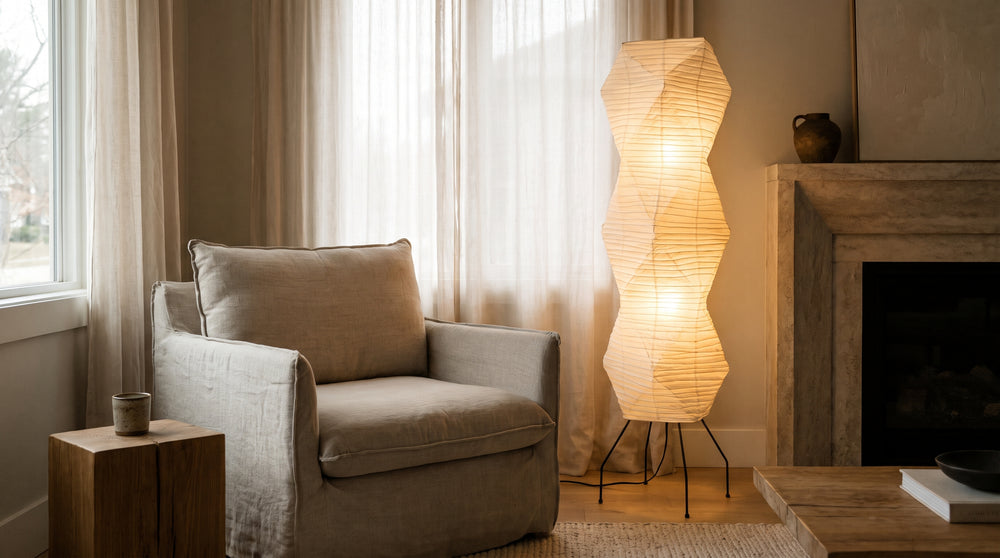
A paper floor lamp is chosen first and foremost for the effect it creates: the shade filters the bulb, softens the light and sends it upwards and to the sides, with no glare at eye level. You place it near the seat, leave the ceiling light off in the evening, and check the product page for the stem height, base diameter and bulb socket before ordering.
What kind of light does a paper floor lamp give?
The paper acts as a diffuser: it intercepts the bulb's output and spreads it. The result is a soft light, with no harsh reflection on the walls, that lights the corner without lighting the whole room. The effect depends on the thickness of the paper, the shape of the shade and the bulb chosen. For the wattage, socket and colour temperature of a specific model, the product page is the reference.
Light paper or coloured paper: what it changes on the wall
Light paper lets more light through and casts a crisp glow on the nearby wall: the corner brightens without raising the power. Coloured or thicker paper tints the light and contains it; the mood is cosier, the wall less washed. In a light interior, light paper blends in; on a dark wall, it creates a contrast in value. Both are equally valid depending on the effect you want, as long as the bulb stays hidden at seated eye level. To compare the lighting families, see all the lighting for the home.
Warm or neutral bulb: what effect on a paper shade?
As a general guide, a bulb around 2700 K gives a warm light, close to a filament bulb, that warms the paper and suits the evening. A bulb around 3000 to 4000 K, whiter, makes the paper look more neutral and helps with reading. Beyond that, the light turns blue and hardens the texture of the paper. A standard-socket LED screws directly into the lamp, with no separate transformer. See also designer LED lamps.
Where to put a paper floor lamp in the living room?
The useful spot is the corner of the sofa or behind a reading armchair, within reach of the seat. The lamp lights the corner without dazzling anyone sitting down and leaves the ceiling light off in the evening. Keep the walkway clear around the base and avoid placing it in the middle of a traffic path.
Living room floor lamp: near the sofa or in the corner?
Near the sofa, it is used for reading or chatting: the shade should sit at shoulder level or just above the seat. In the corner, it becomes an ambient light that washes two walls at once and gives the room depth. If space is short, a slim stem slips between the wall and the seat. Designer lamps for the living room and modern style in the living room give proportion cues.
A large volume: which silhouette for a paper floor lamp?
In a tall or very open room, a large-diameter shade holds its own visually against the furniture; a small one gets lost. Conversely, in a narrow living room, a slim stem and a narrow shade let the space breathe. The practical rule: the lamp should reach roughly the height of the sofa back, neither lower nor higher. Black finishes mark a volume, white models recede.
Which paper floor lamp to choose for the bedroom?
In the bedroom, a paper floor lamp serves as low light: against the wall or near the headboard, it hides the bulb and avoids harsh reflections. You can read or move around without turning on the ceiling light, and you can switch it off within reach from the bed.
Bedroom floor lamp: how far from the headboard?
The reference point is sitting up in bed: the shade should sit around eye level or just below, to light without dazzling. Allow about an arm's length between the lamp and the edge of the bed, enough to reach the switch without getting up, without blocking the way. A taller stem lights the room, a short stem stays a low ambient light. See a model designed for the bedroom.
Night light or reading lamp: which light to choose?
For a night light, you want very low light with no visible bright point: the paper does that job, provided you angle the shade towards the wall. For reading, you need a little more output and paper is not always enough; an adjustable lamp as a complement solves the problem. As a general guide, bedroom LED lighting is set around 2700 K in the evening. Ceramic bedside lamps and bedroom LED lighting complete the set.
Rice paper, papier-mâché or washi: which material for which light?
The verifiable criterion is the opacity of the paper. Rice paper, very thin, diffuses a very soft light and lets the structure show through; papier-mâché, thicker, gives a more contained light and sculpted shapes; washi, close to rice paper but more textured, shows a visible grain. The choice depends on the effect you want and the room, not on a hierarchy of quality.
| Shade material | Light effect | Style | Care |
|---|---|---|---|
| Rice paper | Highly diffusing, lets the structure show through | Japanese-inspired, pared back | Duster, dry, without rubbing |
| Papier-mâché | More opaque, contained light | Sculptural, artisanal | Soft brush, avoid damp |
| Textured washi | Soft, with a visible grain | Contemporary, pronounced texture | Regular dry dusting |
| Linen, as an alternative | Softened light, woven fibres | Scandinavian, natural | Gentle vacuuming or brushing |
Rice paper floor lamp
Rice paper suits rooms where you want a very soft light, almost shadowless: bedroom, reading corner, hallway. Its thinness calls for a stable stem and a bulb that does not get too hot near the surface. Avoid placing it in a draught, where the paper can vibrate. A linen alternative offers a comparable softened effect with a more hard-wearing woven material.
Papier-mâché floor lamp
Papier-mâché allows irregular shapes and more sculpted volumes: the lamp becomes an object in the room, not just a light source. The thickness contains the output and gives a lower light, suited to the evening. It dislikes damp and knocks on the edges; place it in a dry room, away from a walkway.
Paper floor lamp: what height for which room?
A tall stem puts the shade above the seat and lights the sofa corner without getting in the way; a shorter stem suits a spot near an armchair or a desk. The height is chosen according to the seated position and the floor space available, then checked on the product page, which gives height and diameter.
| Room or use | Light sought | Format and height | Where to place it |
|---|---|---|---|
| Living room, sofa corner | Soft, warm supplementary light | Tall stem, shade above the seat | Corner of the sofa, behind the reading armchair |
| Bedroom | Low light, no dazzle | Medium stem, shade below seated eye level | Against the wall, near the headboard |
| Desk | Side lighting for writing | Short stem or adjustable model | Beside the hand that is not writing, out of the screen's field |
| Wooden table, dining room | Light that does not reflect | Tall stem, set back | One metre from the table, on the wall side |
| Hallway | Evening night light | Short stem, small diameter | Near the console, out of the walkway |
Tall stem for the living room, short stem near an armchair?
A tall stem is used when reading seated: the shade passes above the shoulder and the light falls on the lap and the book. Near a low armchair or a desk, a short stem puts the light closer to the work surface and avoids lighting empty space. Wooden bases give a stable footing to tall stems.
How to check the floor footprint before choosing?
Measure the diameter of the base and add the space needed for furniture legs: it is this space, not the height, that decides whether the lamp fits in the corner. A large shade can stick out from the wall and be seen from behind. For a workspace, compare with lighting a desk. Secure payment, tracked delivery, returns and Designix customer service accompany every order: everything you need to confirm the dimensions with confidence before placing the lamp.
How to connect several lamps to a single power supply?
Several lamps can share the same supply via a power strip or a socket block, provided the combined wattage of the bulbs stays within the limits of the circuit and of the block used. To add fixed sockets, an electrician works on the existing circuit. No wattage figure should be improvised: read the label on the block and on the circuit.
Power strip, extension lead or extra socket: what to choose?
A power strip suits two or three lamps grouped behind a piece of furniture, with an accessible switch. An extension lead is for reaching a distant socket, never for stacking several blocks. An extra fixed socket requires an electrician and solves the lack of outlets for good. In every case, avoid running a cable across a walkway. Adjustable lamps often need only one outlet.
Several lamps on one power strip: what to check
Add up the wattage of the bulbs, compare it with the maximum shown on the block, and keep a margin rather than approaching it. Check that the plug sits firmly in the socket, without wobble, and avoid stacking blocks on top of each other. With LEDs, the combined wattage stays low: an argument in favour of this type of bulb. See the LED models.
How to arrange ceiling spotlights when adding a paper floor lamp?
Spotlights are placed above the areas of use (work surface, table, walkway) and angled towards walls or matt surfaces, never towards the paper shade. The floor lamp completes the set with low light, once the spotlights are off. Two separate registers, two uses: seeing and settling in.
Spotlights and floor lamp: how to avoid harsh shadows?
A spotlight aimed at the floor creates a sharp shadow and strong contrast. By aiming it at a light wall, you turn the point into indirect light and the shadow softens. Paper, which already diffuses, should not receive that beam head-on: it whitens and loses its texture. Keep the spotlights on the walkway side and the floor lamp on the seating side.
Spotlights angled towards the wall or towards the table?
Towards the table when you need to see what you are doing: reading, writing, cooking. Towards the wall when you want ambience, with no reflection on a varnished top. On a tabletop, the angle matters more than the wattage: a grazing beam makes it shine, a side beam does not. Metal desk lamps complete this setup as task lighting.
How to care for a paper floor lamp?
A paper shade is dusted dry, with a duster or a soft brush, without liquid products. Avoid direct sunlight and damp rooms, which mark and yellow the paper, and switch off the power before changing the bulb. These steps are enough to keep the colour and the shape.
How to dust a paper shade without tearing it?
Work dry, from top to bottom, without pressing: a duster or a soft-bristled brush is enough. A damp cloth relaxes the paper and leaves a ring. A lamp that has been on for a long time should be dusted when cold, so as not to press the dust onto a warm surface. For the base, ceramic bases are cleaned with a soft cloth.
Sun and damp: where to avoid placing the lamp?
Better to avoid direct sun in front of a window: paper yellows and weakens over time. Move the lamp to a side wall, where it stays visible without receiving full daylight. Damp rooms (bathroom, unheated conservatory) are not suitable for paper; white models would lose their crispness there.
From Scandinavian style to Italian design: which paper lamp for which decor?
Scandinavian style favours simple volumes and light tones, Japanese-inspired style lantern-like shapes and textured papers, Italian design graphic silhouettes and pronounced stems. Match the lamp to the existing furniture rather than changing the whole room.
| Style | Silhouette | Where it works best |
|---|---|---|
| Scandinavian | Simple volume, light tones | Light living room, light wood furniture |
| Japanese-inspired | Lantern shapes, textured papers | Bedroom, reading corner |
| Italian design | Slim stem, graphic shade | Contemporary living room, hallway |
| Artisanal | Irregular shapes, papier-mâché | Living space, desk |
Designer paper floor lamps: which shapes for the living room?
Italian design is recognisable by drawn lines, a slim stem or rod, and a shade treated as a shape in its own right. In paper, this gives round volumes or clean cylinders, with filtered light. Look at the proportion between the stem and the shade. There is no objective ranking of the most beautiful paper living room lamps: you judge the silhouette in the room, the quality of the filtered light and the harmony with the furniture. A successful lamp hides the bulb at seated eye level and leaves the walkway clear around its base. See the Scandinavian selection and gold and black finishes.
Paper and light wood, paper and ceramic: which pairings?
With light wood furniture, an ecru paper shade and a wooden stem extend the material without repeating it. With painted or lacquered furniture, a ceramic base brings a visual weight that balances the lightness of the paper. Wooden lights for the living room set the tone. To compare all the families, browse the Designix lighting catalogue and choose the lamp that holds the corner without cluttering it.
Frequently asked questions
Eating at a wooden table without a tablecloth: which light avoids reflections?
Bare wood reflects light: a spotlight or a pendant aimed too directly creates a reflection on the plate. Light the table from the side, with a paper floor lamp set back, or angle the spotlights towards the wall. Grazing light reveals the grain without dazzling.
Connecting an LED to 220 V: what needs checking?
A standard-socket LED bulb runs on the mains with its electronics built in: it screws into the lamp's socket, with no separate transformer. Check the socket type, the maximum wattage shown on the lamp and compatibility if a dimmer is installed.
Lampe sur pied or lampadaire sur pied: what is the difference?
In everyday use, both terms refer to the same light, standing on the floor on a stem or base. "Lampe sur pied" emphasises the unit placed on its stand, "lampadaire" the supplementary lighting function. The product page gives the actual height and diameter.
Italian design lamp: what sets it apart in paper?
Italian design is recognisable by drawn lines, a slim stem or rod, and a shade treated as a shape in its own right. In paper, this gives round volumes or clean cylinders, with filtered light. Look at the proportion between the stem and the shade.
Can a paper floor lamp be placed in front of a window?
Better to avoid direct sun: paper yellows and weakens over time. Move the lamp away from the window or place it on a side wall, where it stays visible without receiving full daylight. The cast shadow gains in crispness there.




