
Paper floor lamps
This selection is also available in our French store: Lampadaires en papier



- Tracked delivery to your country Tracked delivery
- Secure payment at checkout Multiple payment methods
- 14 days to change your mind 14-day returns
- Secure payment Secure payment
Not sure of your style? Find it in 30 seconds
A few questions, and we will show you the pieces made for you.
Frequently asked questions
How do I choose the right product?
What are the delivery times?
Can I return an item?
Can I pay in instalments?

An interior that reflects who you are
Carefully selected pieces, shipped from our warehouses. Our team advises you before you buy, so you choose with confidence.
- Tracked delivery
- Pay in instalments, where available
- 14 days to change your mind
- Advice & showroom in Lyon, France
Allow one paper floor lamp per seating area: the paper filters the bulb and diffuses a soft light, with no direct glare, that lights the sofa or armchair rather than the whole room. This selection brings together round, conical or woven shades, held by a metal or paper base, in black and beige.
What light does a paper floor lamp give in a living room?
A paper floor lamp lights an area, not a room. The shade filters the bulb and sends a wrapping light upwards and downwards, with no visible bright spot when you are seated. The result depends on two things: the E27 bulb chosen and the grain of the paper.
Why are floor lamps yellow?
A beige or ivory shade already warms the light. Add a bulb with a low colour temperature, around 2700 K, and the halo turns yellow. It is a mood choice, not a constraint: a bulb around 4000 K makes the paper whiter and the room more neutral.
Rice paper floor lamp: what light in the evening?
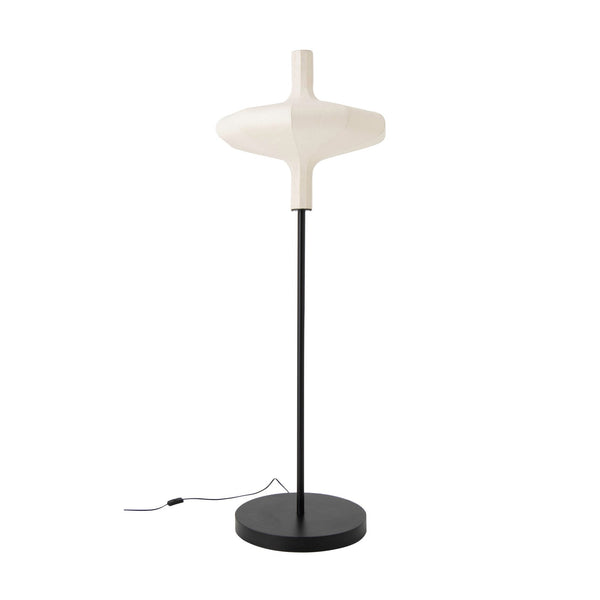
Rice paper is translucent, it lets the shape of the bulb show through and gives a low light, close to candlelight. For reading, prefer a thicker paper or a double shade. The Papia model, in beige paper, plays on this muted effect; it sits alongside our full lighting range.
Where to place a paper floor lamp in the living room?
Set it at the end of the sofa, in a free corner or behind a reading armchair, near a socket to avoid an extension lead across the walkway. Leave one shade-width between the base and the wall: the light spreads better and the cast shadow stays soft. Avoid placing it facing someone seated, the shade would be in their line of sight.
Near the sofa or behind a reading armchair?
Behind the armchair, the shade passes over the shoulder and lights the page without glare. Against the sofa, it lights the low table and the floor. If the corner serves both, an adjustable model settles the question; see an adjustable model.
Tall paper floor lamp or wide shade: which for a small living room?
In a narrow room, a wide shade held by a slim base takes up little floor space and gives plenty of light. A tall, narrow model slips into a corner without blocking the way. For more discreet accent lighting, compare with floor lamps for the living room.
What are the types of floor lamps?
There are four families: the floor lamp, on a base and standing on the floor; the table lamp, for a table or bedside; the pendant, hung from the ceiling; the wall light, fixed to the wall. The ceiling light, fixed flat to the ceiling, is often added in a living room. A floor lamp is then defined by its base: straight, arched or adjustable.
Japanese paper floor lamp, paper chandelier or paper ceiling light?
The Japanese paper floor lamp keeps the light low, near the seating. A chandelier or paper ceiling light diffuses at the centre of the room and replaces the original ceiling lighting. The two work well together: low for reading, high for moving around.
Round, conical or cylindrical shade: what are the differences?
The round shade projects wide and softens shadows, the conical one concentrates downwards, the cylindrical one gives an even halo. The Yunkai model, woven and conical, sets a bohemian mood; for a more graphic line, look at the design pieces.
How to choose the size and shape of your paper floor lamp?
The height of the base sets the use: from 150 to 160 cm, the shade passes above a sofa; around 106 cm, it comes closer to the armchair. The diameter of the shade sets the lit area: 60 cm covers a whole coffee table, 36 cm fits in a corner. The Papia model, beige and round, measures Ø 60 cm and H 160 cm; the Odar, with a double black and beige shade, Ø 36 cm and H 152.5 cm.
| Model | Material | Colour | Dimensions | Socket | Max power | Style |
|---|---|---|---|---|---|---|
| Odar | Woven fabric and paper | Black and beige | Ø 36 cm, H 152.5 cm | E27 | 42 W max | Double shade |
| Green Sofie | Metal and paper | Black | W 44.5 cm, D 189 cm, H 106.5 cm | E27 | 10 W max | Contemporary |
| Papia | Paper | Beige | Ø 60 cm, H 160 cm | not specified | not specified | Wide round |
| Yunkai | Woven paper | Black | W 42 cm, D 34 cm, H 150 cm | E27 | 60 W max | Bohemian |
The Papia floor lamp suits a large sofa, the Odar a sofa end. For a lower base and a contemporary line, the Green Sofie goes down to 106.5 cm. Wooden bases have their own family, see the wooden bases.
Rice paper, polyphane or fabric: which shade to choose?
Rice paper is translucent and light, polyphane is a paper treated to stay rigid, woven fabric filters more. All filter the light; the choice comes down to the effect, the care and the shape. Woven paper shows the weave and casts a pattern on the wall, smooth paper gives an even halo.
| Shade | Material | Light diffused | Care | Use |
|---|---|---|---|---|
| Wide round (Papia) | Paper | Diffused, no direct glare | Dry dusting | Large area near the sofa |
| Cylindrical (Green Sofie) | Paper on metal base | Low and even | Soft cloth, no water | Reading corner |
| Woven conical (Yunkai) | Woven paper | Filtered by the weave | Soft brush | Bohemian mood |
| Double shade (Odar) | Woven fabric and paper | Two volumes, muted light | Dry dusting | Sofa end |
The Yunkai floor lamp shows the gap between smooth and woven paper. If you want a shinier effect, compare with glass shades. For a lighter fibre in texture, see the bamboo models.
How to care for a paper floor lamp?
Switch off the power before any handling, then dust dry with a feather duster or a soft cloth, without water or product. Woven paper is cleaned with a soft brush, without rubbing, so as not to loosen the fibre. The collection is guaranteed for two years, which covers manufacturing defects, not wear of the paper.
How to clean a paper shade?
Run the duster from top to bottom, without pressing. A stubborn mark comes off with a soft eraser, never with a damp cloth: water marks the paper and warps the frame. For a metal base, a dry cloth is enough; the matt finishes can be seen in a black metal floor lamp.
How to change the bulb without damaging the paper?
Unplug, let it cool, then hold the socket with one hand and unscrew the bulb with the other. Never pull on the shade to reach the socket: the frame is what bends. An LED bulb heats less and limits the yellowing of the paper.
Which paper floor lamp for a bohemian, contemporary or Nordic living room?
A bohemian living room calls for a woven shade or a beige paper that shows the weave, with a raw fabric sofa and a patterned rug. A contemporary interior prefers a black cylinder on a slim base, near a light wood piece. In a Nordic version, keep a light colour and a simple shape, without a pattern.
Which furniture to pair with a black paper floor lamp?
Black goes with a velvet sofa, an oak coffee table or a wall painted in a stone tone. It creates contrast without weighing things down, provided it stays the only dark element in the corner. More ideas in the white and black colours.
Which paper floor lamp for a Scandinavian decor?
A round shade, a slim base, a light colour: three markers are enough. The beige of the Papia matches birch and linen. To take the logic further, look at a Nordic floor lamp and the Scandinavian spirit in the living room. A more retro look can be found in a vintage look.
Which socket and bulb to choose for a paper floor lamp?
The E27 socket models in the collection take a standard screw bulb, and the IP20 rating makes them suitable for dry interiors, never for a terrace. Respect the maximum power stated on each model: 42 W for the Odar, 10 W for the Green Sofie, 60 W for the Yunkai. An LED bulb heats less, which suits paper.
What maximum power for an E27 bulb?
It varies from one light to another and is given in its specifications. Stay below it: beyond that, the shade heats up and the paper yellows. A low-power LED often gives as much light as a more power-hungry classic bulb. For task lighting, see the black LED models.
Can a paper floor lamp be used as main lighting?
On its own, no: it lights an area and leaves the corners in shadow. It complements a ceiling light or a pendant. In a small living room, two low sources are often enough for the evening. For a workspace, a dedicated model remains more suitable, such as a floor lamp for the office.
Designix reassurance: secure payment, tracked delivery, returns accepted and a customer service team you can reach to confirm a socket, a height or a colour before ordering. Every floor lamp in the selection is guaranteed for two years.
Frequently asked questions about paper floor lamps
How can I make my own light fixtures?
Start with a rigid frame (stable base, E27 socket, cable, switch) then dress it with a paper shade. The paper must stay away from the bulb and the assembly must be electrically safe. For everyday use, a store-bought model avoids overheating risks and insurance problems.
Which paper to make lamps with?
A thick, translucent paper, such as rice paper or a treated paper like polyphane, holds its shape and lets light through. Paper that is too thin warps with heat and tears during assembly. Avoid papers printed with dark ink, which block the light.
What is polyphane paper?
Polyphane is a paper made translucent and more resistant by a surface treatment. It is used as a shade in paper lamps and light fixtures: it diffuses light, keeps its shape and is easier to clean than raw paper. It does not remove the heat of the bulb, hence respecting the maximum power.
What can replace polyphane in shades?
It can be replaced with laminated rice paper, fabric stretched over a frame or a store-bought shade suited to the diameter. The replacement must leave a gap around the bulb and respect the maximum power of the light. Check the socket diameter before buying.
How can I replace the fabric of a shade?
Remove the shade, take off the fabric and staples, then stretch a new material over the frame, gluing the edge inwards. A paper shade is fitted the same way. Then check that the socket and cable remain intact, and plug back in only once everything is dry.




