
Outdoor motion sensor light bulbs
This selection is also available in our French store: Ampoules d exterieur à détecteur de mouvement
No products in this selection.
- Tracked delivery to your country Tracked delivery
- Secure payment at checkout Multiple payment methods
- 14 days to change your mind 14-day returns
- Secure payment Secure payment
Not sure of your style? Find it in 30 seconds
A few questions, and we will show you the pieces made for you.
Frequently asked questions
How do I choose the right product?
What are the delivery times?
Can I return an item?
Can I pay in instalments?
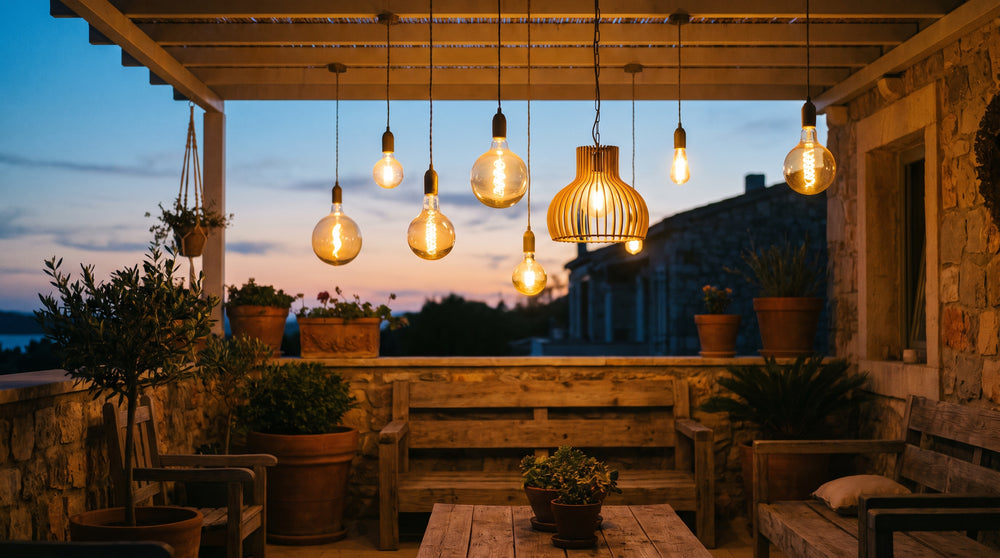
An interior that reflects who you are
Carefully selected pieces, shipped from our warehouses. Our team advises you before you buy, so you choose with confidence.
- Tracked delivery
- Pay in instalments, where available
- 14 days to change your mind
- Advice & showroom in Lyon, France
An outdoor motion sensor light bulb switches on by itself when someone passes and goes off after an adjustable delay. You first choose the cap of the existing fixture, then a protection rating suited to the exposure, then the light colour; this guide walks through these three steps, then the installation areas and the settings.
What is an outdoor motion sensor light bulb?
A passive infrared sensor detects the heat of a moving body in its field, switches the bulb on, then returns it to darkness after an adjustable delay. The twilight cell prevents it from switching on in broad daylight. Two limits matter before buying: opaque glass or a closed shade block the radiation, and a sensor buried inside a globe sees nothing.
Outdoor motion sensor light bulb: how it works
The passive infrared module, often called PIR, compares the ambient heat with that of a passer-by: it emits nothing, it receives. The range and angle of the cone vary from one model to another, a wide cone covers a terrace, a narrow cone targets a step. The timer sets the on time after the last movement. These settings are found on the fixture when the sensor is built into it, on the bulb when the bulb carries the function.
Outdoor LED bulb with motion sensor: what it changes
You come in with your hands full, the light is already there, and you no longer leave a lamp on all night for nothing. The LED generates little heat, which matters in a closed fixture. Bulbs made for outdoors add the moisture resistance that indoor models lack. For a stronger effect, see the outdoor LED bulbs.
Where to install an outdoor motion sensor light bulb?
Where you arrive and where you move around: entrance and facade, terrace, path, garden stairs, garage door, garden shed. The sensor must see the arrival area without pointing at the street or a public passage, otherwise the bulb switches on for no reason and loses all its point.
Outdoor wall light for terrace: at what height to place it
Above shoulder height, offset from the door so the sensor sees arrivals without pointing at the eyes. On the sheltered terrace side, it lights the table without dazzling the guests. The fixture stays open on the passage side: that is what lets the radiation in. Before ordering, check the existing cap and the real exposure under the awning.
Outdoor motion sensor lamp for the path and the gate
On a path or a gate, aim the field along the traffic, never towards the street: otherwise every pedestrian triggers the light. An adjustable spotlight or a bollard sets the direction to the exact degree. For the support, see how to choose a suitable outdoor fixture.
| Area to light | Suitable fixture | Common cap | Recommended IP rating | Light rendering |
|---|---|---|---|---|
| Entrance, facade | Wall light, lantern | E27 | moderate under awning, high if exposed | warm white 2700 K to 3000 K |
| Covered terrace | Ceiling light, wall light | E27 | moderate | warm white 3000 K |
| Path, gate | Spotlight, bollard | GU10, E27 | high | neutral white, directed beam |
| Garage, utility room | Bathten, ceiling light | E27 | high | clear neutral white |
| Garden, beds | Bollard, post lantern | E27, GU5.3 | high | warm white or amber |
Outdoor E27 bulb: which cap to choose for your fixture?
The cap belongs to the fixture, not the bulb: E27 on most outdoor wall lights, lanterns and ceiling lights, GU10 on adjustable spotlights, E14 on small models. Unscrew the existing bulb and read the marking on the socket: it is the only reliable check before ordering.
Outdoor E27 bulb: the great standard of wall lights and lanterns
The large screw cap fits most facade fixtures. It opens up the widest choice of colours and wattages, including dimmer-compatible models. E27 screw caps are changed in one motion, without tools, which matters when replacing a bulb up high.
GU10 and E14 on compact fixtures
The two-pin GU10 fits spotlights aimed at a path or a wall. The smaller E14 fits compact wall lights and balcony fixtures; you find it in the small E14 caps. On an existing low-voltage installation, the pins are replaced identically: see the GU5 spotlights, the G4 and G9 caps, and the 12 volt installations.
| Cap | Shape | Where you meet it outdoors | What it allows |
|---|---|---|---|
| E27 | large screw cap | lanterns, wall lights, ceiling lights | the widest choice of colours |
| E14 | small screw cap | compact wall lights, balconies | reduced format, modest output |
| GU10 | two pins | adjustable spotlights and projectors | beam directed at a path |
| GU5.3 and G4 | pins, low voltage | garden spotlights on transformer | replacement of a 12 V installation |
Outdoor motion sensor bulb or fixture with built-in sensor?
The sensor bulb keeps the fixture already installed and only adds the automation: simple move, contained budget. The fixture with built-in sensor places the cell outside the globe and makes the settings accessible, which works better on a new facade or one very exposed to rain.
The sensor bulb: keep your fixture and gain the automation
You keep the existing wall light, you just change the bulb. It is the solution when the fixture is attractive, sealed, or when you do not want to touch the facade drilling. It also suits models with a built-in sensor whose electronics are wearing out: the bulb takes over the function.
The fixture with built-in sensor: when the sensor is better placed
Cell outside the diffuser, range adjustable without dismantling, timer accessible with one hand. On a new facade, it is simpler to install in one go. The budget ranges from entry level to exceptional piece; for models with a sensor, browse the bulb department and the range of fixtures.
What light to give outdoors: colour temperature and protection rating?
Outdoors, you want a light that illuminates without dazzling: 2700 K to 3000 K for a facade or a terrace, a more neutral white for a work area. The IP rating describes resistance to dust and water; the more exposed the light point, the higher it must be.
Warm white or neutral white: which temperature outdoors
2700 K gives a soft yellow that warms stone and wood. 3000 K, sharper, renders an entrance readable without harshness. Neutral white is reserved for the garage and the utility room. For a decorative lantern, amber glass gives a golden light. See the warm white at 2700 K and the 3000 K tints, or the amber glass for garden lanterns.
IP rating: what the number really protects
Two digits: the first concerns solids, the second water. Under an awning, moderate protection is enough; on a wall light lashed by rain and wind, you must go higher. The IP of the fixture counts as much as that of the bulb, and it is often the weak point of an old lantern.
Solar LED outdoor lamp with motion sensor: does it hold up?
Yes, provided there is sun: the panel recharges the battery during the day, the bulb switches on at night when someone passes. On short days or under a shaded awning, the autonomy drops and the light weakens. It is the right choice where running a cable would be heavy.
Solar outdoor lamp with motion sensor: the day-night cycle
The photovoltaic panel recharges, the battery restores, the sensor triggers. A panel tilted towards the sun's path gives the best yield; laid flat under a roof overhang, it collects little. Allow access to the panel to clean it from time to time.
The limits to know before choosing
A shadow cast by an awning or a tree is enough to halve the recharge. On short days, the reserve lasts less long and the light weakens towards the end of the night. The battery ages, whatever the model. If a cable already exists, a 220 V bulb or a model for 12 volt installations remains more consistent.
Wiring three bulbs in parallel: how to do it simply?
Switch off the power at the breaker, identify live and neutral, then run from the first box to the next two in a branch: each bulb receives the same voltage and they switch on together. Connections are made in closed boxes, never buried in the wall.
Live, neutral, earth: identify before connecting
On a branch wiring, each point is fed by the same supply. The earth is carried from box to box, without interruption. A multimeter or a simple voltage tester removes doubt about the markings, especially on an old installation with faded colours.
The mistakes that cost dearly
Forgetting to switch off at the breaker, clamping a wire on its sheath instead of the copper, leaving a connection outside a box, mixing up the markings, adding a point on an already loaded circuit. If doubt remains about the circuit, have it checked by an electrician: it is faster than a wall to redo.
How to adjust and maintain outdoor motion sensor lighting?
Set the range and the timer once night has fallen, testing at several paces. Clean the diffuser and the lens, and trim the vegetation in front of the sensor: a moving leaf is enough to trigger the light.
Setting the range and the timer, at night, in real conditions
A slow pass does not trigger the same way as an arriving car. Set the cone to cover the arrival without sweeping the street or a heat source such as a chimney flue. Two minutes of walking in front of the cell tell you more than the manual.
Cleaning the lens and clearing the vegetation
A diffuser frosted by UV loses sensitivity, a soft cloth restores it. Clear the leaves, remove a cobweb or nest in front of the cell. These simple gestures avoid phantom switch-ons that make you think of a fault. To replace a tired bulb, see the decorative filament renderings, the dimmer-compatible models and all the bulbs in the catalogue.
Secure payment, tracked delivery, returns and Designix customer service: you order the right cap first time, and if the marking on the socket does not match what you expected, the return stays simple. Take the time to unscrew the existing bulb and photograph the socket before confirming.
Frequently asked questions
Which outdoor E27 bulb to choose for a motion sensor?
An E27 screw cap, made for outdoors, with an IP rating suited to its location: a model sheltered under an awning does not have the same constraints as a lantern in full wind. Check which part carries the function: if the sensor is in the fixture, a simple bulb is enough.
Can an outdoor motion sensor light bulb go in any fixture?
No. The sensor needs to see the passage area: an opaque globe, a closed shade or very tinted glass block the radiation and the bulb no longer triggers. You need a fixture open on the passage side, or a model whose sensor stays outside the diffuser.
Which IP rating for an outdoor motion sensor light bulb?
The IP rating is read in two digits: the first concerns dust, the second water. A light point under an awning is satisfied with moderate protection, whereas a wall light exposed to rain and wind requires a high rating. The IP of the fixture counts as much as that of the bulb.
Does a solar LED outdoor lamp with motion sensor light enough?
It lights enough to find your way and secure a passage, not to work. The result depends on the sun received: a well-oriented panel and a charged battery give the best. On short days or under a shaded awning, the autonomy drops and the light weakens before the end of the night.
LED motion sensor bulbs: do they use less?
For a comparable amount of light, an LED needs less power than a halogen and heats much less. Since the sensor only switches on when someone passes, the saving comes mainly from the reduced on time, not only from the technology. The effect shows on a facade lit all night.




