
Outdoor light bulbs
This selection is also available in our French store: Ampoules d exterieur
No products in this selection.
- Tracked delivery to your country Tracked delivery
- Secure payment at checkout Multiple payment methods
- 14 days to change your mind 14-day returns
- Secure payment Secure payment
Not sure of your style? Find it in 30 seconds
A few questions, and we will show you the pieces made for you.
Frequently asked questions
How do I choose the right product?
What are the delivery times?
Can I return an item?
Can I pay in instalments?
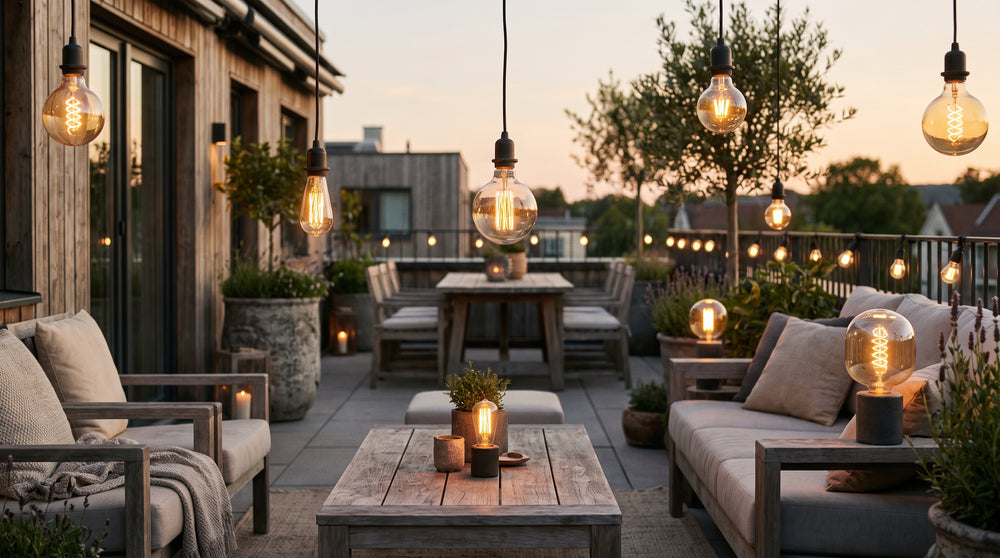
An interior that reflects who you are
Carefully selected pieces, shipped from our warehouses. Our team advises you before you buy, so you choose with confidence.
- Tracked delivery
- Pay in instalments, where available
- 14 days to change your mind
- Advice & showroom in Lyon, France
For a sheltered light point, an E27 LED filament bulb in glass and metal, in warm white 2700 to 3500K, is enough. As soon as rain runs down the socket, it is the protection rating that decides, IP44 or IP65, and the base stays the same.
What is the best outdoor light bulb?
There is no single outdoor light bulb, but a use to define. Two criteria decide: is the light point sheltered or exposed, and do you want ambient light or lighting meant to see by. Once those two answers are set, the base, the format and the colour temperature follow.
Outdoor LED filament bulb: the unbreakable globe format
The globe format, 3.5 cm in diameter by 10 cm high, fits most E27 threaded lanterns and wall lights. Glass and metal give a visible filament, lit or unlit, and the plastic thread protects the screw from repeated knocks when replacing. The unbreakable E27 filament outdoor light bulbs in the selection come in 1W and 2W, in black, gold or white, with a contemporary feel.
Outdoor lamp: first the role, ambience or main lighting
A 1W or 2W LED filament bulb lights to mark a path, highlight a wall, accompany a meal outside. It does not replace a floodlight covering a whole driveway. To place the available technologies, browse all our bulbs before settling your choice. Then look at your socket and the shelter above it: those two pieces of information are enough to decide.
E27 outdoor bulb: how do you recognise the right base and the right format?
The E27 base is the large screw base, the one on standard sockets of outdoor lanterns and wall lights. An E27 LED filament globe bulb, 3.5 cm in diameter by 10 cm high, slips into most E27 threaded fixtures. E14 and GU10 bases are not interchangeable. The collection has 12 outdoor bulbs.
E27, E14, GU10: what each base corresponds to
The thread diameter makes the base: E27 for wide sockets, E14 for compact fixtures, GU10 for bayonet spots. A recessed ground light on a driveway needs a GU10, never an E27 globe. E27 base bulbs cover most wired outdoor lighting, while small E14 base models remain reserved for small accent fixtures.
Floor-standing or table outdoor lamp: another family of fixtures
A floor lamp, a bollard or a table lamp with an E27 socket works like a wall light: you screw in a bulb. GU10 bulbs for spots and other G4 and G9 bases equip integrated fixtures, not these socket models.
Which bulb to put outside depending on the space?
Under a terrace wall light, a house entrance or a garden shed, the bulb changes mainly by its water protection, not by its base: the E27 socket stays the same. A glass and metal LED filament bulb, in warm white, suits sheltered points; areas open to rain need a higher IP rating.
Outdoor terrace wall light: which bulb to install?
A wall light fixed under a roof overhang protects the socket from direct rain. A glass globe bulb fits without forcing, and warm white extends the indoor light once the bay is open. Compare the LED outdoor bulbs to see what fits this type of fixture.
Entrance, facade and garden shed
A facade lantern takes a bulb that withstands humidity and temperature swings. Under a canopy or in a closed shed, the point stays protected and a standard bulb is enough. 2700K bulbs give that golden tint that welcomes without dazzling.
Balcony and city courtyard: mind the neighbours
In dense surroundings, light spills over to the neighbour opposite. A bulb aimed at the wall rather than the street, at low power, limits the nuisance. Warm white also reduces that sense of indirect glare that cool white accentuates.
How many lumens do you need to light outdoors?
The need depends on the surface and the intended role. A 1 to 2W bulb serves for marking a path and ambience, not for lighting a whole driveway. For real outdoor lighting, choose a higher power and check the flux stated on the packaging, rather than relying on wattage alone.
Power and luminous flux: do not confuse them
Watts measure energy consumed, lumens the light produced. Two bulbs of the same power can differ markedly in flux depending on the technology used. On a fixture powered by 220V LED bulbs, the value printed on the box is the only figure comparable from one model to another.
Marking a path, ambience or main lighting
Marking a border is satisfied with a low, discreet point, often set on the ground. Main lighting calls for several sources and a higher flux per point. In low-voltage installation, 12V LED bulbs meet these garden uses, with their own power supply.
What lights whitest, warm or cool white?
At equal power, it is cool white, around 6000K, that appears whitest, because it contains more blue. Warm white, between 2700 and 3500K, leans yellow and appears softer. The bulbs in this collection are all warm white, for a welcoming exterior rather than a clinical look.
Warm white 2700 to 3500K: the mood of a terrace
This range pairs with wood, stone and dark metal. It flatters faces and does not crush the colours of the garden. 3000K bulbs sit in the middle of this range, a versatile warm white that suits a lantern as well as a wall light.
Neutral and cool white: safety and legibility
A neutral white around 4000K better defines the edges of a staircase or an access point. Cool white stays reserved for technical areas, where you want to see clearly rather than be welcomed. For a uniform look across a whole facade, white bulbs avoid shade differences from one point to another.
What do IP20, IP44 and IP65 mean on an outdoor light bulb?
The IP rating measures protection against dust and water. IP20 protects only against finger contact and solid objects, not water. IP44 resists splashes, IP65 water jets. The bulbs in this collection are IP20: they go in a sheltered point, not in full runoff.
IP20: what this rating really protects
An IP20 holds as long as water does not run down the socket. Under a canopy, in a closed conservatory or behind the glass of a lantern, the protection is enough. Placed on a facade without shelter, the same product takes on water and ages quickly.
IP44 and IP65 for exposed areas
As soon as the location gets slanting rain, go up a notch. IP44 for a semi-sheltered wall light, IP65 for a facade or a terrace edge swept by the weather. The fixture matters as much as the bulb: an open socket shelters nothing.
| Use | Base | Light temperature | Protection rating | To check |
|---|---|---|---|---|
| Sheltered terrace wall light | E27 | Warm white 2700-3500K | IP20 possible if rain does not run down the socket | That water does not pool in the fixture |
| House entrance or facade | E27 | Warm white | IP44 or IP65 depending on exposure | Fixing and installation height |
| Border marking or terrace edge | Low power E27 (1 to 2W) | Warm white | IP44 or IP65 | Ambient role, not main lighting |
| Garden shed or under a canopy | E27 | Warm white | IP20 possible under shelter | Protection against splashes |
| Recessed ground light on a driveway | GU10 | Depending on the floodlight | IP65 | Different base, dedicated bulb |
| Rating | Protects against | Where to install it | To avoid |
|---|---|---|---|
| IP20 | Finger contact and solid objects | Under a canopy, protected wall light, closed conservatory | Direct rain, watering, sea spray |
| IP44 | Dust and water splashes | Semi-sheltered terrace wall light, under a roof overhang | Immersion, high-pressure jet |
| IP65 | Dust and water jets | Facade, terrace edge, exposed outdoor area not immersed | Prolonged immersion |
How do you wire 3 bulbs in parallel on the same circuit?
In parallel, each bulb receives the same voltage: all live wires are connected together and all neutrals together, with terminals or connector blocks. The bulbs light independently of one another. The breaker must be switched off before working, and the maximum power allowed by the circuit and the switch must be respected.
Parallel or series: the difference that changes everything
In series, one blown bulb turns off the whole line and the voltage is shared between the points. In parallel, each point keeps the mains voltage and works on its own. This is the wiring chosen for outdoor lighting, whatever the number of points to supply.
Watertight connections outdoors
A closed junction box and a cable gland protect the connections from humidity. Cables must neither lie in a puddle nor serve as a perch. To adjust intensity from a compatible dimmer, dimmable E27 bulbs are controlled without changing the fixture.
Solar, wireless, rechargeable or floor-standing outdoor lamp: how to find your way?
These families do not work like a screw-in bulb: solar, wireless and rechargeable models carry their own battery and LED, while a floor-standing or table lamp uses a socket and a bulb. An E27 LED filament bulb therefore goes into a wired fixture fitted with a socket, not into a solar model.
Solar outdoor lamp: no socket, no bulb to change
A solar model converts energy from the panel and stores it in a battery. When that weakens, you replace the fixture or its battery, not a bulb. For classic wired lighting, see instead our lighting catalogue and the sockets it offers.
Rechargeable or wireless lamp: for nomadic use
A rechargeable lamp moves from the table to the terrace edge without a cable, and also has its own LED. If the wish is for light with a visible character, filament bulbs remain the format that shows its filament, lit or unlit.
How do you maintain an outdoor light bulb and make it last?
Switch off the power before any handling, wipe the glass and the socket with a dry or slightly damp cloth, and check that water does not pool in the fixture. A glass and metal LED filament bulb, in globe format, withstands light knocks. The Designix selection is guaranteed for 2 years.
Cleaning and seasonal checks
Twice a year, check the fixture seal, the condition of the screw thread and for insects in the globe. Frosted glass is cleaned with warm water, without harsh detergent. Glass bulbs scratch little and keep their transparency if abrasive sponges are avoided.
2-year guarantee, returns and Designix customer service
Secure payment, tracked delivery, possible returns, Designix customer service reachable to confirm a base or a rating before ordering. A bulb that blackens or flickers is replaced without touching the fixture: that is the advantage of socket mounting. For a standard socket, E27 LED bulbs offer the same freedom of replacement.
Frequently asked questions
What is the most efficient outdoor lighting?
Efficiency comes first from the match between the fixture, its bulb and the target area. An LED aimed well at the area to be lit, with a flux suited to the surface and a protection rating consistent with exposure, lights better than a powerful bulb badly placed under shelter.
What are the different types of outdoor fixtures?
A distinction is made between wired fixtures with a socket, such as wall lights, lanterns and bollards that take an E27 bulb, and self-contained families: solar, wireless, rechargeable, floor-standing or table. Only the first use a screw-in bulb; the others have their own LED.
What is the best outdoor fixture?
The one whose protection rating matches the real exposure of the location, whose material holds up outside and whose light stays at a pleasant temperature, here warm white. The E27 socket offers the most freedom, since you can change the bulb without replacing the fixture.
What is the difference between IP44 and IP65?
IP44 protects against solid objects over 1 mm and water splashes, which suits a semi-sheltered point. IP65 also protects against dust and resists water jets, for an exposed facade or terrace edge. Neither protects against immersion.
Which bulb should be used outside?
A bulb whose base matches the fixture socket, most often E27, and whose protection rating matches the exposure. In glass and metal, LED filament and warm white, it gives an ambient light. The compact globe format makes installation in lanterns and wall lights easier.
Who are the high-end outdoor lighting manufacturers?
There is no official list: well-made ranges are recognised by materials such as glass and metal, by consistent finishes and by an unambiguous protection rating. At Designix, the selection is based on these concrete criteria, not on a brand name.




