
Outdoor LED neon lights for patio
This selection is also available in our French store: Néons LED d exterieur pour terrasse
No products in this selection.
- Tracked delivery to your country Tracked delivery
- Secure payment at checkout Multiple payment methods
- 14 days to change your mind 14-day returns
- Secure payment Secure payment
Not sure of your style? Find it in 30 seconds
A few questions, and we will show you the pieces made for you.
Frequently asked questions
How do I choose the right product?
What are the delivery times?
Can I return an item?
Can I pay in instalments?
An interior that reflects who you are
Carefully selected pieces, shipped from our warehouses. Our team advises you before you buy, so you choose with confidence.
- Tracked delivery
- Pay in instalments, where available
- 14 days to change your mind
- Advice & showroom in Lyon, France
First check the IP rating and voltage, then the light colour: this trio decides whether an outdoor LED neon light stays outside all year and what effect it gives in the evening. Then measure the line to cover (railing, low wall, step) before comparing strip lengths.
What kind of light does outdoor LED neon lights for patio give on a terrace?
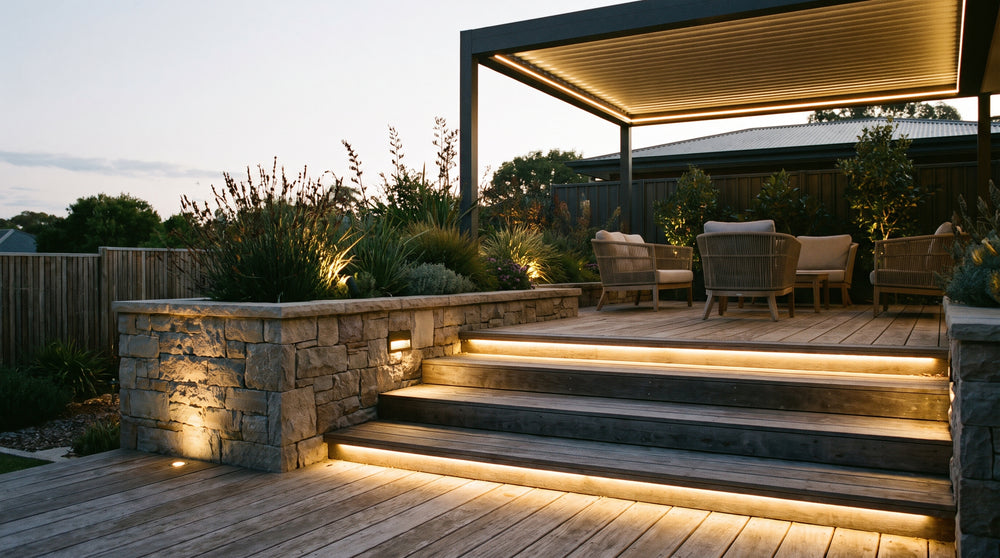
An LED neon gives a continuous luminous line, with no break or hot spot, that underlines a railing, a step or a wall without lighting the whole terrace. The result depends on the light colour and where the line is placed: turned towards the ground, it lights; hidden behind a profile, it decorates.
Which light colour to choose for the terrace?
Around 2700 to 3000 K, warm white brings the terrace close to the living room and suits evening meals. Around 4000 K, neutral white makes steps and thresholds easier to read, which helps on a passageway. Beyond that, the light turns blue and hardens faces as well as foliage. These ranges are general references: the exact tint is shown on the chosen model. To match this line with the rest of the house, browse the Designix lighting collection.
Visible or hidden neon: what effect in the evening?
Visible, the neon becomes a graphic line: it is seen, it draws, it takes on its decorative role. Hidden behind a profile or under a handrail, it shows only the light, softer and without glare. The first dresses a facade, the second a low wall or the underside of an awning. Indirect light needs less output for the same comfort, a point to keep in mind to compare with other light fittings.
Where to install outdoor LED neon lights for patio?
The places that work best are the railing, the low wall, the underside of an awning, the step and the facade wall. Each place changes the use: the railing marks the edge of the terrace, the step lights the passage, the wall draws a decorative outline.
Outdoor LED neon lights for patio on a wooden terrace
On a wooden terrace, the line is fixed to the railing, a joist or the wall, never on a board that moves with moisture. Wood moves and soaks up water in winter: keep a gap under the mounting and let water drain away. An aluminium profile protects the strip and smooths out slight bumps in the support. Find the fixings in all our outdoor light fittings.
Outdoor LED neon lights for patio: wall, railing or step
On a facade wall, a horizontal or vertical line draws an outline and lights a passage, provided an accessible cable feed is planned. On a railing, mounting under the handrail avoids glare from the garden. On a step, a moderate output is enough: too strong, it marks the step without making the rest readable. An outdoor wall light completes the line well to light a dining corner, and choosing a light fitting suited to the terrace is always done according to these uses.
| Location | Type of mounting | What it brings | To check |
|---|---|---|---|
| Railing | Continuous line under the handrail | Marks the edge of the terrace, visible from the garden | Fixing on wood or metal, no moving board |
| Low wall | Wall light or profile | Low indirect grazing light, little glare | Height below eye level, water run-off |
| Facade wall | Horizontal or vertical line | Draws an outline, lights a passage | IP rating, accessible cable feed |
| Step and threshold | Step nosing or groove | Makes the passage safe without lighting the whole terrace | Moderate output, mounting protected from foot traffic |
| Underside of awning | Hidden line | Indirect ambience for meals | Dry support, space for the transformer |
| Wooden terrace | Clips or profile on joist or railing | Warm result that follows the line of the wood | Gap from the ground, wood movement with moisture |
Which IP rating to choose for a terrace LED neon?
The IP rating indicates resistance to dust and water. On a terrace, an IP44 is enough under a sheltered awning; an IP65 is safer for a line exposed to rain or sprayed with a hose. The IP rating says nothing, however, about the quality of the light.
IP44 or IP65: what changes in the rain
The first digit concerns solids, the second liquids. IP44 covers water splashes, IP65 jets. The difference mainly lies in the connections: seals, cable glands and end caps must be in place, otherwise the strip's rating is useless. Check this point before comparing two models in the home's light fittings.
Neon near a pond or wet ground: the precaution to take
Near a water point, low voltage simplifies making the installation safe, and the transformer is housed out of reach of splashes. Keep the line away from areas where people walk barefoot and keep the connections removable, so you can intervene without tearing off the profile.
230V or 12/24V: how to power an outdoor LED neon?
230V connects to the mains without an extra box, which simplifies long lines. 12V and 24V go through a transformer to be installed in a waterproof and accessible box. Near a water point or ground that is often wet, low voltage is simpler to make safe.
Where to house the transformer of a terrace LED neon?
Choose a dry, ventilated and removable place: a wall-mounted enclosure, under the awning or in a nearby technical room. The longer the line, the more the cable cross-section matters to avoid a voltage drop at the end of the strip. Plan the space for the box before tracing, not after.
Can an LED neon be plugged into an outdoor socket?
Yes, provided the socket is protected and the connection stays out of water, raised and sheltered from run-off. For a fixed line, a direct connection in a waterproof box is cleaner than a hanging plug. In both cases, switch off the circuit before working, and call a professional if the consumer unit is not clearly marked: the lighting catalogue groups the models intended for these installations.
How to choose the length, power and output of an outdoor neon?
First measure the line to cover, then check whether the model can be cut at the marked points. Power and output are chosen according to the desired effect: underlining a step does not need the same light as lighting a table. Too high an output glares at eye level.
Is 2000 lumens a lot?
Two thousand lumens represent an output higher than that of a common household bulb: on a terrace, this genuinely lights several square metres and can glare if the line is at eye level. For a railing or a step, a more moderate output is enough and blends better with the rest of the lighting.
Can a flexible LED neon be cut?
A flexible neon can only be cut at the points indicated by the manufacturer, with the power off. Cutting elsewhere breaks the circuit and voids the warranty. Rigid models cannot be cut: the length is ordered after measuring. For a railing of several metres, count the corners and joins before seeing all available light fittings.
| Criterion | Common options | The question to ask yourself |
|---|---|---|
| IP rating | IP44, IP65, IP67 | Is the line sheltered, exposed to rain or sprayed with a hose? |
| Power supply | Direct 230V, 12V or 24V with transformer | Is there an outdoor socket, and where to house the box? |
| Light colour | Warm white, neutral white | Do you want a meal ambience or passage lighting? |
| Length and cutting | Rigid line or flexible neon cuttable at the marks | What exact length, and can the model be cut? |
| Fixing | Clips, aluminium profile, adhesive rail | Is the support smooth, wood, metal or rendered? |
Is it possible to replace a fluorescent tube with LED neons?
Yes, provided the length, support and connection match. On an old installation, the ballast must be removed or the tube chosen compatible. The watertightness of the profile and the supply voltage are checked before installation, especially when the line stays outside all year.
What to check before removing a fluorescent tube
Note the tube length, the type of socket, the voltage and the presence of a ballast or starter. Also note the condition of the profile: a worn seal will let water in even with a waterproof tube. Switch off the power at the consumer unit and check that there is no voltage before touching the wires.
LED neon: what changes in use and maintenance
The light comes on without flicker or warm-up time, and the tube contains no mercury, which simplifies end of life. The result stays even over the whole length, with no dark zone at the ends. For other points of comparison, see outdoor light fitting: the complete collection.
How to install and maintain an LED neon on a terrace?
Installation starts with a clean, dry support, then a level line to avoid waves. Clips, aluminium profile or adhesive rail depending on the support, with the connections and cable feed left accessible. Cleaning with soapy water, without a direct jet on the connections, is enough to keep the line neat.
How to fix an LED neon to a railing without drilling?
An adhesive rail holds on a smooth, degreased support, but remains a temporary solution in the face of temperature variations. Screwed clips or a profile slid under the handrail hold better over time. On painted metal, protect the finish before tightening. To complete the terrace lighting, it is better to fix all three supports with the same method.
What to do with the connections and the cable at the end of the line?
Leave a service loop near the start, close the end with the supplied cap and run the cable up along the mounting rather than letting it hang. The connections remain removable and out of water. A visual check in spring, seals included, avoids unpleasant surprises after winter.
Can an outdoor LED neon be used indoors?
Yes: a model intended for outdoors also withstands indoor air, with a higher IP rating than an indoor neon. It is used as a continuous line under wall units, as a niche outline or as a light signal, in a kitchen as in a living room.
LED neon and decor for a modern kitchen: where to place the line?
Under wall units, the line lights the worktop without cast shadow and without reflection on the fronts. As an outline of an open niche, it replaces a wall light and stays discreet during the day. This kitchen decoration works all the better when the line follows a single stroke, without a break: choose the shade of white at the same time as the room's other sources.
LED neon in the living room: where to give it a place?
Behind a low sideboard or under a shelf, it creates an indirect halo that replaces a table lamp in the evening. Avoid placing it facing the armchairs: at eye level, the line glares. To match the line with the other sources, take a look at another light fitting for the same terrace and keep the same family of tints.
Ordering an LED neon for your terrace from Designix
Before confirming, go back over your measurements, the IP rating and the voltage: this is what avoids a return. Designix provides secure payment, tracked delivery and returns, with a customer service team reachable to check a connection or a cable length. You can browse the lighting collection before ordering then, if the project covers the whole terrace, find all the light fittings to match the sources with each other.
Frequently asked questions
Can an outdoor LED neon be installed on a wooden terrace?
Yes, on the railing, a joist or the wall, never on a board that moves with moisture. Provide clips or a profile, keep the line away from areas of foot traffic and let water drain under the mounting.
Which IP rating for an LED neon installed outdoors?
An IP44 protects against water splashes, an IP65 resists jets. Under a sheltered awning, the first is enough; a line exposed to driving rain or sprayed with a hose needs the second. Also check the watertightness of the connections.
Can an LED neon be cut to fit the length of a railing?
A flexible neon can only be cut at the manufacturer's marks, with the power off. Cutting elsewhere breaks the circuit and voids the warranty. Rigid models cannot be cut: the length is chosen after measuring.
230V or 12V: which power supply for a terrace LED neon?
230V connects directly to the mains and suits long lines; 12V or 24V requires a transformer, to be housed in a waterproof and accessible box. Low voltage is simpler to make safe near a pond or wet ground.
Can an outdoor LED neon be used indoors, in a kitchen?
Yes: a model intended for outdoors also works indoors, its IP rating being higher than that of an indoor neon. It is used under wall units or as a niche outline, with no risk linked to splashes.




