
Outdoor LED neon lights
This selection is also available in our French store: Néons LED d exterieur
No products in this selection.
- Tracked delivery to your country Tracked delivery
- Secure payment at checkout Multiple payment methods
- 14 days to change your mind 14-day returns
- Secure payment Secure payment
Not sure of your style? Find it in 30 seconds
A few questions, and we will show you the pieces made for you.
Frequently asked questions
How do I choose the right product?
What are the delivery times?
Can I return an item?
Can I pay in instalments?
An interior that reflects who you are
Carefully selected pieces, shipped from our warehouses. Our team advises you before you buy, so you choose with confidence.
- Tracked delivery
- Pay in instalments, where available
- 14 days to change your mind
- Advice & showroom in Lyon, France
Outdoor LED neon lights draw a continuous line of light along a facade, an awning or a step, with no visible hot spot. First choose the protection rating according to the actual exposure, then the colour and the mounting method: the rest of the installation follows from that.
What is an outdoor LED neon light and what light does it give?
An outdoor LED neon light is a flexible or rigid light profile, in silicone or PVC, that diffuses a continuous light along its whole length, with no visible dots. It draws a clean line along a facade, an awning or a step, and is chosen according to its protection rating, its colour and its mounting method.
Professional flexible LED neon: flexible or rigid, what is the difference?
The flexible version bends by hand around a corner, a terrace curve or a wall return. The rigid version holds a long straight line without sagging, which matters on a lintel or a roof line. Both are fixed with clips or on a rail, and connect to a power supply placed upstream. To complete a line of light with classic fixtures, compare with our full range of light fittings.
Outdoor LED neon lights: the effect of a continuous line of light
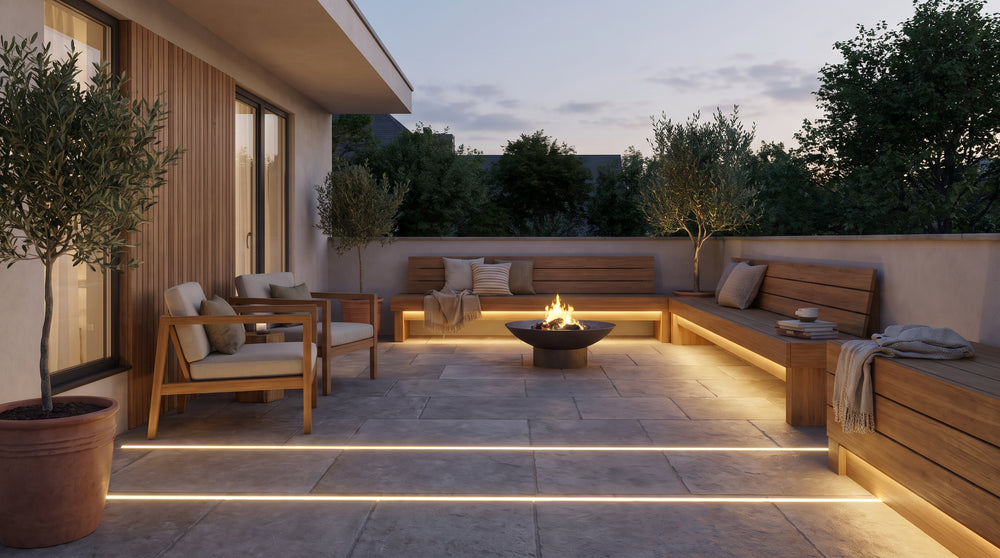
Up close, the surface of the profile diffuses the light without showing the diodes one by one: that is what sets neon apart from a bare strip. In the evening, the effect is that of a graphic line laid on the material, wood, stone or render. The grazing light reveals the relief of the surface instead of flattening it.
Can an LED neon light be installed outside? What the protection rating changes
Yes, provided you choose a model designed for outdoor use and respect its protection rating. An LED neon light rated IP65 withstands water jets and rain, an IP67 withstands temporary immersion, while an IP44 is limited to a sheltered area. The rating appears on the packaging or the product sheet.
IP44, IP65, IP67: reading the rating before buying
The first digit concerns solids, the second water: the higher the second, the stronger the protection against moisture. The rating describes the profile, not the quality of the installation: a badly connected IP65 remains an entry point for water. Always check the rating on the model's sheet and not on the packaging alone.
| IP rating | Resists | Suitable location | To check |
|---|---|---|---|
| IP44 | Splashes and light rain, no jet | Under an awning, covered terrace, enclosed conservatory | Connector seal and power supply box |
| IP65 | Water jets and driving rain | Exposed facade, open terrace, door surround | Cable gland and cable outlet |
| IP67 | Temporary immersion | Pool edge, low flood-prone area | Fixing and condition of the profile over time |
| IP20 | No water protection | Indoor only, in a groove or under a cabinet | Never take this profile outdoors |
Waterproof IP65 LED neon: what it really withstands
An IP65 handles driving rain and the jet of a cleaning hose on a facade or an open terrace. It does not withstand immersion, and its durability depends above all on the fixing and the condition of the profile. A profile that works loose lets water in at the ends.
Where to install an outdoor LED neon light: terrace, facade or stairs?
It finds its place wherever a line of light structures a volume: under an awning, along a terrace, around a facade, on stair steps or around a planting bed. It is installed where grazing light reveals the material, without lighting towards the sky or the neighbours.
Under an awning or along a terrace
Under an awning, the profile is set back from the drip line, on the wall side, to stay clear of run-off. Along a terrace, it runs as a skirting or at the slab edge and draws the boundary of the floor. Both positions light the walkway without dazzling seated people. Our terrace and facade light fittings usefully complement this line of light.
Marking out a staircase or a garden path
On a staircase, the neon is placed under the step nosing or as a handrail: the light falls on the step and makes each height readable. In a path, a profile laid on the ground at the edge, facing the ground, is preferred. A facade outline is reserved for clean lines, never above a neighbour's window. To vary the sources, browse a light fitting suited to each room.
How to connect an outdoor LED neon light without a connector?
When the original connector is missing, the conductors of the strip or neon are joined to the power supply with a solder joint protected by heat-shrink tubing, or with waterproof terminal blocks suited to the cable cross-section. The connection must stay out of water, in a closed box, and respect the polarity markings.
Connecting an LED strip without a connector: solder or terminal block?
Soldering gives the flattest and safest joint in a narrow profile, provided it is sleeved immediately. A waterproof terminal block is suitable when the installation has to be dismantled or redone, provided you choose a model suited to the cable cross-section. In both cases, identify positive and negative before cutting, and leave enough cable length to come out of the profile. A successful outdoor lighting for the home depends first of all on its junctions.
Making the connection waterproof outdoors
The weak point of an outdoor installation is not the profile, it is the connection. Cable outlet with a gland, a closed box fixed high up, heat-shrink tubing on each conductor: water gets in by the shortest path. Some profiles run directly on mains power, others require a power supply or transformer placed upstream, always in a dry and accessible place. See also the light fitting collection for fixtures that connect in the same way.
Cuttable LED strip: how does it work?
A cuttable LED strip or neon has printed cutting marks every group of LEDs. Cut only on these marks, with a clean tool, never between two LEDs of the same group. After cutting, the kept part connects to the power supply, the other no longer works on its own.
Locating the cutting marks on the strip
The mark is a small line or a scissors symbol printed on the circuit, at regular intervals. Cut in the centre of the mark, not beside it. A flexible neon is not always cuttable: check the mention on the product sheet before taking out the tool, because cutting a non-cuttable model makes the section unusable.
What changes once the strip is cut
The cut portion no longer has its own power supply: it must be connected again, with a solder joint or a connector. The adjusted length then fits the surface exactly, which avoids a visible cable return at the end of a facade. Plan the cut before fixing the profile, not after. Other lighting solutions are worth comparing in browse the light fittings.
LED neon, flexible neon or outdoor LED strip: which to choose?
Flexible neon gives a continuous, supple line, easy to bend around a corner. Rigid neon holds a clean straight line on a facade. LED strip, flatter, is stuck into a profile or a groove and stays discreet by day. The choice depends on the layout, the surface and the space available.
| Format | Light output | Installation | Cutting | Typical outdoor use |
|---|---|---|---|---|
| Flexible neon | Continuous line, no hot spot | Bends around corners, fixed with clips | According to the manufacturer's marks | Terrace outline, facade corner |
| Rigid neon | Clean straight line | Installed straight on a rail or fixings | Limited, often at the end | Facade, lintel, roof line |
| LED strip in a profile | Diffused light, discreet by day | Stuck into an aluminium profile or a groove | At the marked LED groups | Steps, railings, under an awning |
Light diffusion: continuous halo or clean line
A silicone neon lets light through evenly and gives a slightly wrapped line. A strip in an aluminium profile, with an opaque diffuser, produces a finer, more discreet line. If the profile is to remain visible by day, choose a neon; if it is to disappear, take the strip.
Length, cutting and bulk
Measure the layout on site, corners included, and allow space for the power supply and the connection. A rigid profile is installed in one or more straight sections, a flexible one follows a curve without constraint. Once the format is chosen, compare the fixtures in lighting solutions.
Which colour of LED neon to choose for outdoors?
Warm white warms a wooden terrace and suits older facades. Neutral white and cool white give a cleaner result, suited to contemporary lines. RGB neons serve mood colour and changing scenes, to be reserved for areas where the light remains decorative.
Warm white or cool white: what result outdoors?
Warm white leans towards gold and flatters wood, stone and old renders: it is the most restful colour for an outdoor dining area. Neutral white stays close to daylight and casts no colour cast on a pale wall. Cool white, bluer, highlights metal and glass but hardens vegetation. As a general guide, a residential exterior stays around warm to neutral white, an architectural highlight rather towards neutral.
RGB neon: for which outdoor mood?
RGB makes it possible to change the colour of a line of light according to the season or the occasion. It is reserved for areas where light is an accepted decoration, a planting bed, a garden lounge, a reception terrace. On a main facade or near a property boundary, a fixed colour remains more restrained. To match this line with other sources, see indoor and outdoor light fitting.
How to install and maintain an outdoor LED neon light?
The profile is fixed with the clips or rail provided, on a clean and dry surface, leaving the connection accessible in a closed box. Maintenance is limited to dusting the profile and checking the seals and fixings at each change of season, to keep the waterproofing and an even light.
Fixing: clips, rail or adhesive?
Clips suit flexible profiles and uneven surfaces, with regular spacing. The rail ensures a straight line on a flat wall and makes removal easier. Adhesive alone does not last outdoors: on an outdoor surface, it is used for positioning before screwing. Always degrease and dry the surface before fixing.
Cleaning and checking an LED neon outdoors
A soft cloth and a little water are enough on the profile, without aggressive products or a direct jet on the connection. At each change of season, check the end seals, the hold of the clips and the absence of water in the box. A point corrected early costs less than a profile to replace. Compare the models in choosing your lighting well.
Ordering from Designix: secure payment, tracked delivery, returns possible and a customer service team available to confirm an IP rating or a mounting method before ordering. Find the Designix light fitting department and all our light fitting families to complete your facade, your terrace or your garden with a consistent indoor and outdoor light fitting, and browse our facade and garden lighting.
Frequently asked questions about outdoor LED neon lights
Can an LED neon light be installed outside?
Yes, if the model is designed for outdoor use and its protection rating matches the exposure. An IP65 withstands rain and water jets on a facade or an open terrace, an IP44 stays under shelter. The fragile point is not the profile but the connection and its box.
What is the difference between an outdoor LED neon light and an outdoor LED strip?
Neon is a solid profile, often in silicone, that diffuses a continuous line and can bend around a corner. LED strip is flat, sticks into an aluminium profile or a groove and stays discreet by day. Both are chosen first according to the layout and the surface.
Connecting an LED strip without a connector, how to do it?
The conductors are joined to the power supply with a solder joint protected by heat-shrink tubing, or with waterproof terminal blocks suited to the cable cross-section. The connection is placed in a closed box, out of water, respecting the polarity markings shown on the strip.
Cuttable LED strip: how does it work?
Cutting marks are printed on the strip, every group of LEDs. Cut only on these marks, with a clean tool, never between two LEDs of the same group. The kept part then connects to the power supply, the other portion no longer works on its own.
Which IP protection rating to choose for an LED neon outdoors?
It all depends on the exposure: under an awning, an IP44 is enough; on a facade or an open terrace, an IP65 is needed; near a pool or in a low flood-prone area, an IP67 is safer. The rating is shown on the product sheet.




