
Outdoor lampshades
This selection is also available in our French store: Abat jours d exterieur
No products in this selection.
- Tracked delivery to your country Tracked delivery
- Secure payment at checkout Multiple payment methods
- 14 days to change your mind 14-day returns
- Secure payment Secure payment
Not sure of your style? Find it in 30 seconds
A few questions, and we will show you the pieces made for you.
Frequently asked questions
How do I choose the right product?
What are the delivery times?
Can I return an item?
Can I pay in instalments?
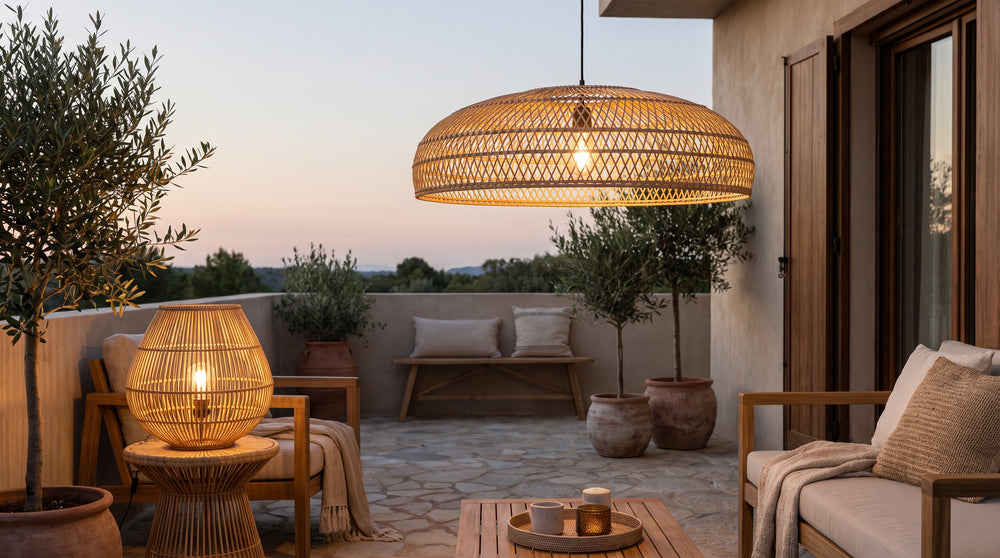
An interior that reflects who you are
Carefully selected pieces, shipped from our warehouses. Our team advises you before you buy, so you choose with confidence.
- Tracked delivery
- Pay in instalments, where available
- 14 days to change your mind
- Advice & showroom in Lyon, France
An outdoor lampshade dresses a lamp installed outside and directs its light downward, onto the table or the path, instead of sending it up to the sky. You choose it on three points: the material seen from a distance, the IP protection rating and the fixing that will hold in the wind, then you check the socket base and the diameter of the collar.
What is an outdoor lampshade and what is it for?
An outdoor lampshade equips a lamp placed outside: facade wall light, terrace floor lamp, garden lantern, veranda pendant. Its function is twofold: it protects the socket and the bulb from splashes and wind, and it directs the light downward to illuminate a table without dazzling the seated people.
Outdoor lampshade: terrace, balcony or garden
On a terrace, it creates the pool of light for the evening meal. On a narrow balcony, it stays small so as not to take up space. In the garden, it tops a floor lamp or a lantern and draws a halo along a path. Our selection of lampshades is read by use before it is read by style.
What distinguishes an outdoor lampshade from an indoor model
Three things matter outside: the material withstands humidity and UV, the fixing holds in the wind, and the socket stays sheltered. A living room lampshade in hand-finished fabric will not last a season on an exposed balcony. For indoors, see rather all our lighting for the home and garden.
How to choose an outdoor lampshade that resists rain and wind?
This collection contains no product to date: there is therefore no material, no IP protection rating, no base, no collar diameter to compare, and no style or dimension to note. The fixing and the wind resistance remain the only points to check as soon as an outdoor lampshade is offered here.
Material and protection rating (IP)
The IP rating is read on the luminaire's data sheet: the first digit concerns solids, the second water. The higher the second, the better the luminaire withstands splashes. A canvas stretched over a frame is suitable under a canopy, not on the front line of rain.
Fixing, diameter and wind resistance
Measure the collar or the neck of the lampshade and compare it with the bulb holder. A wide and tall shape offers wind resistance: on a balcony, a modern and compact shape moves less and is checked more quickly after a gust of wind.
| Material | Light rendering | Outdoor durability | Care |
|---|---|---|---|
| Treated metal (steel, aluminium) | Directed light, little diffusion | Good if the finish is designed for outdoor use | Soft cloth, immediate drying |
| Resin or PVC | Even diffusion | Resists splashes, prone to yellowing | Soapy water then rinse |
| Technical canvas or acrylic | Soft and warm light | Correct if the textile is designed for outdoor use | Soft brush, complete drying |
| Glass | Clear light, no filter | Cleans well, fragile to impacts | Glass cleaner, lint-free cloth |
| Treated wood | Light filtered by the slats | Depending on treatment and exposure | Gentle cleaning, protection to renew |
Which outdoor lampshade for a terrace?
On a terrace, favour a lampshade that directs the light down toward the table, in treated metal or resin if the area gets rain. Under a canopy, a technical canvas works very well. In full wind, a firm, well-fixed model is better, rather wide than tall, to limit wind resistance.
Outdoor terrace lampshade: lantern, pendant or wall light?
The lantern lights at waist height and marks out a step. The pendant lights the dining table top. The wall light frees the floor and draws a halo on the wall. A dark finish such as black and anthracite is less visible by day and frames a light facade well.
Placing the light above the table and the seating area
The principle is simple: the source comes down above the area of use and stays above heads, never in the line of sight of a seated person. Two discreet points are better than one strong point that dazzles. The desired rendering is a light that illuminates the plates, not the faces.
| Location | Suitable luminaire type | First criterion to check | Point of vigilance |
|---|---|---|---|
| Covered terrace | Pendant or wall light | Light rendering toward the table | Height above heads |
| Terrace exposed to rain | Lantern or enclosed wall light | Protection rating and material | Water drainage |
| Balcony | Wall light or floor lamp | Footprint and fixing | Wind resistance |
| Garden and arbour | Floor lamp or lantern on a support | Material resistance | Stability on the ground |
| Facade and entrance | Outdoor wall light | Consistency with the facade | Glare at eye height |
| Veranda | Pendant | Ceiling fixing | Hook in a solid support |
Outdoor E27 bulb: which base and which bulb to choose?
The E27 base is the most common on outdoor luminaires and accepts most LED bulbs on the market. Check that the bulb itself is designed for outdoor use, that its power stays within the limits indicated on the socket, and that its colour temperature matches the desired atmosphere.
E27, E14 or GU10: recognising the base of your socket
The E27 is the large screw base, common on floor lamps, lanterns and pendants. The E14, smaller, equips compact wall lights. The GU10 clips in with a quarter turn on spots and adjustable wall lights. Some luminaires have an integrated LED: there is then no bulb to change.
Outdoor E27 bulb: LED, colour temperature and sealing
Around 2700 to 3000 kelvins, the light leans warm and suits seating areas. Towards 4000 kelvins, it becomes more neutral for moving around or securing an entrance. The sealing of the luminaire takes priority over that of the bulb. See also pendants, table lamps and floor lamps.
Glass lampshade for a bedside lamp, floor lamp lampshade: how to make sense of it?
The glass lampshade mainly concerns bedside lamps and indoor luminaires: clear light, cleaning in one gesture, but fragile to impacts. For a floor lamp, start from the diameter of the bulb holder and the height of the stem, then choose a shape that does not crush the light.
The glass lampshade, an indoor use above all
Glass lets light through without filtering it, which gives a frank clarity on a bedside table. It remains fragile and is rarely seen outside, where impacts and frost batter it. For a bedroom, compare with the models designed for the bedroom.
Floor lamp lampshade: measuring the support and the height
Note the diameter of the bulb holder and the height of the stem before ordering. A lampshade that is too narrow concentrates the beam into a hard spot; a very wide model overhangs the base and unbalances the whole. A natural linen softens the light of a living room floor lamp.
How to match an outdoor terrace wall light with its lampshade?
Align the materials and shades: a black or anthracite lampshade dialogues with a wall light of the same finish, a white matches a light facade. It is better to spread several discreet sources than one strong single point, to light the terrace without dazzling the seated people.
Matching the finishes between wall light and lampshade
Choose a family of material and stick to it: treated metal with treated metal, resin with resin. A light facade supports white models, discreet on a light facade, which blend in by day and fade away at night.
Spreading the light over the terrace
Cross two low sources and one high source rather than lining up three identical luminaires. Seated people mainly see what is at their height: a wall light set too low dazzles. The rest of the equipment is found in the Designix lighting universe.
How to install and hang an outdoor lampshade?
Cut the power at the consumer unit, check that the collar matches the bulb holder, then screw the clamping ring without forcing and check that it holds. For a hanging model, the hook or ceiling rose must be fixed into a solid support, never into plaster alone.
How to hang a lampshade on the ceiling of a canopy or a veranda
Locate the joist or the slab behind the plate, not just the plaster. Drill, plug, then test the hold of the hook by hand before hanging anything on it. A lampshade in canvas or stretched textile remains light, which limits the strain on the fixing.
How to install a lampshade on a wall light or a floor lamp
Switch off the power, remove the bulb, check that the neck of the lampshade matches the bulb holder, then screw the ring without forcing. Check that the whole does not move in the wind, put the bulb back and restore the power. Any creation of a light point on a facade is a job for an electrician.
How to change the fabric of an outdoor lampshade?
Remove the lampshade, take off the old canvas and keep the metal frame. The new fabric is glued or stapled onto the uprights, stretching evenly from top to bottom. A textile designed for outdoor use, treated or technical, will last longer than an upholstery fabric.
Changing the fabric of a lampshade, step by step
Note the direction of the seam, unclip edge by edge, keep the frame clean and dry. Whether gluing or stapling, start at the top and work down, pulling without deforming the shape. The canvases and textiles stretched over a frame provide a useful basis for comparison.
Outdoor lampshade DIY: what can be done safely
Changing a canvas, replacing a ring, cleaning a finish: yes. Connecting a wall light, drilling a facade or improvising the sealing of a socket: no, that touches the electrical circuit. DIY stops at dressing the luminaire. For an indoor project, see a contemporary style for the terrace and the rooms of the house.
How to maintain an outdoor lampshade through the seasons?
Regular dusting is enough most of the time: soft cloth on metal, soapy water rinsed on resin, glass cleaner on glass. Before winter, check the fixing, the condition of the socket and the presence of water inside the luminaire, and replace a tired bulb.
Cleaning according to material, without damaging the finish
On treated aluminium and steel, dry immediately to avoid marks. On resin, rinse with clean water and let dry in the air. On a canvas, brush dry: a wet sponge marks the textile. For indoors, compare with the care of a living room model.
What to check before winter
Check the fixing and tighten the ring if it has loosened. Look at the socket: a trace of humidity or blackening means the luminaire must be replaced. Check that water does not stagnate in the cup. A flickering bulb is changed before the long evenings.
Ordering from Designix
Before ordering, check the socket base, the diameter of the collar and the IP protection rating of the luminaire already in place. This collection contains no product to date: send us the reference of the luminaire and we will tell you if a lampshade can be fitted to it.
Before confirming, three checks
The socket base, the diameter of the collar, the protection rating if the piece is exposed. Once these three points are settled, the rest is a matter of taste. For a terrace, the modern lampshade family remains the simplest to match with a contemporary wall.
And for the other rooms
The same reasoning applies indoors: measure, check the socket, choose the light. If you are equipping a child's bedroom, look rather at the models for a baby's bedroom, or return to the complete collection of lampshades.
Frequently asked questions
How to choose a glass lampshade for a bedside lamp?
Choose a glass that lets light through without dazzling, with a neck suited to the lamp's bulb holder. Glass cleans in one gesture but remains fragile: on a bedside lamp shaken every evening, a simple and stable shape is better than a very thin model.
Which E27 bulb to choose for an outdoor luminaire?
An LED bulb with an E27 base that is itself designed for outdoor use, whose power stays within the limits indicated on the socket. The colour temperature is chosen according to the atmosphere: warmer near seating, more neutral for moving around. The sealing of the luminaire remains a priority over that of the bulb.
How to install an outdoor wall light on a terrace?
Switch off the power, fix the support with plugs suited to the wall (plaster, brick, concrete), connect the terminal block respecting live and neutral, then refit the diffuser. If no light point exists at that spot, running the cable is a job for an electrician.
How to hang a lampshade from the ceiling?
Cut the power, check that the hook or ceiling rose is screwed into a solid support, then hang the lampshade and check that it holds before restoring the power. In a canopy or a veranda, never fix into the plaster plate alone.
How to change the fabric of a lampshade?
Remove the lampshade and take off the old canvas while keeping the frame. The new fabric is stretched from top to bottom, glued or stapled onto the uprights. For outdoor use, choose a treated or technical textile, more resistant than a classic upholstery fabric.




