
Standing garden lamps
This selection is also available in our French store: Lampes à poser sur pied pour jardin
No products in this selection.
- Tracked delivery to your country Tracked delivery
- Secure payment at checkout Multiple payment methods
- 14 days to change your mind 14-day returns
- Secure payment Secure payment
Not sure of your style? Find it in 30 seconds
A few questions, and we will show you the pieces made for you.
Frequently asked questions
How do I choose the right product?
What are the delivery times?
Can I return an item?
Can I pay in instalments?
An interior that reflects who you are
Carefully selected pieces, shipped from our warehouses. Our team advises you before you buy, so you choose with confidence.
- Tracked delivery
- Pay in instalments, where available
- 14 days to change your mind
- Advice & showroom in Lyon, France
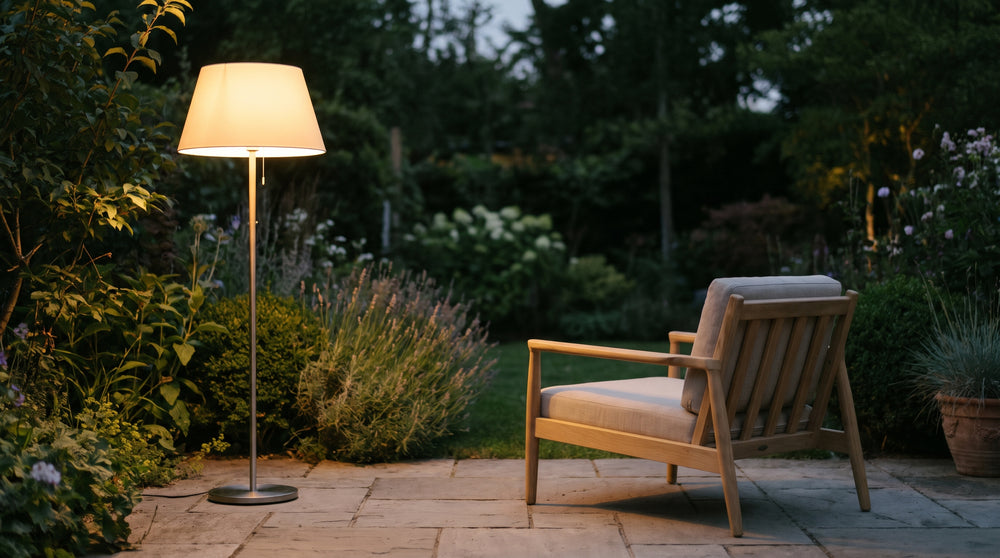
Place the lamp on the ground at the edge of a terrace or along a path, in a spot where foot traffic stays clear, and aim the light toward the ground rather than toward the eyes. This collection currently contains no products: no model, material, socket, protection rating, light temperature, dimension or style can therefore be presented here.
What is an outdoor floor lamp for the garden?
An outdoor floor lamp for the garden is a freestanding light fixture that rests on the ground: a base, a vertical stem and a diffuser up high. It lights a terrace, a path or a dining corner without wall mounting or a ground stake, and it moves when usage changes. The term floor lamp refers to the same object, with everyday usage favoring "outdoor floor lamp."
What to expect: stability, height, mobility
The base must stay stable in the wind, especially with a tall stem and a wide diffuser: a wide, dense base is better than a narrow, light one. Height determines usage, a tall stem lighting a tabletop, a low stem guiding footsteps. Easy mobility matters in the garden, where light moves with meals and seasons.
Common uses: dining, path, entrance, balcony
Near the dining corner, the outdoor floor lamp sets the evening mood. Along a path, it marks the way. Near the door, it helps you see the lock. On a balcony, it plays the role of a compact floor lamp, provided you watch the footprint. To compare formats and styles, browse the Designix lighting catalogue, and for an interior look, see a floor lamp for the living room.
What is the best lighting for a garden?
The best garden lighting layers three levels: low path marking along walkways, ambient light at seating height near the terrace, and a functional point at the entrance. An outdoor floor lamp plays the ambient role, with a warm white that hardens neither faces nor materials.
Three layers of light rather than a single point
A single floodlight above the terrace lights strongly and leaves the rest black: the contrast tires the eye and the terrace loses its relief. Three weak sources, distributed and aimed at the ground, shape volumes without blinding. Path marking works for footsteps, the floor lamp for the table, the entrance for safe movement. To broaden the comparison, see all our lighting families.
Lighting without glare: where to place the light
The diffuser is placed above eye level or hidden behind an opaque shade. Light aimed at the ground and the wall illuminates indirectly, softening the scene. For color temperature, a warm white (around 2700 to 3000 K) suits an evening terrace; a cooler white, around 4000 K, is reserved for circulation areas.
Where to place an outdoor floor lamp in the garden?
Place the lamp at the edge of the terrace, at the corner of a dining area, along a path or near the front door, always in a spot where foot traffic stays clear. Keep it away from play and mowing areas, and check that an outlet exists nearby before choosing the location.
At the edge of the terrace and dining corner
The lamp sits back from the table, about one meter from the edge, to light faces without putting the diffuser in the line of sight. The cord must reach the outlet without crossing the walking area, and the base must stay clear of chair traffic.
Along a path or on a lawn
On a path, a low stem every few meters is enough to guide footsteps, with light aimed at the ground. On a lawn, a tall stem placed in the background lights the border and is visible from afar; keep it away from mower blades and the mower's path.
| Location | Role of the light | Stem height to favor | Point to check |
|---|---|---|---|
| Terrace and dining corner | Ambiance, faces lit without glare | Tall stem, diffuser above the tabletop | Base stability and access to an outlet |
| Path and walkway | Marking, guiding footsteps | Low to mid-height stem | Light aimed at the ground, not in the eyes |
| Entrance and service door | Functional, reading the lock | Tall stem | Rain resistance and long enough cord |
| Lawn and border | Signature, luminous backdrop | Tall stem | Distance from mowing areas |
| Balcony and small terrace | Compact ambiance | Low stem | Reduced footprint |
How to choose an outdoor floor lamp?
Choose first according to exposure: a covered terrace supports a model protected against water splashes, while in the open air you need rain protection, with a base and cord designed for outdoors. Then come stem height, material, socket and base weight.
Material, base and stability
Powder-coated metal withstands wind and rain, composite stays light to move, wood requires a covered terrace, ceramic offers an opaque diffuser and a presence even when off. Base weight matters as much as material: it is what prevents falling. To transpose a warm look, compare the wooden versions for indoors.
| Material | Light rendering | Maintenance | Favor if |
|---|---|---|---|
| Powder-coated metal | Crisp light, sharp shadows | Damp cloth, paint touch-up if chipped | Garden exposed to wind and rain |
| Wood | Softened light, warm ambiance | Dusting, oiling if the wood grays | Covered terrace or conservatory |
| Ceramic | Opaque diffuser, soft light | Washing with clear water | Dining corner, object visible even when off |
| Glass | Wide diffusion, transparency | Non-abrasive glass cleaner | Looking for a generous light rendering |
| Composite and resin | Uniform diffusion, lightness | Rinsing with clear water | Large garden, frequent moving |
Socket, bulb and light
A replaceable-bulb socket lets you choose color temperature and replace a burnt-out bulb; the maximum allowable wattage is on the fixture's spec sheet. An integrated LED gives stable light but cannot be replaced. On budget, material and stem finesse make the difference between an entry-level model and an exceptional piece; the grid shows the current price. For crafted pieces, see the ceramic pieces.
Can a living room floor lamp be used outdoors?
A living room floor lamp can go out onto a covered terrace if its protection rating and materials withstand humidity. Without water protection, it stays indoors. For durable outdoor use, a fixture rated for outdoor use is better.
The most beautiful living room lamps remain fragile outdoors
A fabric shade, a lacquered finish, a polished marble base withstand neither driving rain nor nighttime condensation. The risk is not the day's rain, it is the humidity that settles under the diffuser. These pieces are better kept sheltered, in a conservatory or near an open bay window.
What changes between indoor and outdoor
An outdoor fixture adds seals at the diffuser and cable gland, a cord designed for humidity and sometimes a heavier base. The IP rating sums up this resistance: depending on the piece, protection against splashes is enough or protection against rain becomes necessary. If the lamp stays inside, see those that will stay in the bedroom, then the linen shades for a soft look, or a modern kitchen decor if you are lighting a worktop.
What are the trendy outdoor floor lamps for a garden?
Trendy garden lighting leans toward discretion: slender stem, glass or technical fabric diffuser, black, white or gold finishes, lines inspired by Italian design. The trend mainly follows self-effacement, a fixture that goes unnoticed by day and lights just enough at night.
Italian design floor lamp, what it changes
Italian design brings stem finesse and balanced volumes that make the lamp read as an object, even when off. This visual lightness comes at the cost of a often more compact base: check stability on soft ground. The rendering is crisp, without decorative overload. For an interior in the same spirit, compare a modern living room model.
Colors and materials that hold up outdoors
Black structures the space and disappears in evening shadow, white shows by day and reflects light, gold warms the scene. These colors pair with powder-coated metal, glass or a ceramic base. Indoors, the black finish applied to the living room extends the same logic, as do gold and black pairings. For low, stable light, see the LED design range, and for a more dressed effect, crystal models remain reserved for indoors.
How to connect several lamps to a single power supply?
Several lamps connect to the same supply via a power strip or extension cord rated for outdoor use, whose total supported wattage covers the sum of the bulbs. Avoid ground-level connections, protect the outlet from rain and entrust any circuit modification to an electrician.
Power strip, extension cord and safety
An indoor power strip placed on a terrace picks up humidity and becomes dangerous: choose a model rated for outdoor use, with a cover and a cable long enough to avoid a taut length across the walkway. The connection stays raised, never in a puddle or under a gutter. An adjustable lamp indoors reminds us that well-aimed light avoids adding sources.
Calculating cumulative wattage
Add up the wattage of the installed bulbs, not of the fixtures: the value is on each bulb's packaging. This sum must stay below what the power strip and the line accept. As soon as a supply must be created, a cable buried or protection added, the electrician takes over.
How to maintain and winterize an outdoor floor lamp?
Clean with a soft cloth and clear water, without abrasive products on glass or metal, then wipe dry. In winter, bring the lamp in or cover it, check the seals and unplug the power before any handling.
Routine cleaning
A damp cloth is enough on the stem, clear water on the glass or composite diffuser. Abrasive products dull glass and attack powder coating; a chip on metal is touched up with suitable paint to prevent rust. Remove leaves and cobwebs accumulated around the base, which hold humidity.
Winterizing and storage
At the first frosts, unplug, let dry and store the lamp in a dry place, or cover it with a breathable cover. A worn seal shows as water pooling under the diffuser: replace it before putting back into service. To complete your interior installation, browse kitchen decor and see the whole selection.
Secure payment, tracked delivery, returns and Designix customer service: you choose the stem height and material, we follow the order through to installation.
Frequently asked questions
What is the difference between a floor lamp and a floor-standing lamp?
Both terms refer to the same object: a fixture that rests on the ground on a base and a stem. "Floor lamp" is the common usage, "floor-standing lamp" emphasizes height. For outdoors, the main checks are the protection rating and base stability.
What light color should I choose to light a garden?
A warm white gives welcoming light and tires the eye less than a very cool white. Avoid very white sources near a dining corner: they flatten materials and harden faces. Warm white remains the reference for an evening terrace.
What IP protection rating for an outdoor floor lamp?
The IP rating indicates resistance to dust and water. For a covered terrace, protection against splashes is enough; in the open air, rain protection is needed, and check that both the base and the cord are designed for outdoors.
Can an outdoor floor lamp be placed on a wooden terrace?
Yes, provided the weight is spread: a wooden terrace marks under a heavy, narrow base. Insert a pad or plate to widen the support, avoid dragging the lamp to move it and protect the outlet from rain.
Do I need an electrician to install a lamp in a garden?
If an outdoor outlet already exists, an outdoor floor lamp plugs in without work. As soon as a supply must be created, a cable buried or a protected circuit added, an electrician is needed: they guarantee the safety of the connection.




