
Vintage orange floor lamps
This selection is also available in our French store: Lampadaires coloris orange vintage
No products in this selection.
- Tracked delivery to your country Tracked delivery
- Secure payment at checkout Multiple payment methods
- 14 days to change your mind 14-day returns
- Secure payment Secure payment
Not sure of your style? Find it in 30 seconds
A few questions, and we will show you the pieces made for you.
Frequently asked questions
How do I choose the right product?
What are the delivery times?
Can I return an item?
Can I pay in instalments?
An interior that reflects who you are
Carefully selected pieces, shipped from our warehouses. Our team advises you before you buy, so you choose with confidence.
- Tracked delivery
- Pay in instalments, where available
- 14 days to change your mind
- Advice & showroom in Lyon, France
Plan on one floor lamp per rest area: in a corner of the living room, next to a reading armchair or near a desk, it provides a warm supplementary light that the ceiling light cannot give. An orange vintage street lamp is chosen on three points: the floor space available, the use of the light and the shade that dialogues with the rest of the room.
What light does an orange vintage street lamp give?
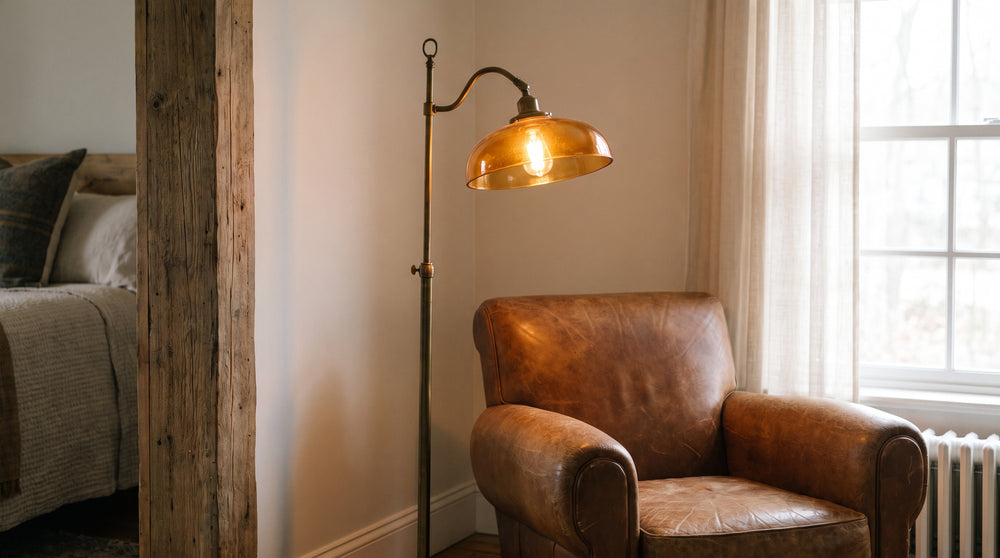
The orange shade filters and warms the light: the bulb illuminates, the lampshade colours the halo. The result is a warm supplementary light, more golden than a white light, suited to ambient reading or a relaxation corner. The actual power depends on the bulb and the socket of the chosen model.
Orange retro street lamp: a warm light, never white
An orange lampshade behaves like a filter. The light passing through the material comes out amber on the sides, while part of it goes straight down to the floor. It is this mix that gives that cosy room impression without having dimmed the ceiling light. The more saturated the shade, the stronger the halo; a pale or amber orange stays more discreet and suits a small room better.
Orange vintage lamps: what the shade changes in the evening
In the evening, the difference with a white light becomes clear: faces and wooden materials take on a warmer tone, shadows soften. This is what you look for in a relaxation corner, not in a space where colours must be distinguished precisely. If you need to read closely, direct the lampshade towards the book rather than the wall, and choose a bulb whose base matches the lamp socket. Most living room models take an E27 base, compact formats an E14 base: check before buying the bulb.
Where to install an orange vintage street lamp in the home?
Place it where the light should warm without dazzling: living room corner, next to an armchair, sofa end, desk corner or hallway. Avoid pressing it against a very light white wall, the shade shows less. A stable base and free clearance around the lamp matter more than the exact position.
Orange vintage street floor lamps: living room, desk, reading corner
In a living room, the corner opposite the window almost always works: the orange halo fills the gap left by low furniture and warms the wall. Near an armchair, the base slips behind the seat, the lampshade reaches shoulder level and the light falls on the knees. In a desk area, place it on the opposite side to the writing hand, to avoid reflection on the screen. In a hallway, a narrow model against the wall is enough to create a welcoming point.
Why let the lamp breathe around the street lamp
An orange street lamp placed against a full bookcase or wedged between two pieces of furniture loses half its effect: the shade needs a neutral background to diffuse. Allow free space around the lampshade, and keep the cable out of the walkway. The models in the orange street lamp range are first recognised by their floor silhouette: that footprint is what you need to measure before choosing.
Which colour goes with orange in a vintage decor?
The complementary colour of orange is blue: midnight blue, petrol blue or grey-blue bring it out without shouting. Softer pairings go through sage green, off-white, light grey, dark wood and brown leather. Orange serves as an accent, it does not occupy all the walls.
| Paired colour | Effect in the room | Where to use it | Watch out for |
|---|---|---|---|
| Midnight blue or petrol blue | Strong contrast, the orange stands out | Living room, reading corner | Keep the blue on a small surface |
| Sage green | Soft pairing, 70s spirit | Living room, hallway | Avoid an overly saturated green on a large wall |
| Off-white or light grey | Visual rest, the orange shade dominates | Bedroom, desk | A too-white wall dulls the glow |
| Dark wood and brown leather | Continuous warmth, vintage decor | Near an armchair, a sofa | Do not stack three different woods |
| Brass or gold | Warm sparkle, a more dressed look | Living room corner, sideboard | Mix two metals maximum |
The complementary colour of orange, and how to use it
On the colour wheel, blue is exactly opposite orange. In decoration, this means that a burnt orange placed in front of a petrol blue wall gains intensity without becoming garish. Blue does not need to be everywhere: a cushion, a rug or an accent wall behind the street lamp is enough. It is the simplest solution for a very neutral room lacking a colourful point.
Orange colour pairing: the combinations that work in vintage decor
The most manageable pairings remain sage green, off-white, light grey and browns. They let the orange play the role of warm accent, without competing. A third bright colour in the same room blurs the reading: better to have a single strong point. If the rest of the decor is already colourful, go for a modern white version rather than a strong orange.
How to choose an orange vintage street lamp according to the room and use?
Start from the use: reading light near an armchair, ambience in a living room corner, supplementary light in a desk area. Then the format, taller for a large room, more compact for a hallway, then the shade of orange, burnt for a sober interior, stronger for an already colourful decor.
| Room | Role of the light | Recommended orange shade | Format to aim for | To check before buying |
|---|---|---|---|---|
| Living room | Corner ambience, supplementary light | Burnt orange or terracotta | Tall, to light above the seat | Base stability and cable length |
| Reading corner | Close lighting for reading | Strong orange | Height allowing the lampshade to reach near the shoulder | Bulb base and direction of the halo |
| Desk | Warm supplementary light beside the screen | Soft, low-saturation orange | Compact, slim base | No reflection on the screen |
| Bedroom | Late evening night light | Pale or amber orange | Medium, wide base | Switch reachable from the bed |
| Hallway | Welcome, first impression | Bright orange | Narrow, close to the wall | Floor footprint and clear passage |
A burnt or strong shade depending on the room
A burnt orange or terracotta blends into a sober interior, it warms without drawing the eye. A strong orange, closer to mandarin, becomes a decorative object in its own right: it holds up in a room with light walls and discreet furniture. Finally, amber or pale suit bedrooms, where a late evening light is wanted without too marked a point.
What to check before confirming a model
The collection brings together an orange vintage street lamp. For a living room, also compare metal, rattan, ceramic and the 70s spirit: vintage metal models make more of a statement, the vintage rattan version softens the silhouette. On the budget side, accessible models play on the shade, more elaborate pieces play on material and finish.
Hesitating between two heights? Measure the distance between the floor and the seat of the armchair, then add shoulder height: the lampshade should reach that zone. It is the criterion that most often decides between two models. Find orange street lamps designed for the living room to compare silhouettes.
How to match an orange vintage street lamp with a vintage decor?
Orange works as a warm note: it dialogues with a vintage leather armchair, a patterned rug, a dark wood piece or a brass lamp. The rest of the room benefits from staying neutral so that the street lamp remains the colourful point. Two different oranges in the same room compete for attention.
Vintage decor: composing around the orange street lamp
Start from the street lamp as an added piece: existing furniture stays in place, only the corner changes. A geometric patterned rug, a dark wood sideboard and an off-white wall form a neutral background that lets the shade speak. If you are looking to complete the whole, a vintage street lamp for the living room or vintage wood models extend the same writing without adding a competing colour.
Vintage leather armchair and vintage lighting: the pairings that hold
Brown or camel leather shares the warm tone family with orange: the two support each other. The street lamp placed next to the armchair underlines the reading zone. Black leather, on the other hand, creates a sharper contrast, to be reserved for already light rooms. To vary the material without leaving the style, look at smoked glass street lamps or gold-coloured metal: warm reflections replace orange when you want to tone it down.
How to install and maintain an orange vintage street lamp?
Assembly is done with the base placed on the floor, the base flat, the cable clear of the walkway. Screw in the bulb of the right base without forcing and check stability before plugging in. For maintenance, a soft cloth is enough: water and abrasive products mark the paint and the finish.
Assembly, stability and cable routing
Assemble the base on a hard floor rather than a thick rug, which unbalances the base. Screw the bulb in until contact, without forcing beyond. Run the cable along a wall or behind a piece of furniture, never across a walkway, and check that the switch remains reachable from the seat or the bed. A slightly wobbly model is often corrected by tightening the clamping screw under the base.
Cleaning a base and a lampshade without damaging the shade
Unplug before any cleaning. On a painted metal base, a slightly damp soft cloth then a dry cloth are enough; abrasive dulls the shade and makes rubbed areas shine. A fabric lampshade is dusted with a soft brush or a vacuum on the gentle setting. On rattan, avoid standing moisture: regular dusting is better than washing.
What is another name for street lamps?
Depending on catalogues, the street lamp is also called a floor lamp, living room lamp, torchère or floor standing supplementary lamp. The word street lamp remains the most common term in France for a tall light placed on the floor. Looking for orange vintage lamps therefore comes down to the same object with another word.
Street lamp, floor lamp or torchère: the catalogue words
The torchère originally refers to a tall light whose light goes up to the ceiling; the word has remained for models with a slim base. The floor standing supplementary lamp describes more compact formats, often around 1.20 m to 1.50 m, against 1.60 m and more for a living room street lamp. These height references vary by model: rely on the lamp's specification sheet rather than the vocabulary. The full catalogue can be browsed in all the lighting for the home.
How to tell if a lamp has value?
Look at the maker's signature or label, the condition of the base and lampshade, the presence of original parts and the quality of materials to the touch. An old lamp is also recognised by its wiring, often to be replaced for daily use. An expert opinion remains necessary for an estimate: the retro mention in a catalogue describes a look, it does not certify old manufacture.
How to choose without making a mistake at Designix?
The collection brings together an orange vintage street lamp. Payment is secure, delivery is tracked and returns are provided for. If in doubt, the Designix customer service answers before the order.
Secure payment, tracked delivery and returns
The process is simple: you select the model, payment is secure, delivery is tracked to your address and returns are provided for if the shade does not render as expected once placed in your home. Before confirming, check the socket, the floor footprint and the cable length: these are the three most frequent reasons for return.
A doubt about the shade? Designix customer service
If you are wavering between a burnt orange and a stronger orange, describe to customer service the colour of your walls, your floor and your sofa: the advice is based on that. To place orange among the other finishes, compare with gold and black finishes, a green shade for the living room or the industrial black style. And if you are looking for a more technical ambience, black LED street lamps show what an integrated source changes.
A final reflex: order the bulb at the same time as the lamp, and favour a warm light shade (around 2700 K to 3000 K) to stay consistent with the orange halo of the lampshade. A too cold bulb (above 5000 K) whitens the shade and breaks the evening effect. To compare the available shades, return to all available orange shades, then widen to the Designix lighting catalogue if you need to light several rooms.
Frequently asked questions
What is the complementary colour of orange?
The complementary colour of orange is blue, on the colour wheel. In decoration, a burnt orange placed next to a midnight blue or petrol blue gains intensity without becoming garish. Blue can stay on a small surface: cushion, rug, accent wall behind the street lamp.
Which colour does orange go with?
Orange goes with blue in all its forms, sage green, off-white, light grey, dark wood and brown leather. These pairings work because they let orange play the role of warm accent. A third bright colour in the same room blurs the reading.
Which colour with orange in a living room?
In a living room, the simplest is a neutral background, off-white or light grey, lifted with a deep blue and dark wood. The orange street lamp then brings the warm note near the sofa or armchair. This combination also holds if the room receives a lot of natural light.
What is another name for street lamps?
The street lamp is also called a floor lamp, living room lamp, torchère or floor standing supplementary lamp depending on catalogues and periods. The word street lamp remains the most used in France for a tall light placed on the floor. These synonyms designate the same object, only the wording changes.
How to recognise an orange retro street lamp?
A retro street lamp is recognised by its silhouette: slim or tapered base, enveloping lampshade, sometimes worked base, an assumed orange shade rather than pastel. These are style clues, not a guarantee of period. The retro mention describes the lamp's look, it does not certify old manufacture.




