
LED outdoor stair lights
This selection is also available in our French store: Luminaires d exterieur LED pour escalier
No products in this selection.
- Tracked delivery to your country Tracked delivery
- Secure payment at checkout Multiple payment methods
- 14 days to change your mind 14-day returns
- Secure payment Secure payment
Not sure of your style? Find it in 30 seconds
A few questions, and we will show you the pieces made for you.
Frequently asked questions
How do I choose the right product?
What are the delivery times?
Can I return an item?
Can I pay in instalments?
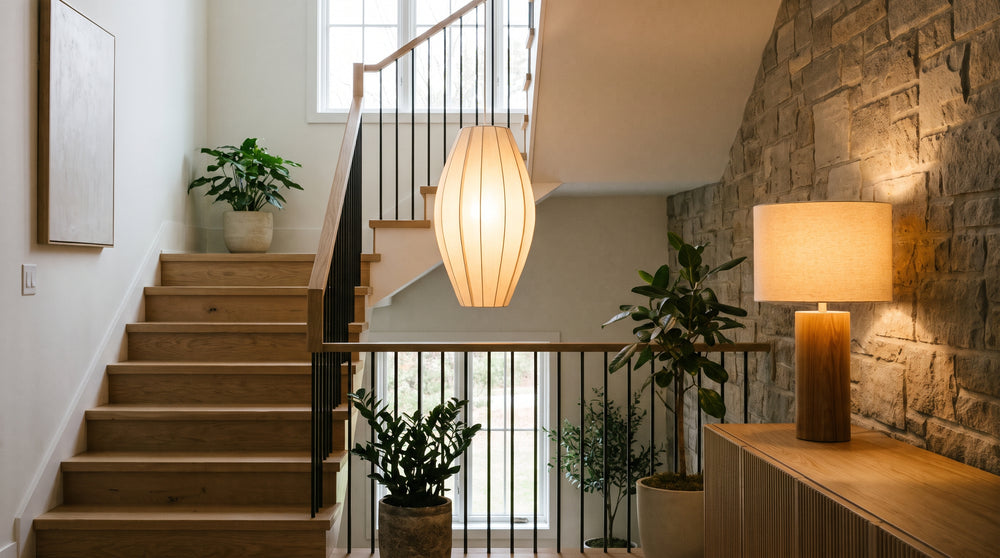
An interior that reflects who you are
Carefully selected pieces, shipped from our warehouses. Our team advises you before you buy, so you choose with confidence.
- Tracked delivery
- Pay in instalments, where available
- 14 days to change your mind
- Advice & showroom in Lyon, France
Allow one light point every two to three steps, aimed at the step nosing and never toward the eyes, in a housing whose IP rating matches the real exposure: IP44 under a canopy, IP65 for a flight open to the rain. The rest comes down to the surface, wood, concrete or stone, and to whether fixing is possible in that material.
Which LED outdoor light should you choose for an outdoor staircase?
Choose first by surface: a recessed spot in the step when the thickness allows it, a wall light or marker light on the side wall when it is load-bearing, a ceiling light under a covered landing. Above all, check the IP rating and whether you can screw securely into the material.
| Location | Light type | What it gives | What to check |
|---|---|---|---|
| Step nosing | Recessed spot in the step | The step reads on its own, the light does not rise to the eyes | Step thickness and housing sealing |
| Side wall of the flight | Wall light or marker light | A low, regular reference point along the handrail | Mounting height and glare risk |
| Low wall or pillar | Bollard or post marker light | The entrance to the staircase can be spotted from the garden | Stability on the ground and IP rating |
| Covered landing | Ceiling light or pendant | Overall light for the threshold | Ceiling height and light output |
The three families that cover an outdoor staircase
The step spot gives the cleanest result: the light grazes the stone and draws each level. Wall lights and marker lights suit when drilling the step is impossible; they are fitted at step height, on the wall side, and come in ranges close to the recessed step spots to keep a consistent design. The bollard finds its place at the bottom of the flight, with the post bollards and marker lights, to signal the entrance from the path.
Wooden staircase: what really changes
Light wood reflects a lot of light: a moderate intensity is enough, otherwise the flight becomes a white screen. Fixing requires suitable screws and a housing that does not hold water against the fibre. A model with a clean design, like those among the outdoor lights with a clean design, avoids overloading a flight already marked by the wood grain.
How many light points and what light for a staircase?
Allow one point every two to three steps so the flight reads at a glance, with no dark zone between two sources. A wide staircase needs two lines of light, one on each side, or regular step-nosing lighting. Aim for 2700 to 3000 K, a moderate intensity and a beam directed at the step.
How many light points should you plan along a flight?
Regularity matters more than number: two well-distributed sources are better than four bunched at the top. On a flight of twelve steps, three to four points are usually enough. Beyond one and a half metres wide, add a second line or switch to step-nosing lighting to avoid a dark band in the middle.
Which colour temperature avoids glare?
2700 K gives a warm light that brings out wood and stone. 3000 K, neutral warm, remains the right compromise outdoors on concrete or stone. 4000 K lights cooler and suits a technical staircase, basement or garage. Glare rarely comes from the tint: it comes from a source seen directly, so from an insufficient diffuser.
Can you install an LED outdoor stair light indoors?
Yes: a light designed for outdoors works perfectly well indoors, it is simply more protected than needed. The reverse is not true. In an indoor stairwell, you can therefore go down in IP rating, but you keep the same attention to glare and to fixing in the wall.
Which wall light for a stairwell?
A wall light that shines down or up rather than straight at the eyes, fixed at step height. An opal diffuser softens the light and avoids the bright-point effect. If the wall is damp, a model rated for damp rooms, like the bathroom models, remains a simple precaution.
A powerful LED wall light: useful or blinding?
On a staircase, power is not the decisive criterion. A source that is too strong facing the step flattens the contrasts: you distinguish the step nosing less well than with a soft, regular light. Better to multiply discreet points than concentrate one very bright point, and to keep a light family consistent with all the lights in the house.
How do you install and maintain an LED light in a staircase?
The light is fixed at step height or just above, on the wall side, to light the step nosing without casting the handrail's shadow. Marking the points and running the cables are done before drilling; cleaning then comes down to a soft cloth on the diffuser.
At what height should you fit a wall light on a staircase?
Around 30 to 50 cm above the step nosing, the light falls on the next step without shining into the eyes of whoever is coming down. Mark the position with the handrail in place: a wall light that is too close casts a shadow over the whole flight. Also check the cable entry before drilling.
How do you keep an outdoor light clean and long-lasting?
A soft cloth on the diffuser, a check of the seals and screws once a year, and water does not stagnate in the housing. On a point recessed into the step, check the tightness after the first season. If the housing holds water, the problem comes from the fixing, not from the LED. Once these markers are settled, choosing the model becomes simple: browse the complete lighting catalogue keeping height and rating in mind.
Which IP rating should you choose for a staircase exposed to rain?
A covered outdoor staircase is fine with IP44, protected from splashes. As soon as it is open to the rain, you move to IP65, and to IP67 for a point recessed into a step or a low wall. The rating protects the light, not the quality of the light.
IP44, IP65, IP67: what does the rating really protect?
The first digit concerns solids, the second water. IP44 stops splashes, IP65 withstands jets, IP67 withstands temporary immersion. Nothing in these figures says anything about colour temperature or output: a well-protected light can light very badly, and vice versa.
| Rating | What it protects | Staircase concerned | Avoid if |
|---|---|---|---|
| IP44 | Water splashes | Covered staircase, canopy, porch | Steps open to driving rain |
| IP65 | Water jets | Open outdoor staircase | Point intended to be immersed |
| IP67 | Temporary immersion | Step or low wall often wet | Fixing not suited to the surface |
Covered or open staircase: how do you decide?
Look at what happens to the light in bad weather, not the usual weather: a wide canopy protects from splashes, a flight under open sky receives slanting rain. To understand what each level guarantees, compare what an IP65 protects and the IP44 models for damp rooms.
How do you match the staircase with the kitchen decoration and the rest of the house?
Keep the same light family from the bottom of the staircase to the neighbouring rooms: a discreet wall light in the stairwell, a carefully worked kitchen decoration on the worktop side, a simple ceiling light in the toilet. Consistency reads better when the light tints stay close from one room to the next.
Living room chandelier, LED chandelier or LED ceiling light at the top of the staircase?
A passage landing calls for a ceiling light: even light, no suspended volume you brush against. A chandelier is justified if the landing is large and serves as a living room. From the flight, the eye travels to the next room: stay on a close tint and continue in LED toward the living room.
Toilet light and original lights: staying consistent
In the toilet, a simple ceiling light or an offset wall light is enough, like the models designed for toilets. For a modern kitchen decoration, a feature piece above the island pairs well with discreet shapes on the staircase side: that is where original lights take their place, one strong point per zone. A kitchen decoration is built this way without breaking the unity with the rest of the house.
Where to see and buy your lights: Lyon store, clearance or online order?
A lighting store in Lyon lets you see the light tint; searches for lighting clearance Lyon often correspond to end-of-line stock. Online, you mainly check the IP rating, the fixing and the technical sheet. At Designix: secure payment, tracked delivery, returns and customer service.
Seeing in store or buying online: what to check
In store, switch the light on and look at the real colour of the light, not just the light switched off. Online, read the IP rating, the material, the fixing and the beam direction. For a complete project, extend to the outdoor pieces with a worked design and to the lights around the pool if the flight leads down to the pool.
Payment, delivery and returns
- Secure payment on the Designix site.
- Tracked delivery, with a check point on receipt.
- Returns possible if the model does not match the surface.
- Designix customer service to confirm a rating or a fixing before ordering.
For a porch or a canopy above the flight, also look at the pendants for canopy and porch, then place your order once the height and rating are settled.
Frequently asked questions
How do you light my terrace without electricity?
Standalone marker lights, solar-powered or battery-powered, placed on the ground or on a low wall and aimed at the area to be lit. The result stays soft and depends on sunshine. For a staircase leading down to the terrace, these points complement a fixed installation without running a cable.
What are the regulations on staircase lighting?
There is no single text setting a number of light points in a private staircase. The constraints come from how the home is used, from co-ownership rules and from the electrical standards applicable to the installation. In shared areas, have the project approved by the building manager before any drilling.
Wooden staircase: what should you check on the light?
The fixing in the wood, the resistance to moisture and how the light renders on the fibre. Light wood reflects a lot of light: a moderate intensity is enough. Prefer a housing that does not hold water in contact with the step, and screws suited to the surface.
Which wall light should you choose for a staircase?
A wall light that shines down or up rather than straight at the eyes, fixed on the wall side at step height. Favour a diffuser that softens the light, a material that withstands moisture if the staircase is outdoors, and a fixing suited to the surface, wood, concrete or stone.
Which light for a small windowless landing?
A simple ceiling light, or a wall light if the ceiling is low, with a warm, diffuse light. On a landing with no window, avoid the frontal source just above the head and prefer an offset point that lights the floor and the doors.




