
LED kitchen strip lights
This selection is also available in our French store: Néons LED pour cuisine
No products in this selection.
- Tracked delivery to your country Tracked delivery
- Secure payment at checkout Multiple payment methods
- 14 days to change your mind 14-day returns
- Secure payment Secure payment
Not sure of your style? Find it in 30 seconds
A few questions, and we will show you the pieces made for you.
Frequently asked questions
How do I choose the right product?
What are the delivery times?
Can I return an item?
Can I pay in instalments?
An interior that reflects who you are
Carefully selected pieces, shipped from our warehouses. Our team advises you before you buy, so you choose with confidence.
- Tracked delivery
- Pay in instalments, where available
- 14 days to change your mind
- Advice & showroom in Lyon, France
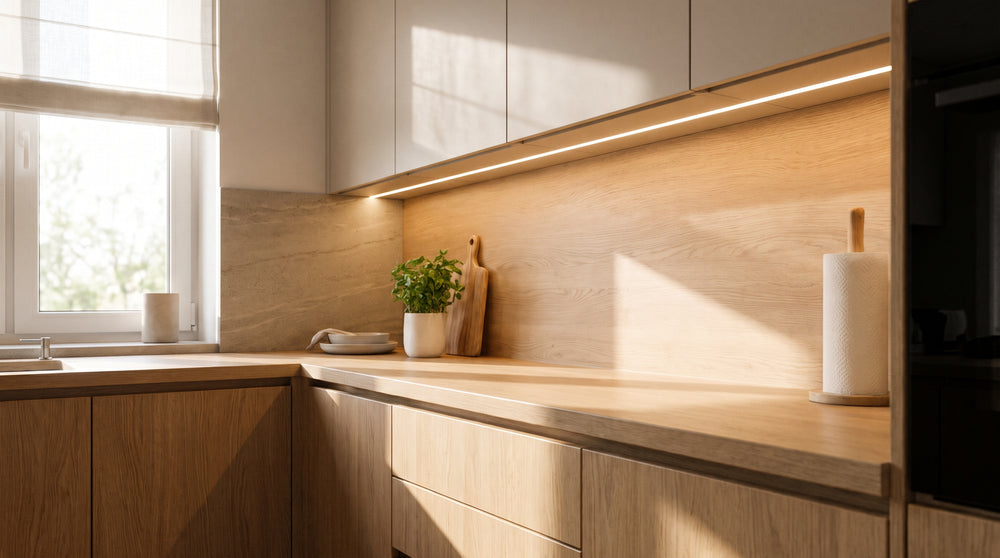
Mounted under a wall cabinet or along a backsplash, an LED neon strip provides the light the worktop lacks without lighting the whole room. Choose it based on the available length, the IP rating and the colour temperature, then decide on the mounting and the type of power supply.
Which LED neon light should you choose for a kitchen?
First measure the free length under the cabinet, then set the colour temperature between 2700 and 4000 K and the IP rating according to the distance from water. The mounting and the dimmable-compatible power supply are decided last, once the line has been drawn in pencil under the cabinet.
LED neon lights for kitchen: start with the available length
An LED neon strip is ordered to measure, not on impulse. Take the dimension between the two uprights of the wall cabinet, subtract the space needed for the fixings, and note whether the line should stop at the edge of the sink or extend past it. A continuous line is less visible than a series of small sections, and it avoids shadow zones between two modules. If the worktop forms a corner, two short lines are better than one that is too long and overhangs the cabinet.
LED neon tube for kitchen or flexible strip: which shape of light
The LED neon tube gives a clean, poised line that underlines the backsplash like a trim. The flexible strip in an aluminium profile diffuses more widely and suits when the source must remain invisible. The first is slightly noticeable, the second fades away: choose according to whether you want a deliberate line or a simple wash of light. To compare the two families, browse indoor lighting solutions before deciding.
Where should you install an LED neon light in the kitchen?
Place it where the general light does not reach: under the wall cabinets, above the backsplash, in a niche or along a plinth. Under the cabinet, it lights the worktop without glare; on the plinth, it underlines the lower volumes. In every case, the source stays hidden from a standing position.
LED neon for kitchen cabinet: under the wall cabinets
The fixing point sits a few centimetres from the wall, not flush against the backsplash: the light must fall flat on the worktop, otherwise it bounces off the tiles and creates a white band in your eyes. A clean, flat surface is enough to screw or clip on, and the power supply should be planned on the side of the cabinet's cable grommet.
LED neon strip for kitchen along the worktop
On a backsplash with no wall cabinet, the strip is fixed directly to the wall, at the height of the first shelf. Near the sink or the extractor hood, steam and splashes call for a higher IP rating than elsewhere. For lighting the rest of the room, see choosing a light fitting suited to each room.
| Location | Recommended format | Light | IP rating | Point of caution |
|---|---|---|---|---|
| Under the wall cabinets | Rigid strip or slim tube | Neutral white, around 4000 K | IP20 to IP44 | Keep the source away from the wall to limit reflections |
| Backsplash and worktop | LED neon tube under a profile | Warm white, around 3000 K | IP44 near the sink | Provide a dimmable-compatible power supply |
| Plinth and base of cabinets | Flexible strip in a profile | Warm white, 2700 to 3000 K | IP20 | The light should graze the floor, not light the feet |
| Niche and open shelf | Slim strip | Warm white | IP20 | Hide the source behind an upright |
| Kitchen open to the living room | Recessed LED neon tube | Neutral white | IP20 | Harmonise with the living room light fittings |
Which light for the worktop: warm white or neutral white?
A warm white, around 2700 to 3000 K, warms the kitchen and suits meals; a neutral white, around 4000 K, renders food colours more accurately and makes chopping easier. The colour rendering index matters more than temperature alone: it decides whether a tomato looks red or dull.
Warm white: the mood for evenings and meals
Around 3000 K, the light stays soft without yellowing light wood. It is the most versatile shade for a backsplash, a wall cabinet or a kitchen open to the living room, because it pairs easily with other light points. Below 3000 K, reserve it for the dining corner and plinths: over a chopping station, it is less tiring but slightly distorts colours.
Neutral white: seeing accurately above the worktop
Around 4000 K, vegetables, flour and the stone of the worktop keep their true shade. It is the choice for a preparation station, provided you do not light the whole room with this shade alone: a kitchen bathed in neutral white quickly feels cold. Match the shade of the neon light with that of the full lighting range already installed.
| Colour temperature | Result | Where to use it | To avoid |
|---|---|---|---|
| 2700 K | Very warm, close to the classic bulb | Dining corner, plinth, evening mood | Chopping station and precision work |
| 3000 K | Warm but clear | Backsplash, wall cabinets, open kitchen | Few limits, it is the most versatile |
| 4000 K | Neutral, accurate colours | Worktop, meal preparation | Large surface with no other source, the room feels cold |
| Above 5000 K | Very white, slightly bluish | Occasional technical use | Living room, wood and food look unnatural |
Professional kitchen LED neon: what are the differences with a domestic model?
A so-called professional LED neon light stands out through a higher IP rating, a power supply designed for continuous use and more robust mounting. In a home kitchen, these qualities are most useful near the sink, the extractor hood or in a damp room, where an entry-level model wears out faster.
Pro kitchen LED neon: the IP rating first
An IP20 is enough under a dry cabinet. As soon as you get close to water, an IP44 protects against splashes, and a higher rating is justified against the steam of an extractor hood or in a very well-ventilated kitchen. It is the first criterion to read on the label, before length and shade.
Cheap kitchen neon: what you pay for elsewhere
What changes between two models of the same length: the thickness of the aluminium profile, the quality of the polycarbonate diffuser, the connectors and the presence of a dimmable-compatible power supply. Under a dry cabinet, an affordable model holds up very well. Near water, better to prioritise protection than immediate savings. Compare the listings in the Designix lighting catalogue.
How do you install and maintain a kitchen LED neon light?
Installation is done under the cabinet or against the backsplash, with the supplied fixings, out of reach of washing splashes. The profile is cleaned with a soft, non-abrasive cloth, power switched off. Dimmer mounting requires a compatible power supply, to be checked before purchase.
LED neon lights for kitchen: installing under a cabinet, step by step
Mark the holes in pencil, check that no cable runs directly below, then screw in the clips. Position the profile so that the edge of the diffuser comes a few millimetres from the edge of the cabinet: the light then falls on the worktop and not into the room. Connection to the mains is entrusted to a professional, and the power supply is placed in an accessible spot so it can be replaced without dismantling everything.
Cleaning an LED neon light without damaging the profile
A slightly damp microfibre cloth is enough on the diffuser; avoid abrasive sponges and solvent-based products that dull the polycarbonate. On a strip, clean the profile, never the tape itself. Dusting every two or three months in a kitchen where a lot of cooking happens keeps the light output looking good.
How do you integrate an LED neon light into kitchen decoration and modern kitchen decor?
In modern kitchen decor, the LED neon light stays discreet: it underlines a backsplash, a worktop or a shelf, without becoming a visible source. Match it to the kitchen light fitting already in place by colour temperature and material, rather than multiplying styles.
Kitchen light fitting: which other light point to add
A ceiling light for general lighting, an LED wall light above a sideboard, a pendant above the dining corner. The rule for successful kitchen decoration: three different heights, no source in the line of sight. Find ceiling and wall light fittings to complete the line of the neon light.
Applying a neon light in a kitchen open to the living room
When the kitchen is visible from the sofa, the light line becomes a decor element for modern kitchen decor in its own right. Keep the same family of shades as the living room, and avoid a neutral white on the kitchen side facing a warm white on the living room side: the break is immediately visible. A tube recessed in a niche gives a clean line with no visible light point.
Should you add a kitchen ceiling light in addition to the LED neon light?
Yes, the two do not do the same job: the kitchen ceiling light provides the general light of the room, the LED neon light lights the work area. A kitchen works better with general lighting and localised lighting than with a single powerful source on the ceiling.
Trendy kitchen ceiling light: choosing it without glare
A diffusing ceiling light, in frosted glass or with a diffuser, avoids glare when standing in front of the cabinets. In a small kitchen, prefer a flush model that does not eat up height. For a kitchen with an island, go for a light point for the dining corner suspended above the worktop.
Modern kitchen chandelier or LED chandelier: when the room allows it
A chandelier is justified in a kitchen with a dining table and comfortable ceiling height, not in a narrow work corridor. Above a table, the pendant hangs low to frame the light on the plates rather than on heads. See all the light fittings in the house to match the two.
Which mistakes should you avoid with an LED neon light in a kitchen?
The most frequent mistakes: placing the neon light too close to the wall, which creates a luminous band and reflections on the worktop; neglecting the IP rating near the sink; and mixing two colour temperatures in the same room, which is immediately visible.
Glare and reflections on the worktop
A stainless steel, glass or polished stone worktop reflects light like a mirror. Move the source a few centimetres from the wall, aim it towards the back of the worktop and choose a diffuser rather than a bare tape. A continuous line is better than several sections: fewer breaks, fewer hot spots.
Two colour temperatures in the same kitchen
A neon light at 4000 K under the cabinet and a ceiling light at 2700 K above give a room with two moods, which is more noticeable than you would think. Choose a dominant shade and keep the other for a single use, for example the dining corner. To harmonise, see completing the lighting with another light fitting.
Frequently asked questions
LED neon lights for kitchen: which model should you choose?
Start from the length to cover and the space under the cabinet, then choose an IP rating suited to the proximity of water and a colour temperature consistent with the rest of the room. The mounting and the dimmable-compatible power supply are checked before purchase.
Where should you place an LED neon light for a kitchen cabinet?
Under the wall cabinets, set back from the wall so that the light falls on the worktop and not on the backsplash. The source must stay invisible from a standing position. Above the sink, a higher IP rating is preferable.
LED neon strip for kitchen: how do you fix it?
The strip is screwed or clipped under the cabinet, on a clean, flat surface. Mark the holes before drilling, keep the source aligned with the edge of the cabinet and leave the power supply accessible. Connection to the mains is entrusted to a professional.
Professional kitchen LED neon: is it useful in a home kitchen?
Useful mainly near the sink, the extractor hood or in a damp room: a high IP rating and a power supply designed for continuous use provide durability over time. For a simple dry cabinet, a domestic model is enough.
Cheap kitchen neon: how do you avoid a bad purchase?
Compare what is actually supplied: diffuser, connectors, fixings and dimmer compatibility. An entry-level model is suitable under a dry cabinet; near water, better to prioritise the IP rating than immediate savings.
To go further, browsing light fittings by room helps to place the neon light among the other sources in the house. Secure payment, tracked delivery, returns and Designix customer service: you can discover the lighting catalogue and check the length, the IP rating and the shade before confirming your lighting line.




