
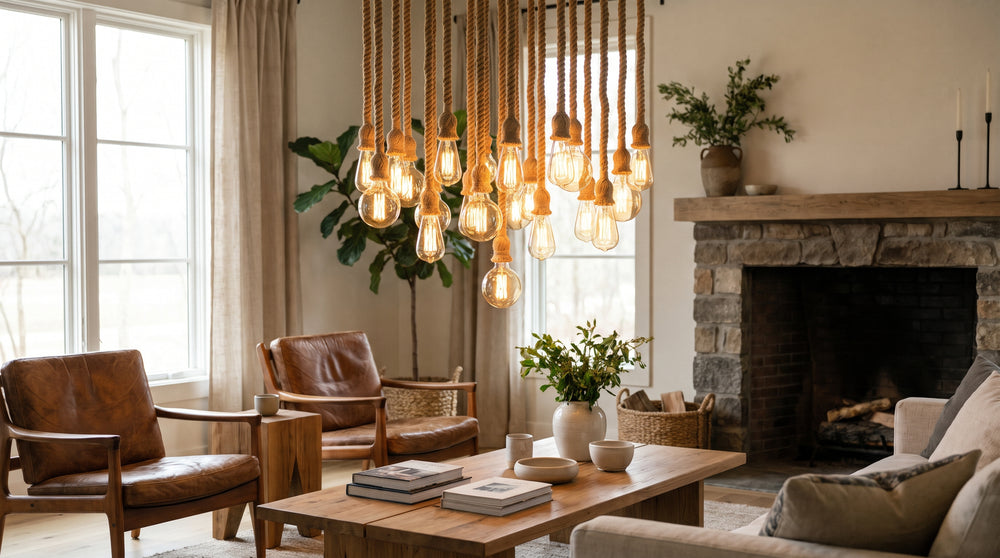
Rope hanging light bulbs
This selection is also available in our French store: Ampoules suspendus en corde
No products in this selection.
- Tracked delivery to your country Tracked delivery
- Secure payment at checkout Multiple payment methods
- 14 days to change your mind 14-day returns
- Secure payment Secure payment
Not sure of your style? Find it in 30 seconds
A few questions, and we will show you the pieces made for you.
Frequently asked questions
How do I choose the right product?
What are the delivery times?
Can I return an item?
Can I pay in instalments?
An interior that reflects who you are
Carefully selected pieces, shipped from our warehouses. Our team advises you before you buy, so you choose with confidence.
- Tracked delivery
- Pay in instalments, where available
- 14 days to change your mind
- Advice & showroom in Lyon, France
Start with the socket base, set the cord length, then choose the bulb last: this order avoids nasty surprises. A hanging rope light bulb is a socket carried by a textile sleeve, with no shade, whose source stays visible and lights the room in every direction.
- What a hanging rope light bulb is
- Where to install it
- What height
- Fixing without drilling
- Creating an offset pendant
- Which bulb to choose
- Wiring several bulbs
- Matching the cord to the room
What is a hanging rope light bulb and what light does it give?
The fixture comes down to three parts: a socket, a textile sleeve and a cable coming down from the ceiling. Nothing hides the bulb, so the light travels up to the ceiling and down to the table at the same time, without directing the flow. The result depends as much on the shape of the glass as on the wattage.
Hanging rope light bulb: what the textile sleeve changes
The cord does not touch the light, it dresses the wire. On a white ceiling, a braided cotton or linen sleeve breaks the electrical line and becomes a decorative element in its own right. Jute gives a more rustic look, cotton stays softer to the eye. Plan the cord length according to the drop you want: the sleeve rarely cuts cleanly once installed, so it is better to adjust before fixing. Visible filament bulbs make perfect sense here, since the filament becomes the pattern of the fixture.
Bulbs on a cord: the light you get
With no diffuser, you get direct light, with brighter areas under the socket and a ceiling lit by bounce. This is accent or dining light, not general lighting on its own: in a large room, it combines with other points. The choice of glass matters: frosted glass softens, clear glass lets the filament show. For an overview of the available sources, browse all Designix light fixtures.
Where to install a hanging rope light bulb in the home?
You place it where the ceiling is high and the passage clear: above a table, in a corner of a living room, near a bed or in a hallway. The cord plays the decorative role, the bulb gives the light. Avoid the vertical line of a busy corridor if the pendant hangs low.
Above a dining table
A single pendant above a narrow table, several if the table is long. The visible source creates a gathering point at mealtime and warms the wood or the tablecloth. For evening light, pick from the living room bulbs and keep the same tone on every point in the room.
Soft light in the bedroom
Near a bed or in a reading corner, a low pendant replaces the bulky bedside lamp. Choose a low-intensity, warm source, otherwise the bare bulb glares when you look at it from the pillow. The bedroom bulbs catalogue gathers the tones suited to the evening. In a hallway, the visible bulb acts as a landmark and takes a stronger light.
What height for a pendant lamp?
The pendant hangs low enough to be seen, high enough not to get in the way: above a table, the bulb sits at the eye level of seated guests. In a corridor or hallway, leave the passage clear under the socket. Set the cord length before fixing, never after.
Above a dining table
The trade reference is taken seated: the socket sits around the eye level of the people installed, so you can see your guest without staring into the bulb. A low table calls for a lower pendant than a high table. Set the height taking the bulb into account, since it hangs below the socket: a large filament bulb adds several centimetres.
In a hallway or corridor
Here the priority is passage: keep clearance under the socket so you do not hit the pendant while carrying a box. If the ceiling is low, shorten the cord rather than changing the model. The length is adjusted on the cable at the socket end, once the height has been checked by eye from the floor. To vary the sources from room to room, compare the whole bulb range.
How to fix a pendant to the ceiling without drilling?
A high-load adhesive hook or a rail mount suits light cord sockets; beyond that, a toggle anchor remains the safe solution. A plug-in pendant, with no connection to the mains, avoids all work. The weight of the cord and the bulb must stay within the limit stated by the mount manufacturer.
How to hold a pendant on the ceiling without drilling
Degrease the ceiling, apply the adhesive hook, respect the setting time before hanging. This solution holds a light socket and a short cord; it does not replace a mechanical fixing for a heavy fixture or for several light points on the same mount. Check the load stated on the packaging and count the bulb in the suspended weight.
How to install a cordless ceiling light
There are two families: the standalone battery-powered fixture, and the plug-in pendant connected by a visible cable that you run along the wall. Neither requires a connection to the ceiling mains, which suits rented homes. Choose the visible cable in the colour of the cord to keep it discreet. If you are looking for other sources for these setups, look at the 220 V LED bulbs.
How can I create an offset pendant?
An offset pendant is created with an eye bolt fixed to the wall or ceiling, a tensioned cable and a socket at the end of the cord: the bulb arrives where the ceiling has no fixing point. Keep the cable taut to avoid loops, and the supply follows the same path.
Moving the socket away from the fixing point
The principle comes down to three points: an eye bolt near the supply, a second plumb with the future socket, a cable linking the two. The textile cord sleeves this cable and hides the run. This solution makes a corner usable without an electrical supply in the right place, for example above a table offset from the ceiling point.
Tensioning the cable without loops
A cable that dangles is visible and breaks the line of the fixture. Tension moderately, without forcing on the eye bolt, and leave a slight curve at the end so as not to mark the sleeve. The supply takes the same path, sleeved too. If in doubt about the strength of the anchor, have the installation checked, especially if the wall is plasterboard.
Which bulb to choose for a hanging rope light bulb?
The base depends on the socket: E27 for large filament bulbs, E14 for small formats, GU10 and G9 for compact sources. Check the base before buying the bulb, then the colour temperature: warm white for the evening, more neutral for a worktop.
Bulbs on a cord: E27 or E14?
E27 is the large screw base, the one on spectacular filament bulbs, and it equips most simple pendants. E14, smaller, is used for compact sockets and multi-point setups. G9 and GU10 concern tiny sources and directional spots. Compare E27 base bulbs and small E14 bases before ordering, then take a look at the other G4 and G9 bases and the GU10 sources if your socket requires them.
| Base | Bulb format | Typical use on a pendant | To check before purchase |
|---|---|---|---|
| E27 | Large screw base | Pendant alone, visible filament bulb | Socket diameter and bulb length |
| E14 | Small screw base | Small sockets, several light points | Maximum wattage allowed by the socket |
| G9 | Compact pin base | Small-diameter pendants | Pin spacing and socket type |
| GU10 | Two pins, directional source | Pendant aimed at a worktop | Mounting direction and spot angle |
| GU5.3 | Low voltage, two pins | Low-voltage pendant | Transformer compatibility |
2700 K or 3000 K depending on the room
2700 K leans warm yellow and flatters wood, cord and skin tones; it is the tone for living rooms in the evening. 3000 K stays warm but crisper, useful in a kitchen or hallway where you want to see clearly. Beyond that, you enter neutral and cool white, rarely desirable under a bare bulb. See a warm white light at 2700 K and 3000 K bulbs.
| Rendering | Temperature or tone | Where to prefer it | Effect on a textile cord |
|---|---|---|---|
| Warm white | 2700 K | Living room, bedroom, dining corner | Warms the cord and the wood |
| Neutral white | 3000 K | Kitchen, hallway, study | Makes the cord crisper, less golden |
| Amber glass | Warm tone, even when off | Living room in the evening | Accentuates the cosy feel |
| Clear glass | Most direct light | Small spaces, bright rooms | Discreet, lets the filament show |
On the glass side, the amber finish warms even when off, while clear glass stays more neutral. Compare amber glass with glass bulbs depending on whether you want a decorative fixture or a discreet source.
How to wire 3 bulbs on the same cord?
Several sockets can run from a single supply: each bulb is wired in parallel on the common cable, in an accessible box or connector block, never on bare twisted wires. For an LED strip without a connector, use a suitable mechanical connector. If in doubt, an electrician checks the setup.
Wiring 3 bulbs in parallel on a single supply
The three sockets receive live and neutral from the common cable: this is the parallel setup, the one that keeps the same voltage on each point. A series setup divides the voltage and makes them glow dimly. Switch off the power at the breaker before any work and leave the junction box accessible. If the circuit is low voltage, check compatibility with 12 V low-voltage bulbs.
Connecting an LED strip without a connector
A strip connects on its designated pads, with a mechanical connector of the right width or by soldering, respecting polarity. Insulate the junction and never connect a strip directly to the mains without its transformer. On a rope pendant, the strip is hidden behind the socket or along the sleeved cable. For adjustable intensity, look at the dimmable bulbs.
How to match the cord to the rest of the room?
The cord pairs with wood, rattan and linen. The same rope appears on a wall light or a wood and woven-cord chair, which links the furniture to the fixture without matching them exactly. On the bulb side, amber glass warms the room, clear glass stays more discreet.
Rope wall light: repeating the material without copying it
Repeating the cord on two light points works if the shapes differ: a round pendant above the table and a more discreet wall light on the side wall. Copying the same model twice in a small room clutters the view. Keep the same family of rope, cotton or jute, and the same bulb tone for unity, then vary the shapes. Bohemian and country styles take very well to this pairing.
Wood and woven-cord chair: the material duo that works
Wood and cord share a family of warm tones: brown, beige, ecru. A wood and woven-cord chair under an ecru cotton pendant creates effortless continuity, provided you do not stack three different textures in the same field of view. Complete with retro models or more contemporary bulbs depending on the mood. For care, dust the sleeve dry, without products.
Frequently asked questions
How to fix a pendant to the ceiling without a hook?
A hook is not mandatory: an adhesive mount, a rail clip or a plug-in socket can hold a light pendant. The choice depends on the weight of the socket and cord, and on the nature of the ceiling. For a heavy pendant, a toggle anchor remains the reliable solution.
How to hold a pendant on the ceiling without drilling?
Clean and degrease the ceiling, apply an adhesive hook rated for the load, then allow the setting time before hanging. A plug-in pendant, plugged into the wall, also avoids any drilling. Check that the weight of the socket and cord stays within the limit stated by the mount manufacturer.
What can you make with cord?
With cord, you sleeve a pendant cable, dress a wall light, redo the seat of a wood and woven-cord chair, or make a lampshade. Cord mainly serves to make visible and tidy what would otherwise be a bare wire.
Connecting an LED strip without a connector, how to do it?
An LED strip is connected with a mechanical connector designed for its width, or by soldering on the designated pads. Polarity is respected and the junction is insulated. The strip is not connected directly to the mains without its transformer. If in doubt, have the setup checked.
How to install a cordless ceiling light?
Two solutions exist: the standalone battery-powered fixture, and the plug-in pendant connected by a visible cable. Neither requires a connection to the ceiling mains. Choose according to battery life, desired intensity and available cable length.
Before ordering, check the base of your socket and the available cord length: that is what decides the final height and the type of bulb. Payment is secure, delivery is tracked, returns are provided for and the Designix customer service answers assembly questions.




